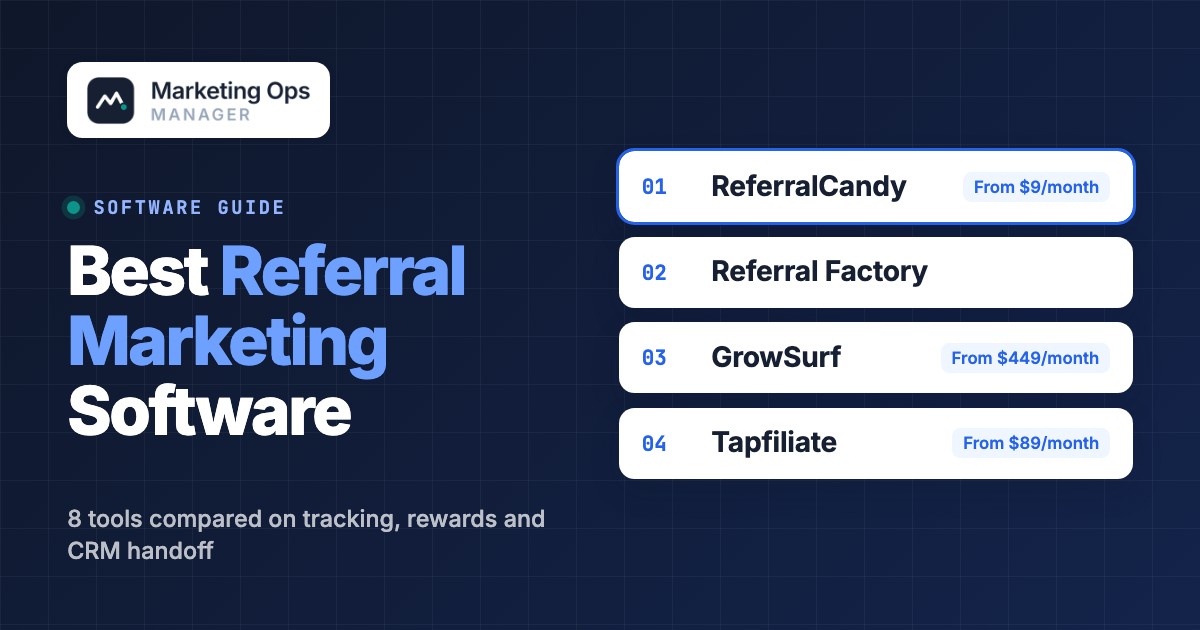
Referral marketing software gives every customer or partner a trackable link or code, records who they bring in, decides when a referral counts and pays the reward. The eight tools below split into three groups: store-focused tools, SaaS and service tools, and affiliate or partner platforms. The useful question is how each one ties a new customer back to the person who referred them, and what reaches your CRM when it does.
We judged each tool on that attribution step, on the reward trigger and on the fraud checks it documents. Prices come from vendor pricing pages and ratings from G2, both checked in October 2026.
- tools compared
- 8
- publish a price
- 5
- list a free plan
- 0
- G2 reviews behind the ratings
- 1,456
Our picks by situation#
 Best for Shopify and WooCommerce storesReferralCandyStore orders feed in directly, and a $9 entry plan plus a success fee keeps the start cheap.
 Best for no-code qualification from CRM eventsReferral FactoryA referral turns Qualified on a CRM stage change, a Stripe payment or a webhook, with no code.
 Best for SaaS teams with a developerGrowSurfCredit a referral through the REST API or SDKs after your backend confirms the signup.
 Best flat-price program with managed setupReferral RockOne plan with unlimited referrals and an advisor who helps set the program up.
 Best for brands that validate rewards server-sideFriendbuyA callback to your own systems can reject a reward for a returned or cancelled order.
 Best for referrals that never use a linkMention MeName Share lets a friend type the referrer's name at checkout.
 Best for recurring commissionsTapfiliatePercentage, fixed, tiered and recurring commissions tracked through Stripe or Shopify.
 Best for B2B SaaS partner programsPartnerStackAffiliate, referral and reseller partners in one platform with CRM sync and consolidated payouts.
 Our product · for the gaps between toolsThe Marketing Ops ManagerChecks that the landing page, tracking and CRM handoff behind a referral still work.
Referral marketing software compared#
| Tool | Category | Referral handoff | Starting price | G2 rating |
|---|---|---|---|---|
| ReferralCandy | Ecommerce referral and affiliate programs | Store order to a tracked referral, a purchase review period, then a coupon or cash reward | Basic $9 per month plus 10.5% success fee; Grow $79 plus 3.5%; Scale $249 plus 1.5%; Enterprise $799 plus 0.25%; 7-day trial | 4.5 (111) |
| Referral Factory | No-code customer referral programs | Referral link to a pending lead, then a qualified lead when a CRM stage, Stripe payment or webhook says so | Basic $200 per month list price (shown at $100 in an October sale), up to 20,000 users; Pro $400 list ($200 sale), 40,000 users; Enterprise from $1,000 | 4.8 (192) |
| GrowSurf | Referral and affiliate programs for SaaS and apps | Referral link or API call to a credited signup, then a webhook to your own reward logic | Business $449 per month for up to 10,000 participants, $649 for 25,000, $879 for 50,000; Startup plan price not listed; 14-day trial | 4.5 (10) |
| Referral Rock | Customer referral and ambassador programs | Referral page or tracked link to an approved referral, a paid reward and a record in HubSpot, Stripe or Shopify | Operator plan $250 per month (10% off billed annually), 14-day trial; unlimited referrals, 10,000 base members, 10 admin users | 4.5 (16) |
| Friendbuy | Enterprise referral and loyalty for consumer brands | Signed referral link to an attributed purchase, validated against your own systems before the reward fires | Not published; the pricing page offers a demo only | 4.3 (59) |
| Mention Me | Referral marketing for ecommerce and consumer brands | Referrer tag after purchase, a checkout tag on the friend's order, and a fraud-scored referral before the reward | Quote only, based on annual online revenue band; the pricing page says you pay for the referrals you generate | 4.4 (61) |
| Tapfiliate | Affiliate and referral tracking | Affiliate link or coupon code to a tracked conversion and a commission on the thank-you page | Launch $89 per month ($74 billed annually); Scale $179 per month ($149 billed annually); Enterprise custom | 4.3 (57) |
| PartnerStack | B2B partner, affiliate and referral programs | Partner link to a customer key on signup, then Stripe or Chargebee transactions synced to partner payouts | Quote only (Launch, Growth, Enterprise); no cap on partners or internal users | 4.7 (950) |
| The Marketing Ops Manager Our product | Campaign monitoring | Checks every handoff in the campaign journey on a schedule | Starter $159/month billed annually ($199 monthly), Growth $399/month billed annually ($499 monthly), Enterprise custom; every plan starts with a 14-day trial, no credit card | No reviews yet |
Starting prices as published by each vendor, checked October 20, 2026. Quote only and Demo only mean the vendor publishes no price. Referral Factory showed a half-price October sale; the figure here is its list price.
What is referral marketing software, and how is it different from affiliate software?#
Referral marketing software runs a program in which existing customers or partners recommend you and get a reward when the person they bring in qualifies. It handles four jobs: giving each advocate a link or code, tying a new customer to that advocate, deciding when the referral counts, and paying the reward.
Affiliate software does the same attribution job for a different audience and reward. Referral programs usually reward customers with credit, discounts or gift cards, while affiliate programs pay commissions to outside promoters, often as a percentage and sometimes recurring. Several tools in this list cover both, though the emphasis differs. Referral Rock lists customer referral, brand ambassador and affiliate programs, and GrowSurf supports affiliate structures with tiers. Tapfiliate and PartnerStack sit on the affiliate and partner side. Our guide to affiliate marketing software compares nine tools for the affiliate side.
| Type | Who refers | Typical reward | Tools in this list |
|---|---|---|---|
| Customer referral | Existing customers | Store credit, coupons, gift cards, cash | ReferralCandy, Referral Factory, Referral Rock, GrowSurf, Friendbuy, Mention Me |
| Ambassador or advocate | A smaller group of fans | Gift cards, cash, custom rewards | Referral Rock |
| Affiliate and partner | Outside promoters and partners | Commissions, including recurring ones | Tapfiliate, PartnerStack, GrowSurf, Referral Rock |
How does a referral get from the advocate to your CRM?#
A referral crosses the same five handoffs in every tool here. The tools rarely fail inside a step, but the losses sit at the joins, where one system passes the referral on and nobody checks that it arrived intact.
- Step 1Share
- Referral Rock
- GrowSurf
Breaks when the referral link loses its parameter in a redirect - Step 2Attribute
- ReferralCandy
- Tapfiliate
- Mention Me
Breaks when the thank-you page tag is removed and the sale is never tied to the advocate - Step 3Qualify
- Referral Factory
- Friendbuy
Breaks when the CRM stage that should qualify the referral never changes - Step 4Reward
- PartnerStack
- Referral Rock
Breaks when a reward fires for an order that's later returned - Step 5Report
- GrowSurf
Breaks when referral source never reaches the CRM record, so reporting counts it as direct - Across allMonitor the path
- The Marketing Ops Manager
Catches broken landing pages, tracking and CRM handoffs, with evidence
- Share. The advocate gets a personal link, code, QR code or, with Mention Me, a name a friend can type at checkout.
- Attribute. The tool ties the new customer to the advocate through a cookie, a signed ID in the link, a coupon code, an API call or a server-to-server postback.
- Qualify. The referral counts only once the new customer meets the condition you set: a signup, a paid order, a CRM stage or a subscription payment.
- Reward. The tool issues credit, a coupon or a payout, usually after a review period or a fraud check.
- Report. The referral source and the reward status reach your CRM and analytics, so the program can be measured against pipeline.
When is the reward paid? Usually not at the moment of the order. ReferralCandy sends rewards only after the purchase review period ends, Friendbuy can hold a reward until a condition is met, such as the return window closing, and Referral Factory supports delayed rewards and manual approvals. The limit is that every hold adds a delay for the advocate, so decide how long a referred customer can be returned or cancelled before you promise a payout date.
The attribution method is the part that differs most between tools, and it decides what you have to maintain on your side, even though every vendor promises "easy tracking".
| Tool | How the referral is tied to the advocate | Qualifies or pays on | Fraud checks documented |
|---|---|---|---|
| ReferralCandy | Unique advocate link; orders from Shopify, BigCommerce, Squarespace and WooCommerce are pulled in, other platforms use a snippet or the API; cookie lasts up to one year | A purchase after a review period | Self-referral and existing-customer blocks; suspicious purchases held |
| Referral Factory | Link, QR code, direct lead submission or Stripe promo code | A chosen event: CRM stage change, Stripe payment, webhook, API call or manual review | Fraud alerts and reward approvals |
| GrowSurf | Widget, form or portal link; REST API referredBy field; JavaScript and mobile SDKs | Signup, or signup plus a qualifying action your backend confirms | Browser fingerprinting, burner email and data-center IP detection |
| Referral Rock | Hosted pages, capture forms and tracked links with a first-party cookie | Shopify paid order, Stripe payment or a manual approval | Duplicate prevention, IP tracking, manual review queue |
| Friendbuy | Link with a signed attribution ID; JavaScript SDK or Merchant API | Events you send, checked by a reward validation callback | Real-time payout checks, velocity controls, human review |
| Mention Me | Referrer tag and checkout tag; Name Share; API | Eligibility rules, with an optional approval step | Fraud score and a review queue |
| Tapfiliate | Affiliate link with a ref parameter and a cookie; coupon codes; postbacks | A conversion on the thank-you page or from a postback | None documented on the pages we read |
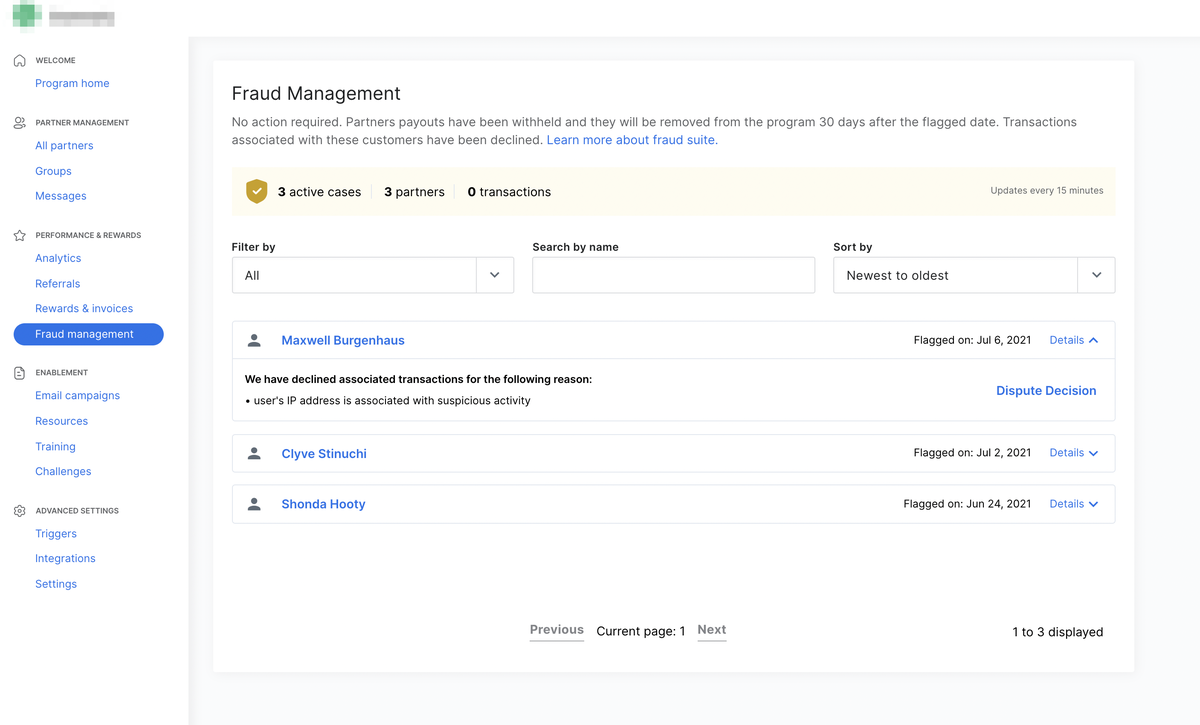
| PartnerStack | First-party cookie set by PartnerStackJS; signup events carry a customer key | Billing transactions synced from Stripe, Chargebee, Chargify or Recurly | Fraud management page in the docs: flagged partners, withheld payouts, declined transactions |
Ecommerce referral tools#
Store tools lean on the order itself, not on a separate signup event. The referral is real when an order arrives from the platform, so the main thing to check is that the order feed or tag keeps working after theme, checkout and tag changes.
ReferralCandy#
ReferralCandy
ReferralCandy is built for online stores: Shopify, BigCommerce, Squarespace and WooCommerce orders flow in directly, and a referral cookie lasts up to one year from the click.
ReferralCandy is the quickest route to a working referral program on a Shopify, WooCommerce or BigCommerce store, and it charges a share of the revenue it brings in.
Each advocate gets a unique, campaign-specific link. A referral is recorded when the friend opens the link and the order data reaches ReferralCandy: Shopify, BigCommerce, Squarespace and WooCommerce pull purchase data directly, while other platforms use a JavaScript snippet on the purchase-completed page or the API. The referral cookie lasts up to one year from the click and matches on the same device and browser. Exact self-referrals and existing customers are blocked, and near-matches or repeated IP and device purchases are flagged as suspicious for a longer review. Rewards are sent only after the purchase review period ends.
- you run a Shopify, WooCommerce or BigCommerce store and want a program live quickly.
- you prefer to pay a small fixed fee plus a share of the revenue the program brings in.
- you are not an ecommerce store: the product is built around store orders.
- you need a configurable attribution window: the one-year cookie is not configurable, and the Basic success fee of 10.5% can outgrow the $9 fee.
- Users like
- Support and easy setup
- Users dislike
- Limited customization and reward options
- Source: G2, 111 reviews
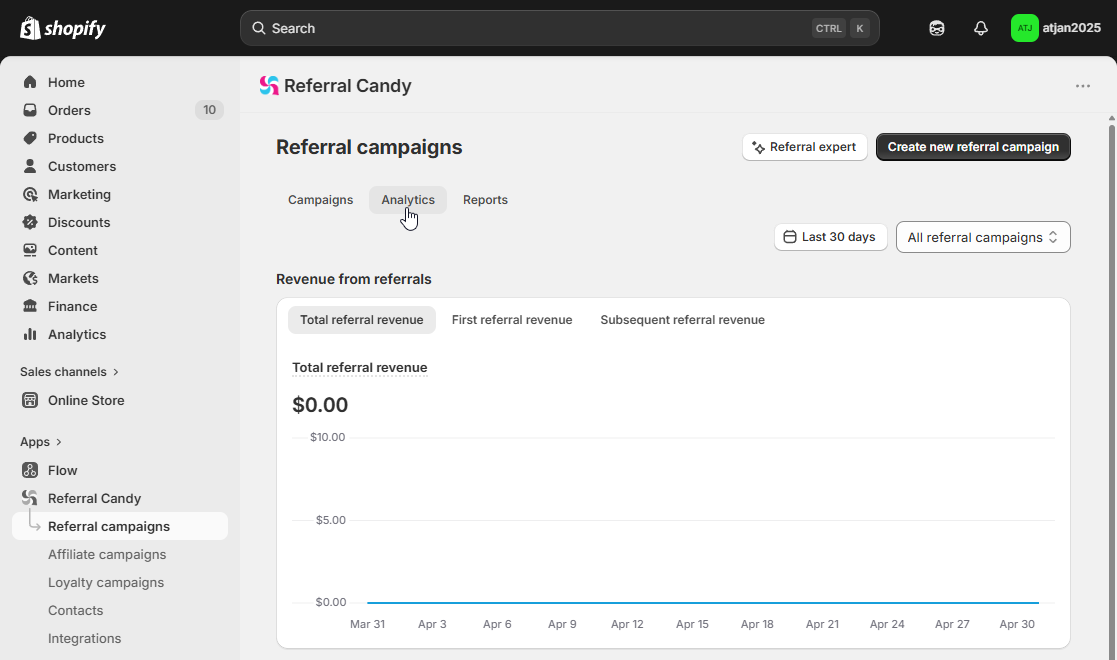
How the fees and review period work
The fee structure is the thing to model. The success fee is a percentage of the purchase subtotal after discounts and before tax and shipping, and it's charged only on a net-new customer's first three orders. It falls from 10.5% on Basic to 0.25% on Enterprise, so a store whose referral revenue grows will usually move up a plan on its own. Every plan includes unlimited campaigns, custom coupon codes and API access, so the plan choice is about cost, not capability. Payouts carry no ReferralCandy transaction fee, and Tremendous virtual debit cards are free, while PayPal, Venmo and bank transfers pass through provider fees. Integrations include Klaviyo, Recharge, Omnisend, Customer.io and Google Analytics. G2 reviewers praise the support and the quick setup, and name limited customization of branding and reward options as the main complaint.
- Starting price
- Basic $9 per month plus 10.5% success fee; Grow $79 plus 3.5%; Scale $249 plus 1.5%; Enterprise $799 plus 0.25%; 7-day trial
- Tracking
- Unique advocate link, platform order feed or JavaScript snippet, one-year cookie
- Rewards
- Two-sided offers, store credit, cash, custom coupon codes
- Fraud checks
- Purchase review period, self-referral and existing-customer blocks
- Pricing metric
- Monthly fee plus success fee on first three orders of new customers
- Success fee
- On net-new customers' first three orders
- Trial
- 7 days, all plans have the same features
- Extra stores
- $20 per month each
Mention Me#
Mention Me
Mention Me registers a referrer through a JavaScript tag, Google Tag Manager, the Shopify app or the API, and Name Share lets a friend type the referrer's name at checkout, so word of mouth without a link still counts.
Mention Me is built for consumer brands that want to capture word of mouth that never involves a link, and it prices by revenue band instead of by seat.
A tag installed through JavaScript, Google Tag Manager, the Shopify app or the server-side API registers a customer as a referrer after a purchase or signup. The referrer shares a unique link, an email, a social post or Name Share, where a friend simply enters the referrer's name at checkout. The friend clicks or enters the name, registers, and the checkout tag fires on completion. The docs state that Mention Me recognises the referral as completed whether or not the friend applies the code, and rewards are issued once the eligibility criteria are met.
- you sell to consumers and want Name Share to capture recommendations that never involve a link.
- you want a fraud-score review queue with approve and decline rules before rewards go out.
- you want public pricing or a self-serve start: pricing is by quote.
- you need quick changes without a vendor: a G2 reviewer notes that changes have to go through the support team.
- Users like
- Support and easy setup
- Users dislike
- Changes need the support team
- Source: G2, 61 reviews
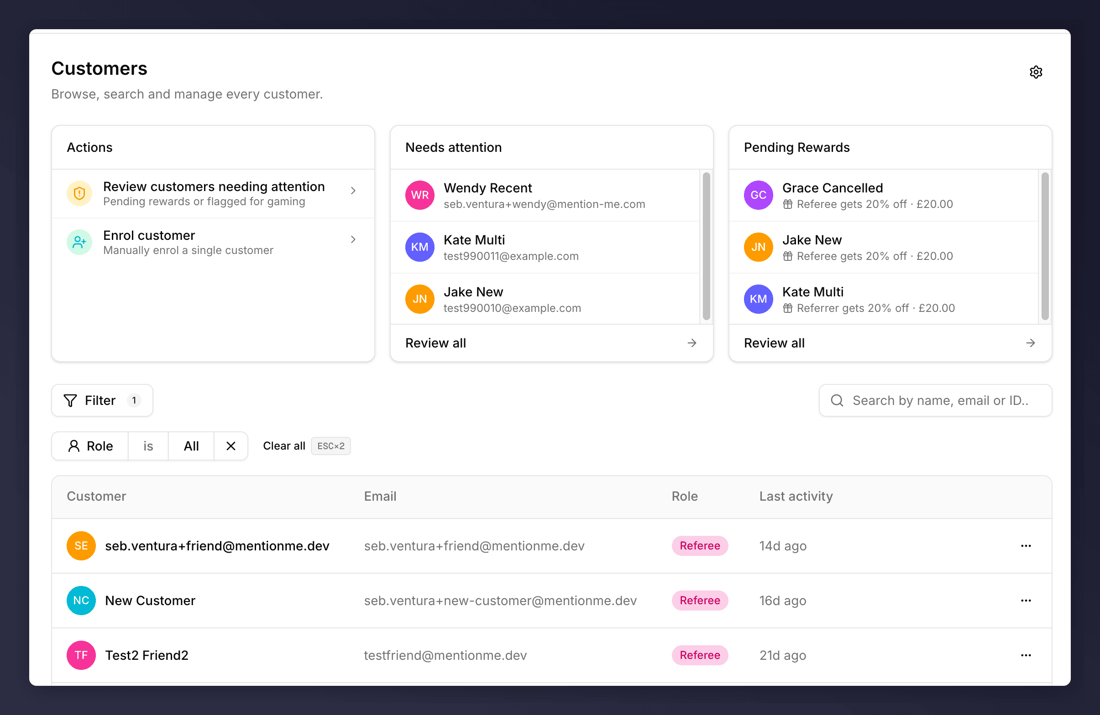
Fraud scoring and rewards
Fraud handling is the most detailed in this group. Each referral gets a fraud score, for example from matching details between referrer and friend, and a review queue ranks them by score so a team can bulk approve or decline by threshold. Approval and auto-decline rules weight the signals. Rewards can be vouchers from uploaded batches of discount codes, rewards through providers such as GiftCloud, Love2shop, Runa or Recharge, or rewards for actions that aren't purchases, such as leaving a review. The site lists integrations with Klaviyo, Salesforce Marketing Cloud, Bloomreach, Emarsys, Ometria, Attentive, Gorgias and Recharge. Pricing is a quote based on annual online revenue band, and the page says you only pay for the referrals you generate. Only 61 reviews back the G2 rating, so weigh it with a trial conversation.
- Starting price
- Quote only, based on annual online revenue band; the pricing page says you pay for the referrals you generate
- Tracking
- Referrer tag, checkout tag, Name Share, API
- Rewards
- Vouchers, reward automation providers, non-purchase actions
- Fraud checks
- Fraud score, review queue, approval and auto-decline rules
- Pricing metric
- Annual online revenue band
- Tags required
- Checkout and Referrer tags; landing page and product tags recommended
- Connection options
- Shopify, Google Tag Manager, JavaScript tags, API
- Implementation
- Two months on G2
Friendbuy#
Friendbuy
Friendbuy is an API-first referral platform for ecommerce, subscription and lending brands: the referral link carries a signed attribution ID and every payout can be checked against your own systems first.
Friendbuy is the most engineering-led option here: attribution rides in a signed link, and your own systems get the last word before any reward is paid.
The developer docs describe a personal referral link per advocate and campaign, generated through the Merchant API. The link carries a signed attribution ID that you can decode. Purchases, signups and custom events reach Friendbuy through the JavaScript SDK or the Merchant API, and a visitor-status call returns the attribution ID, the advocate and a self-referral flag. Before a reward fires, a Reward Validation Callback posts to a URL you control: a 200 response approves the reward and a 400 rejects it, which is how a return or cancellation stops a payout. Signed webhooks cover rewards, email captures and ledger transactions.
- you want server-side attribution and a reward validation callback that can reject returns or cancellations.
- your stack already includes Shopify, Recharge, Klaviyo, Braze or Segment.
- you need a public price before talking to sales: no prices are published.
- reporting accuracy matters to you: G2 reviewers mention weak reporting dashboards and integration problems.
- Users like
- Support and referral process
- Users dislike
- Weak reporting and integration issues
- Source: G2, 59 reviews
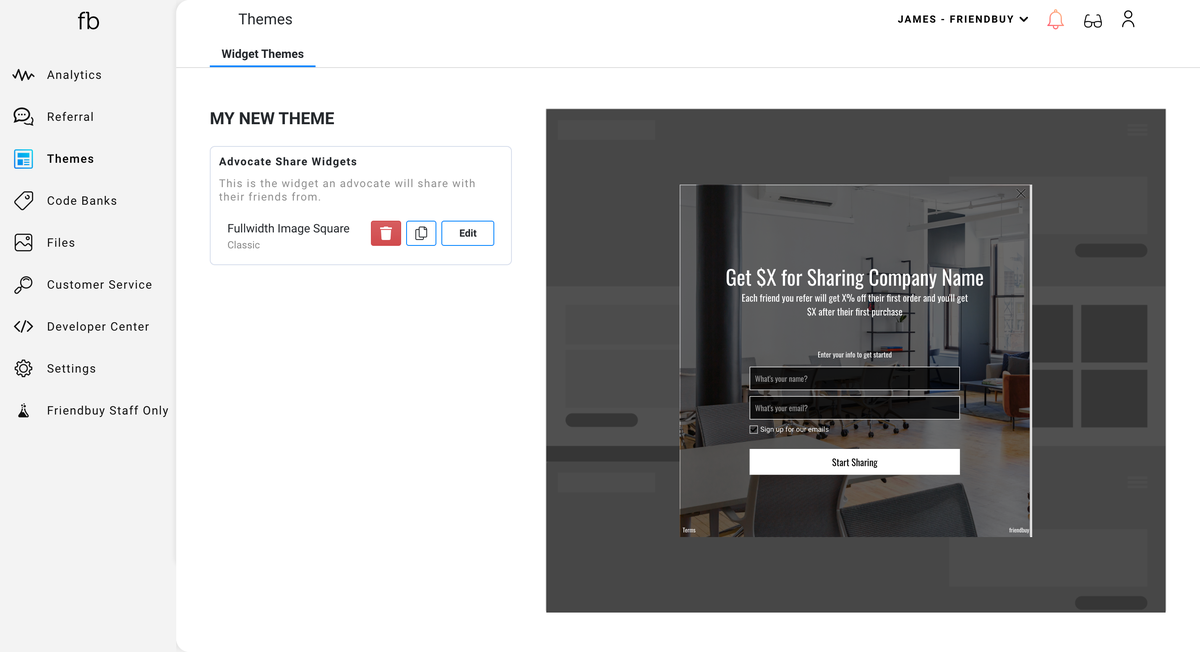
Reward triggers and fraud controls
Rewards can trigger on SKU or plan events, downstream purchases, subscription renewals or loyalty enrollment, and can be held until a condition is met, such as the return window closing. Fraud controls include real-time payout checks against your systems, layered rules with human review for borderline cases, and velocity controls that hold suspicious spikes. The vendor's own use cases are ecommerce, subscriptions, consumer lending, education and telecom. No prices are published; the pricing page offers a demo instead. That lack of a number, plus G2 comments about weak reporting dashboards and integration problems, is the reason to ask for a reporting walkthrough before signing.
- Starting price
- Not published; the pricing page offers a demo only
- Tracking
- Signed attribution ID in the link, JavaScript SDK, Merchant API
- Rewards
- Coupons, store credit, cash back, gift cards, rewards store
- Fraud checks
- Real-time payout checks, velocity controls, human review
- Pricing metric
- Not published
- Attribution
- Signed ID in the link; client-side, server-side or backfilled
- Integrations
- Shopify, Salesforce Commerce Cloud, Recharge, Ordergroove, Stripe Billing, Klaviyo, Braze, Segment
SaaS and service referral tools#
These tools qualify a referral on a business event, not just an order: a signup, a CRM stage, a subscription payment. That makes the connection to your CRM or billing system the part to test.
GrowSurf#
GrowSurf
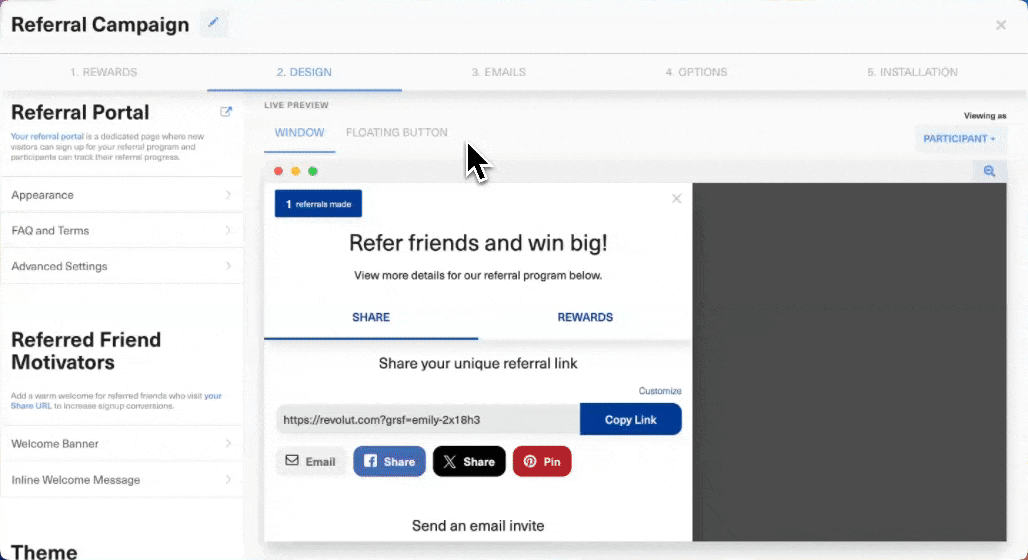
GrowSurf is a developer-friendly referral platform for SaaS and apps: a referral can be credited from a widget or form, through the REST API with a referredBy field, or through JavaScript and mobile SDKs.
GrowSurf gives a SaaS team with a developer the most control over what counts as a referral, because credit can be set from your own backend.
Participants share a link from the referral widget, an embedded form or the hosted referral portal. Attribution can also be set through the REST API by passing a referredBy value, the referrer's email or GrowSurf ID, when you add a user, through the JavaScript SDK for forms the automatic form detection doesn't support, or through the iOS and Android SDKs. Credit is recorded on the trigger you choose, either signup or signup plus a qualifying action your backend confirms, often through the API. Webhooks such as a participant reaching a goal drive your own reward logic.
- you have a developer and want the signup or a qualifying action confirmed by your own backend before credit.
- you reward with Stripe, Chargebee or Recurly coupons and want browser fingerprinting and burner-email checks.
- you want a small, transparent entry price: Business starts at $449 per month and cost scales with participants.
- nobody on the team can work with APIs or webhooks: G2 reviewers call the referral management flow unclear and the tutorials thin.
- Users like
- Support and quick setup
- Users dislike
- Unclear referral management, thin tutorials
- Source: G2, 10 reviews
Fraud tooling, rewards and what counts as a participant
Fraud tooling is broad: auto-blocking of high-risk referrals, browser fingerprinting, burner email and data-center IP detection, IP thresholds, reCAPTCHA and IP, email and country blocklists. Double-sided rewards can use upfront coupon codes through Stripe, Chargebee or Recurly. Automatic form detection credits a referrer even when the signup form sits on a different page, and cookie duration and credit expiration are configurable. Pricing counts participants, meaning anyone who receives a referral link or signs up through one, counted by unique email, so a viral program raises the bill, although the starting price looks modest. The Startup plan's price isn't listed on the page. Only 10 G2 reviews back the 4.5 rating, with praise for support and setup and complaints about unclear referral management.
- Starting price
- Business $449 per month for up to 10,000 participants, $649 for 25,000, $879 for 50,000; Startup plan price not listed; 14-day trial
- Tracking
- Widget or form, REST API referredBy, JavaScript and mobile SDKs
- Rewards
- Single-sided, double-sided, milestone, leaderboard, dynamic
- Fraud checks
- Browser fingerprinting, burner email and data-center IP detection, reCAPTCHA
- Pricing metric
- Participants (unique emails)
- Plans compared
- Startup: 5,000 participants, 2 programs. Business: 5 programs, 5 team members, custom portal domain
- Integrations
- Stripe, Chargebee, Recurly, HubSpot, Salesforce, Mailchimp, Klaviyo, Zapier, Make
Referral Factory#
Referral Factory
Referral Factory is a no-code builder: each referrer gets a link, QR code or Stripe promo code, and a lead moves from Pending to Qualified when a chosen event such as a CRM stage change occurs.
Referral Factory is the best match when you want to qualify referrals from a CRM or payment event without writing code, and it has the largest G2 sample in this list.
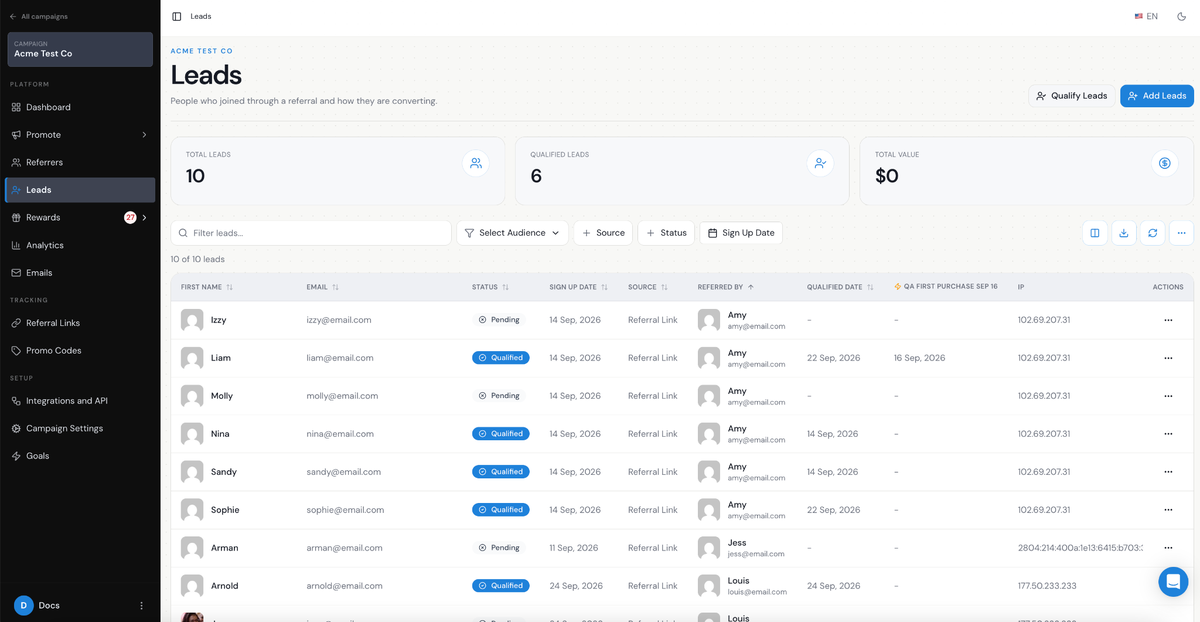
Each referrer gets a unique link, and the program can also use a QR code, direct lead submission or a Stripe promo code. A visitor who opens the referral page and submits their details becomes a lead, recorded with Referred By and Source, and starts as Pending. The lead turns Qualified when it meets the program's success condition. That condition can be a CRM stage change, a Stripe payment, a referral code redemption, a webhook, an API call, a CSV upload or a manual review. Leads, Referrers and Analytics views show the status and the conversion rate.
- you want to qualify referrals from a CRM stage change, a Stripe payment or a webhook without writing code.
- you want many reward types with manual approvals and payouts through PayPal, Tremendous or Stripe.
- you need white-label or SAML SSO: both start at the Pro plan.
- you need deep customization: G2 reviewers name limited customization as the main complaint.
- Users like
- Ease of use and quick setup
- Users dislike
- Limited customization options
- Source: G2, 192 reviews
Plan limits and what the sale hides
Basic includes unlimited campaigns, referral links and codes, fraud alerts, all integrations, webhooks and the API. White-label and SAML SSO start at Pro, which also adds email verification and teammate access. Enterprise adds a managed service, a dedicated account manager and self-hosted data. The pricing page showed a half-price October sale for new customers, $100 for Basic and $200 for Pro against list prices of $200 and $400, so confirm the current figure before you budget. Integrations include HubSpot, Salesforce, Intercom, Zoho, Pipedrive and Monday. The 4.8 G2 rating comes from 192 reviews, with praise for ease of use and setup and limited customization as the main complaint.
- Starting price
- Basic $200 per month list price (shown at $100 in an October sale), up to 20,000 users; Pro $400 list ($200 sale), 40,000 users; Enterprise from $1,000
- Tracking
- Referral link, QR code, direct lead submission, Stripe promo code
- Rewards
- Cash, gift cards, account credits, coupons, discounts, custom
- Fraud checks
- Fraud alerts and reward approvals; email verification on Pro
- Pricing metric
- Number of users
- Plan limit
- Basic 20,000 users, Pro 40,000, Enterprise 100,000+
- Payouts
- PayPal, Tremendous, Stripe, Zapier, Make, webhooks
Referral Rock#
Referral Rock
Referral Rock runs customer referral, ambassador and affiliate programs from one account, and records a referral through hosted pages, capture forms and tracked links that use a first-party cookie on your own domain.
Referral Rock suits a team that wants one flat price, unlimited referrals and an advisor who helps set up the program, at the cost of a thin plan menu.
Referrals are recorded through hosted referral pages, capture forms and tracked link clicks, and link attribution uses a first-party cookie on your own domain. For Shopify there are two paths: a native customer feed that marks a matching referral approved when an order reaches the paid status, or the Referral.js SDK through a custom pixel that fires on checkout completion and sends the email, name, order ID and subtotal so the referring member is identified. Stripe payments are matched to the advocate automatically. An approved referral can trigger the reward payout, including a one-time-use discount code for the next checkout.
- you want a flat monthly price with no referral caps or overage fees.
- your stack is HubSpot, Stripe or Shopify and you want rewards approved from the payment event.
- you need a published low entry tier: the pricing page lists a single plan at $250 per month, and extra members, programs and users are add-ons.
- Salesforce sync is a hard requirement: reviewers on G2 report integration problems with existing stores and sales software.
- Users like
- Support and concierge setup
- Users dislike
- Learning curve and integration problems
- Source: G2, 16 reviews
Program types, rewards and add-ons
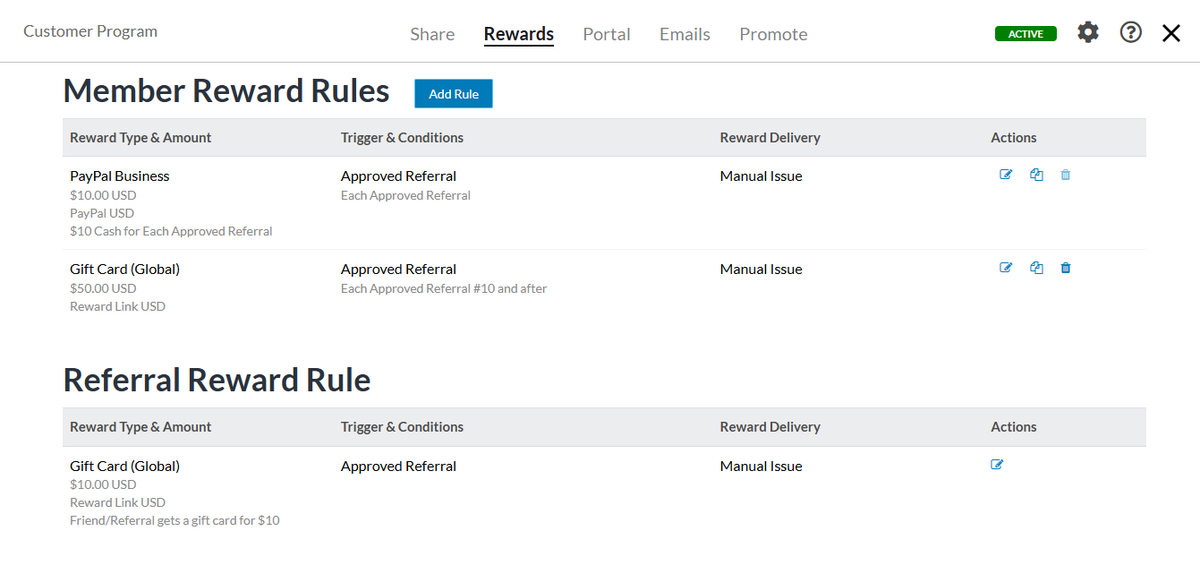
Rewards include global gift cards, cash through PayPal or Wise, store credit, coupons and custom rewards, and commissions can repeat on subscription renewals. Fraud controls cover duplicate prevention, IP tracking, coupon-use controls and a manual review queue. The page lists more than 50 CRM and platform integrations plus Zapier, a public REST API and webhooks. Extra members, programs and users are paid add-ons, and a separate Scale and Multi-Org page exists that we didn't price. G2 shows 16 reviews with praise for support and the concierge setup, and complaints about a learning curve and integration problems with existing stores and sales software.
- Starting price
- Operator plan $250 per month (10% off billed annually), 14-day trial; unlimited referrals, 10,000 base members, 10 admin users
- Tracking
- Hosted referral pages, capture forms, tracked links with a first-party cookie
- Rewards
- Gift cards, cash via PayPal or Wise, store credit, coupons
- Fraud checks
- Duplicate prevention, IP tracking, coupon-use controls, manual review queue
- Pricing metric
- Base members, referrals unlimited
- Plan limits
- 10,000 base members, 1,000 rolling members per month, 10 admins, 10 recruiters
- Program types
- Customer referral, brand ambassador, affiliate
- Integrations
- HubSpot, Salesforce, ActiveCampaign, Intercom, Mailchimp, Zapier, Stripe, Shopify
Affiliate and partner platforms#
If advocates are partners or promoters who earn commissions, these two tools fit better than a customer referral widget. They also raise a different question: how commissions are calculated from real revenue.
Tapfiliate#
Tapfiliate
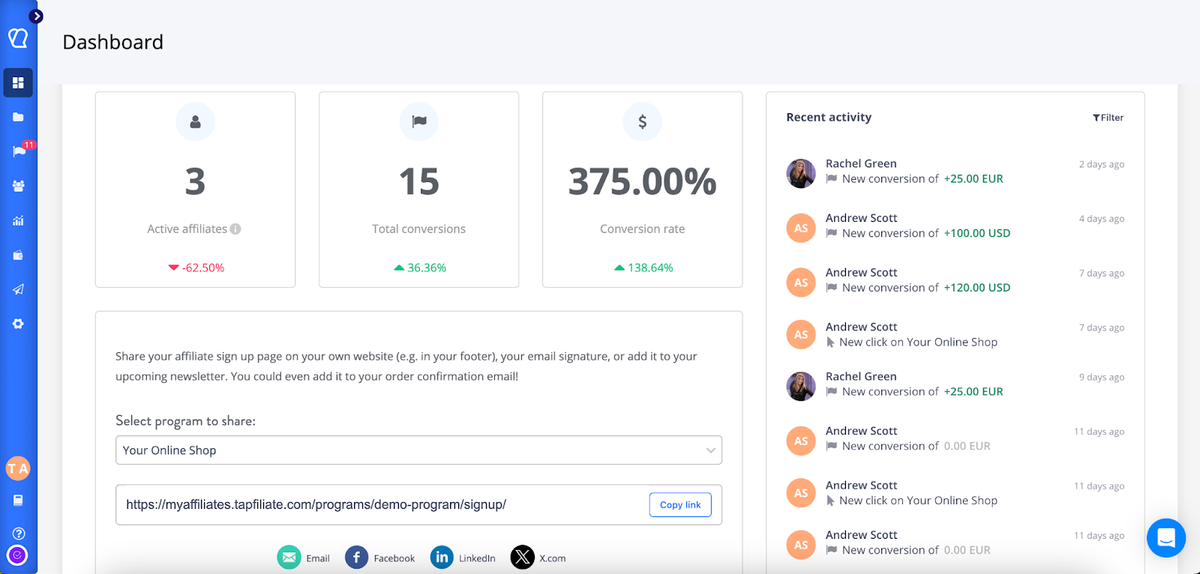
Tapfiliate is affiliate-first: a tap_vid cookie stores the affiliate code, a conversion script on the thank-you page records the sale, and coupon codes or server-to-server postbacks cover sales that never click a link.
Tapfiliate treats a referral as an affiliate conversion, which makes it a good fit when advocates earn commissions that repeat.
Each affiliate gets a unique link with a ref parameter. The tracking script stores the code in a tap_vid cookie, and a conversion script on the thank-you page reads it, records the sale and calculates the commission. Coupon codes can attribute sales that never click a link, through the REST API, Zapier or Make, and automatically for Shopify, WooCommerce and Teachable. Server-to-server postbacks cover payments made off site. Subscription tracking covers initial purchases, renewals, upgrades and downgrades.
- you pay commissions, including recurring or tiered ones, and track them through Stripe or Shopify.
- you want the cookie window configurable, and coupon codes or postbacks to attribute sales that never click a link.
- you need fraud tooling: none is documented on the pages we read.
- you track across several domains: the help center says first-party cookies do not support cross-domain tracking.
- Users like
- Ease of use and setup
- Users dislike
- Limited analytics
- Source: G2, 57 reviews
Limits, overage and payouts
The cookie duration is configurable, and the cookies are first-party, so a help article says cross-domain tracking isn't supported. Automated payouts through Trolley, multi-level commissions and deeplinks start on Scale. Overage is billed per thousand clicks and conversions, and the pricing is metered by clicks and conversions as well as affiliates, so a successful program raises the bill. The features and tracking pages we read don't mention fraud detection, and G2 reviewers name limited analytics and the lack of fraud filters. The 4.3 rating rests on 57 reviews. Integrations include Stripe, Shopify, Zapier, WooCommerce, Squarespace, Wix, BigCommerce and Paddle.
- Starting price
- Launch $89 per month ($74 billed annually); Scale $179 per month ($149 billed annually); Enterprise custom
- Tracking
- Affiliate link with ref parameter, tap_vid cookie, coupon codes, server-to-server postbacks
- Rewards
- Percentage, fixed, tiered, recurring and multi-level commissions
- Fraud checks
- None documented
- Pricing metric
- Clicks and conversions per month
- Launch limits
- 1 program, 50 affiliates, 500 conversions per month
- Scale limits
- Unlimited programs and affiliates, 10,000 conversions per month
- Commissions
- Percentage, fixed, tiered, recurring, multi-level
PartnerStack#
PartnerStack
PartnerStack is a B2B partner platform: PartnerStackJS stores the partner key in a first-party cookie, your signup event attributes the customer, and billing webhooks sync transactions so partners are paid on real revenue.
PartnerStack is a partner platform for B2B SaaS, so a referral there is one partner type among affiliates, resellers and influencers.
PartnerStackJS, a snippet in the site header, stores the referring partner's key in a first-party cookie when a visitor arrives through a partner link. Your signup event then attributes the customer to that partner, with a customer key on each signup. The alternatives are a server-to-server API or the Universal Importer. Transactions sync from Stripe, Chargebee, Chargify or Recurly webhooks, the API or a CSV import, and partners are rewarded under the program's reward structure. Partner Payments calculates what each partner is owed and pays them in one run, so you receive a single invoice.
- you sell B2B SaaS and want affiliate, referral and reseller partners in one platform with CRM sync.
- you want one invoice for partner payouts instead of paying each partner yourself.
- you want a published price or a free start: every plan is sold through a demo.
- you need a simple customer-referral widget for a B2C store.
- Users like
- Ease of use and partner management
- Users dislike
- Payout delays and fees, thin reporting
- Source: G2, 950 reviews
What each plan unlocks
Launch includes affiliate link tracking or lead and deal registration, and you select one. Full access to link tracking plus lead and deal registration comes only on Enterprise. Growth adds partner challenges and incentives, MDF management and payments, a learning management solution and advanced partner segmentation. A marketplace of active B2B partners is included in every plan. The platform page doesn't document fraud prevention or the specific commission models. G2 shows 4.7 from 950 reviews, the largest sample here. Reviewers praise ease of use and partner management, and complain about payout delays and fees, onboarding delays and thin reporting.
- Starting price
- Quote only (Launch, Growth, Enterprise); no cap on partners or internal users
- Tracking
- PartnerStackJS first-party cookie, signup events, billing webhooks
- Rewards
- Partner payments handled by the platform
- Fraud checks
- Fraud management page in the docs: flagged partners, withheld payouts, declined transactions
- Pricing metric
- Program size, features and support level
- Plans
- Launch, Growth, Enterprise; all through a demo
- Limits
- No cap on partners or internal users
- Integrations
- Salesforce, HubSpot, Slack, Stripe, Chargebee, Recurly, Pipedrive, Zendesk, Workato
What does referral marketing software cost?#
Referral marketing software costs from $9 per month plus a success fee to $449 per month among the five tools that publish a price, and none of the eight lists a free plan. The metric that grows the bill differs, yet it matters more than the starting price.
| Tool | What the price counts | What makes the bill grow |
|---|---|---|
| ReferralCandy | A monthly fee plus a success fee on first orders | Referred revenue; the fee percentage falls as you change plan |
| Referral Factory | Number of users | Crossing 20,000 users on Basic or 40,000 on Pro |
| GrowSurf | Participants (unique emails) | A viral program that adds many participants |
| Referral Rock | Base members | Extra members, programs and users sold as add-ons |
| Tapfiliate | Clicks and conversions per month | Overage per thousand clicks and conversions, or moving to Scale |
| Friendbuy | Not published | Not published |
| Mention Me | Annual online revenue band | Moving to a higher revenue band |
| PartnerStack | Program size, features and support level | A larger program or a higher plan |
How do you choose referral marketing software?#
Start with who refers and what counts as a conversion. Five questions cut the shortlist quickly:
- Who refers? Customers point to ReferralCandy, Referral Factory, GrowSurf, Referral Rock, Friendbuy or Mention Me. Partners who earn commissions point to Tapfiliate or PartnerStack.
- What counts as a referral? An order points to the store tools. A signup or a CRM stage points to GrowSurf and Referral Factory. A paid subscription points to Tapfiliate or PartnerStack, which read billing events.
- Who maintains the tracking? A tag or snippet breaks when someone changes a thank-you page or a tag container, whereas tools that read orders or billing events directly don't depend on it.
- How does the price grow? Use the cost table above, then add what you need beyond the base plan, such as white-label, SSO or extra programs.
- What reaches the CRM? Among the integrations we found listed, HubSpot appears for Referral Rock, GrowSurf, Referral Factory and PartnerStack, and Salesforce for Referral Rock, GrowSurf, Referral Factory and PartnerStack as well, while the store tools list platforms such as Shopify and Klaviyo instead. Ask each vendor to show the referral source on a HubSpot or Salesforce record. Our guide to the HubSpot Salesforce integration covers what breaks when the CRM is Salesforce.
Referral data is only useful if the source survives the form. Check that UTM parameters and referral parameters reach the lead, and read how lead management software routes the lead once it arrives. Customer engagement software covers the emails and messages around the program, and our guide to marketing operations software shows where referral tools sit in the wider stack. If you're new to the discipline, what marketing operations is explains who should own it. Customers who refer others also leave reviews, and our guide to online reputation management software covers the tools that ask for and answer them.
- The trigger event is written down: signup, paid order, CRM stage or subscription payment
- A test referral from a fresh browser is attributed to the right advocate
- The referral parameter survives redirects, consent banners and form pages
- The thank-you page tag or order feed still fires after the last site change
- The referral source and reward status reach the CRM record
- Self-referrals and existing customers are blocked, and someone reviews flagged referrals weekly
- Rewards wait until the return or cancellation window closes
- One person owns a monthly check of referrals that were attributed but never rewarded
FAQ#
What is referral marketing software?
Referral marketing software gives customers or partners a link or code, records who they bring in, decides when a referral counts and pays the reward. The tools in this guide differ mostly in how they tie a new customer to the referrer: a cookie, a signed ID in the link, a coupon code, an API call or a postback.
What is the difference between referral software and affiliate software?
Referral software usually rewards existing customers with credit, discounts or gift cards, while affiliate software pays commissions to outside promoters, sometimes as recurring percentages. Several tools cover both. Referral Rock lists customer referral, ambassador and affiliate programs, and Tapfiliate and PartnerStack sit on the affiliate and partner side.
Is there free referral marketing software?
No. None of the eight tools in this guide lists a free plan, so the realistic way to test one is a trial: 14 days for Referral Rock and GrowSurf, 7 days for ReferralCandy. Check the vendor pages for the current trial terms.
How much does referral marketing software cost?
Referral marketing software costs between $9 per month plus a success fee and several hundred dollars per month at entry level. Among the five tools that publish a price, entry plans run from $9 per month plus a success fee for ReferralCandy to $449 per month for GrowSurf Business. Referral Rock lists $250 per month, Tapfiliate starts at $89 and Referral Factory's list price starts at $200. Friendbuy, Mention Me and PartnerStack sell by quote or demo.
How do you create a customer referral program?
Choose the event that counts as a referral, such as a paid order or a signup. Pick a reward and the moment it's paid. Choose a tool that reads that event from your store, CRM or billing system. Then test one referral end to end, including the CRM record, before you invite customers.