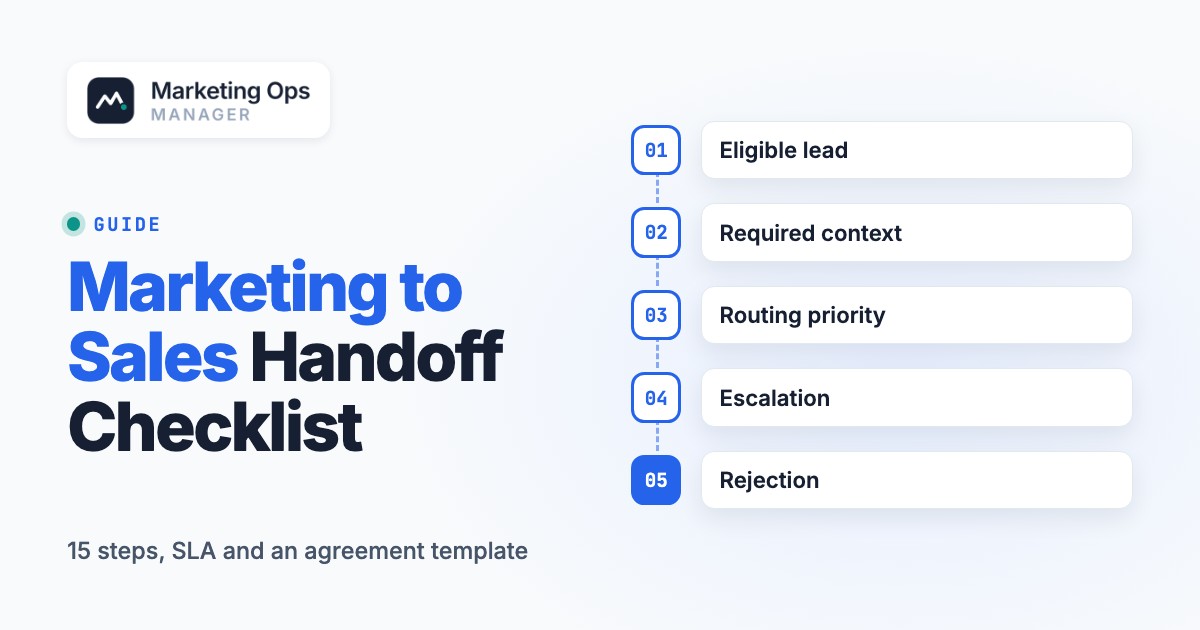
A marketing-to-sales handoff is the controlled transfer of an eligible prospect and its context to one accountable sales owner. A marketing-to-sales handoff checklist makes that transfer repeatable: it helps ensure that qualified inquiries reach the right seller with enough context, clear ownership and a measurable next action. The examples below use fictional records, so don't copy the numbers. They're illustrations, and you'll want to set your own thresholds.
- Hand off only records that meet written eligibility rules, and send the reason and the prospect's own words along with them. Don't send a bare lead label. Context is what makes the handoff useful, not the stage change.
- Check for an existing account owner before applying territory or rotation, and name a monitored fallback owner.
- Start the SLA clock from a defined timestamp, and measure first action separately from a completed conversation.
- Give every rejection a specific reason and a defined next state, so no record disappears into an undefined status.
- Test the routing with fictional records before launch, and again after every change to fields, territories or integrations.
What is a marketing-to-sales handoff?#
A marketing-to-sales handoff is the moment a record stops being marketing's responsibility and becomes a seller's. It's more than changing a CRM stage. The transfer should identify why the prospect qualifies, what action they requested, who must respond and how the response will be tracked.
Marketing and sales should agree on the definitions before implementing automation. Otherwise a workflow can move records quickly while hiding an unresolved disagreement about lead quality, and nobody will notice until sales stops trusting the queue. If your teams still argue about what counts as qualified, settle that first. The MQL definition examples and the lead lifecycle stages guide, because every handoff rule refers to those states.
Copyable marketing-to-sales handoff checklist#
Use this list as a starting point and adapt the wording to your own stages. Most items are covered in the sections that follow, so you'll find the detail there.

- Confirm the contact and company details needed for appropriate outreach
- Check communication permissions and suppression flags
- Record the original campaign and the meaningful conversion event
- Preserve the prospect's explicit request and latest context
- Check for duplicate contacts and existing account ownership
- Apply documented eligibility and qualification rules
- Separate explicit sales requests from passive content engagement
- Assign a named owner or a monitored fallback owner
- Notify the owner with context and a clear next action
- Start the SLA clock from a defined timestamp
- Record acceptance or rejection and a useful reason
- Escalate unowned or overdue records
- Send rejected records to a defined next state
- Track acceptance, response and downstream outcomes
- Review exceptions with both teams regularly
What information should accompany the lead?#
Include the contact details needed for legitimate outreach, company and account context, the originating campaign, the prospect's latest meaningful interaction and the specific next action. Separate observed facts from inferred intent. A guide download doesn't prove that someone has budget, and a contact request doesn't automatically establish buying authority.
Record the source and timestamp of important signals so the seller can interpret them. That's especially true for intent signals, which age quickly. A seller who sees "pricing page viewed twice, demo form submitted Tuesday 10:12" can open a conversation that fits. A seller who sees only a lead score has to guess, and a guess is easy to get wrong. Minimize unnecessary personal information and respect consent and suppression preferences, but don't skip the context the seller needs. If it isn't needed to follow up, don't pass it along.
Which qualification criteria should marketing and sales share?#
Define eligibility with explicit criteria such as relevant market, account fit, a contactable record and a meaningful action. Document exceptions for existing customers, students, partners, competitors and duplicate inquiries. They're easy to forget, but they cause most of the disputes.
If you use a lead score, expose the underlying signals instead of making a mysterious number the only reason for transfer. Review the qualification rules against downstream outcomes and rejection reasons every quarter or so. What's worked last year won't necessarily work after a pricing or territory change. A local definition is more useful than copying an industry acronym without explaining it. The MQL vs SQL guide shows how different teams draw that line and where the criteria typically differ. The lead scoring guide shows how to build a model sales can inspect.
How do you assign ownership?#
Check whether the account or contact already has an owner before applying new territory rules. It's a small step, yet it prevents most duplicate outreach. Then consider market, language, product, segment and team capacity. Define a fallback owner for the case where no standard rule matches, because there's always an exception. A shared queue without monitoring isn't a complete assignment policy.
Document reassignment for three situations: a seller is unavailable, an account changes territory, or an active opportunity already exists. One person should be accountable for the next action at any moment. If two people think they've got it, nobody does. For the full rule order, exception queues and test cases, see the lead routing workflow guide.
What should a service-level agreement specify?#
An SLA should name the triggering event, the expected action, the clock rules, the escalation path and the evidence that the action occurred. Distinguish a first attempted contact from a completed conversation. Decide whether weekends and holidays count, and whether reassignment resets the deadline.
Differentiate explicit inbound sales requests from low-intent engagement. A demo request deserves a faster response than a newsletter signup, so write that difference into the agreement. Choose response expectations that fit your staffing and your prospects' needs. Copying a number from another company looks tidy, but it's rarely what your team can deliver. Review missed deadlines as process failures to understand, not merely scores to punish. They can be a sign that routing, staffing or definitions need work.
What does a useful seller notification look like?#
A good notification clearly summarizes the reason for the handoff, the prospect's request, relevant account history, the source, the owner and the due action. Avoid a message that contains only a generic lead label and a CRM link.
For example, a fictional notification could read: "Dana Whitfield at Northwind Logistics asked to discuss a workflow migration. The account already has an owner, so Sam Ortiz should reply under the inbound inquiry policy by end of day tomorrow." That gives the seller what they need to prepare a relevant response. They won't have to open three systems to find out who the prospect is. Don't infer financial authority or purchase timing from a form submission.
How should acceptance and rejection work?#
Provide clear dispositions such as accepted, duplicate, existing opportunity, wrong territory, insufficient information, not currently eligible and disqualified. Make rejection reasons specific enough to improve targeting, data capture or routing, and don't let "other" become the most common answer. A generic "bad lead" label isn't actionable.
A rejected lead needs a defined next state. The next state may be nurture, correction, reassignment or suppression. Require a timestamp and a responsible actor for each disposition. A missing timestamp or actor makes the pattern review much harder. Don't automatically reassign every rejection to another seller, because that can create loops and duplicate outreach. Define the conditions for recycling a record, retain the rejection reason so operations can diagnose repeated patterns, and respect communication preferences throughout. Review the patterns with both marketing and sales instead of assigning blame.
How do you distinguish MQL from sales acceptance?#
A marketing-qualified lead reflects marketing's documented assessment that a record merits sales review. Sales acceptance, however, is the receiving team's separate decision that the record is actionable under the shared agreement. These are operational definitions, not guarantees of intent or eventual revenue.
The transition between them shouldn't be hidden; it should be visible, timestamped and reversible with a reason. Teams may use different labels, but the underlying responsibilities must remain clear: marketing owns the quality of what it sends, and sales owns the speed and quality of what it does next.
How do you test routing before launch?#
Create fictional records that represent common and exceptional scenarios. For each case write down the expected owner, status, notification and deadline, execute the workflow and compare the actual result. The table shows one reasonable starting set.
| Test scenario | Expected owner | Expected status | Expected deadline |
|---|---|---|---|
| New inbound inquiry from an eligible, unowned account | Territory owner | Assigned, seller notified | SLA starts at form submission |
| Inquiry from an existing customer | Current account owner | Assigned, flagged as existing customer | Inbound inquiry policy applies |
| Inquiry from a named account | Named account owner | Assigned, seller notified | Inbound inquiry policy applies |
| Out-of-region request | Fallback owner or regional queue | Assigned to a monitored queue | Fallback policy applies |
| Duplicate of an open record | Owner of the original record | Linked, no new assignment | No new SLA clock |
| Contact without company information | Data review queue | Needs enrichment | Operations deadline, not the sales SLA |
Don't treat the tests as a one-off; they're cheap, while a silent routing failure isn't. Repeat them after changing field names, territory assignments, integrations or account matching rules. Test failures should always block deployment until the routing owner resolves them.
Which handoff metrics matter?#
Track eligible handoffs, accepted records, rejection reasons, time to first action, overdue assignments and later sales outcomes. Define the denominator for each rate and explain whether unreviewed records are included.
Acceptance rate equals accepted handoffs divided by handoffs with a recorded acceptance decision. SLA compliance equals eligible handoffs with an on-time required action divided by all eligible handoffs whose deadline has passed. For example, if 40 records reached a decision and 30 were accepted, acceptance is 30 ÷ 40 = 75%. If 36 of 45 due handoffs received an on-time action, compliance is 36 ÷ 45 = 80%. Keep pending records separate so the denominator is transparent. If they're mixed in, compliance looks worse than it is.
Segment by source or account type when sample sizes permit sensible comparisons, but don't read much into a handful of records. Acceptance isn't equivalent to revenue, and a first email isn't the same as a conversation. Use these metrics to diagnose process health rather than to imply a causal effect from a single campaign touch.
How can teams audit existing handoffs?#
Select a sample of recent records across different campaigns, sellers and outcomes. Inspect the source, qualification evidence, account matching, assignment, notification, first action, acceptance and disposition. Compare each record with the documented agreement.
Look for records that were unowned, repeatedly reassigned, rejected without reasons or moved between stages without a real action. Discuss the exceptions with marketing, sales and operations. They'll each see a different cause. Assign each fix an owner, a test case and a review date, then sample again after the changes. The marketing operations audit checklist covers the wider stack around the handoff.
What mistakes commonly break the process?#
Teams sometimes treat every engagement as a sales request, which creates avoidable interruptions. Sellers who've been burned by that start ignoring the queue. Others route by geography while ignoring an existing account owner, so the customer's current rep doesn't hear about the new inquiry. Some rely on opaque scores, or measure handoff volume without checking acceptance, which rewards quantity instead of quality. Another common failure is overwriting the original acquisition information when a later campaign touches the contact.
Automation can amplify each of these mistakes, so fix the process first. Fix definitions, data quality and ownership before adding complexity, and retain an audit trail for changes. You'll need it the first time someone asks why a lead went where it did.
What belongs in a shared handoff agreement?#
Write down the entry criteria, required fields, account matching rules, assignment precedence, response expectations, acceptance and rejection reasons, and escalation. Name the owners for the qualification definition, the CRM routing and the sales response. Everyone should know who's accountable for which part. Include a version date so teams know which rules were active when a lead moved. Review the agreement when sales territories, products or forms change. It's a living document, not a launch artifact. It's a living document. A short document used consistently is far more valuable than a long policy nobody follows, and it's the one people will actually update.
Marketing-to-sales handoff agreement
Use this sample agreement as a starting point, then replace every bracketed field with a decision your team has approved.
| Decision | Agreement to complete |
|---|---|
| Eligible lead | [Account fit] plus [explicit request or qualifying behavior] |
| Required context | [Contact permission], [source], [request], [account owner], [timestamp] |
| Routing priority | Existing account owner, then [territory or segment], then [fallback owner] |
| Marketing commitment | Supply complete, correctly classified records and correct failed routes |
| Sales commitment | Accept or reject within [business hours] and attempt contact within [business hours] |
| Escalation | Alert [backup owner] when [deadline] passes without a logged action |
| Rejection | Select [reason code] and move the record to [nurture, correction, reassignment or disqualification] |
| Review | [Named marketing and sales owners] review exceptions every [interval] |
How should a small team implement the checklist?#
Work through the steps below in order, and expand automation only when the basic process produces dependable, explainable outcomes.
Name the owner and the definition
Pick one process owner and write down what counts as an eligible sales inquiry. If it isn't written down, it isn't a rule.
Audit a small sample
Review a manageable set of recent records to find the most harmful gap first. Don't try to fix everything at once.
Add simple assignment rules
Implement existing-owner checks and a monitored fallback owner before any territory or rotation logic.
Improve the seller notification
Add the reason for handoff, the request and the required next action to every notification.
Test fictional edge cases
Run the routing scenarios above before deploying, and keep the results so you can show what's been tested.
Hold a recurring joint review
Look at rejections and missed follow-ups together, with named marketing and sales owners. It's a conversation, not a report.
Who should approve changes to routing rules?#
Name one operational owner for CRM routing changes, and require sign-off from marketing and sales for changes to qualification or response commitments. Record the effective date, the reason for the change and the routing test cases that passed before activation. This makes exceptions traceable when ownership or territories change.
How do you keep the process reliable over time?#
Monitor exceptions, duplicate assignments, stale owners and missing fields. They're the early warnings. Retest routing after CRM schema changes or territory updates. Review a mix of accepted and rejected records with representatives from both teams, and update the documentation and communicate changes before they take effect. Keep reports consistent with the stage definitions in force during the reporting period.
Reliability comes from ownership, feedback and testing, not from a one-time workflow launch. A pre-launch review such as the campaign tracking checklist catches the data problems that otherwise surface later as rejected handoffs.
What is the takeaway?#
Reliable handoffs depend on shared definitions, complete context, explicit ownership, timely follow-up and feedback. Start with a simple documented process, test the edge cases and improve it based on observed records rather than assumptions.
What should a marketing-to-sales handoff checklist include?
Contact and consent checks, the original campaign and request, duplicate and ownership checks, eligibility rules, a named owner, a seller notification, an SLA clock, an accept or reject decision with a reason, escalation and a review routine.
Who owns the handoff, marketing or sales?
The handoff belongs to both teams, for different parts. They're accountable for different outcomes. Marketing owns the quality and completeness of what it sends, and sales owns the speed and quality of the follow-up. One named process owner should keep the agreement current.
What is a good SLA for following up on a handoff?
A universal SLA number doesn't exist, and a benchmark from another company rarely fits. Choose response times that match your staffing and the type of request, separate explicit sales requests from low-intent engagement, and define the clock start and what counts as a first action.
What should happen when sales rejects a lead?
The record needs a specific rejection reason, a timestamp and a defined next state such as nurture, data correction, reassignment or suppression. It shouldn't return to an undefined status.
How do you test a handoff before launch?
Create fictional records for common and exceptional cases, write down the expected owner, status, notification and deadline, run the workflow and compare the results. Repeat the tests after any change to fields, territories or integrations.