An MQL (marketing qualified lead) is a lead that marketing has judged ready for sales because it fits the target customer and has shown enough interest. An SQL (sales qualified lead) is a lead that a salesperson has qualified as a real sales opportunity, usually after a conversation. The difference is who decides and on what evidence: marketing decides from data, sales decides after talking to the person. Scores, SLAs and CRM stages exist to make that handoff happen the same way every time.
- An MQL is qualified by marketing from fit and behavior. An SQL is qualified by sales from a conversation.
- The handoff needs written criteria: fit, intent, a way to contact the person and no open owner.
- Every rejected MQL needs a reason code, or marketing never learns what to change.
- An SLA names who acts, within what time and what happens when nobody does. The numbers are yours to set.
- Judge the split by sales acceptance and progression to later stages, not by MQL volume.
What is the difference between an MQL and an SQL?#
An MQL is a lead marketing has qualified as ready for sales, and an SQL is a lead sales has qualified as a potential customer. HubSpot's documentation words it the same way: an MQL is a contact or company that the marketing team has qualified as ready for the sales team, and an SQL is one that the sales team has qualified as a potential customer.
| Lead type | Who qualifies | Evidence | Typical trigger | Owner | Next step | If it fails |
|---|---|---|---|---|---|---|
| MQL | Marketing, by rule or score | Company and role fit plus behavior such as a pricing page visit or a content download | Score crosses a threshold, or a high-intent form is submitted | Marketing until accepted, then a named rep | Route to sales with the reason it qualified | Recycle to nurture with a reason code |
| SQL | A salesperson, after contact | A conversation that confirms need, authority, timing or budget | A rep accepts the lead and confirms a real opportunity | The assigned rep or account executive | Create or progress an opportunity | Disqualify or return to marketing with a reason |
The table is a working convention. Teams draw the line in different places, and that's why the definition has to be written down before anyone argues about conversion rates. The six examples in MQL definition examples show how the same rule changes with the sales motion.
Where does an SAL fit between them?#
A sales accepted lead (SAL) is an MQL that a rep has agreed to work but has not yet qualified. It's an optional checkpoint, and it's really useful when you want to measure whether sales accepted a handoff separately from whether the conversation went anywhere. If you skip it, acceptance still has to be recorded somewhere, because "marketing sent it" and "sales took it" are different events.
What is a PQL and how does it differ?#
A product qualified lead (PQL) is a user whose in-product behavior, such as inviting teammates or hitting a usage limit, suggests they are ready to buy. It replaces the marketing signal, not the sales one. A PQL still needs a salesperson to qualify it, so it becomes an SQL by the same acceptance rule.
What is a marketing qualified lead?#
A marketing qualified lead is a contact that meets an agreed mix of fit and demonstrated interest. It's a decision rule, not proof that anyone will buy. Three parts make the rule usable:
- Fit: company size, industry, region and role match your target customer.
- Intent: the person did something that signals buying interest, from a demo request to repeated visits to pricing and comparison pages.
- Exclusions: current customers, partners, competitors, students and duplicate records never qualify.
Direct requests such as a demo form should skip the points race and go to sales immediately. A score is for contacts who show interest gradually, so don't make everyone wait for points.
What is a sales qualified lead?#
A sales qualified lead is a lead a salesperson has contacted and confirmed as a real sales opportunity. In practice that means the rep has spoken with the person or the account and found a problem you can solve, someone with a say in the purchase and a plausible timeframe. Teams use different checklists for this, including BANT (budget, authority, need, timing). Pick one, write it down and use it for every lead.
In HubSpot, SQL is a lifecycle stage and the finer states sit in a separate property. The SQL stage includes sub-stages stored in the Lead Status property, whose default options are New, Open, In Progress, Open Deal, Unqualified, Attempted to Contact, Connected and Bad Timing. Keep that split in mind when you build reports: lifecycle stage tells you how far the relationship has come, and lead status tells you what the rep is doing now. The lead lifecycle stages guide covers that distinction in more detail.
What are the handoff criteria from MQL to SQL?#
A lead is ready to move from MQL to SQL when it passes four checks: it fits, it shows intent, someone can reach it, and no other owner already has the relationship. Each check needs a yes or no answer and a reason code when the answer is no.
| Check | Question to answer | Passes when | Reason code if rejected |
|---|---|---|---|
| Fit | Does the company and role match the target customer? | Region, size and role are inside the written profile | Out of profile |
| Intent | Did the person show buying interest, or only research interest? | A high-intent action, or a score above the agreed threshold | Research only |
| Contactable | Can a rep reach the person? | Valid email or phone, not a role mailbox that bounces | Bad contact data |
| Ownership | Is anyone already working this account? | No open opportunity or active owner | Existing owner |
- Lead fits the written customer profile
- High-intent action or score above threshold, with the reason stored on the record
- Valid contact data and consent recorded
- Duplicate and existing-customer check passed
- Owner assigned and notified
- Rejection reason codes available to the rep
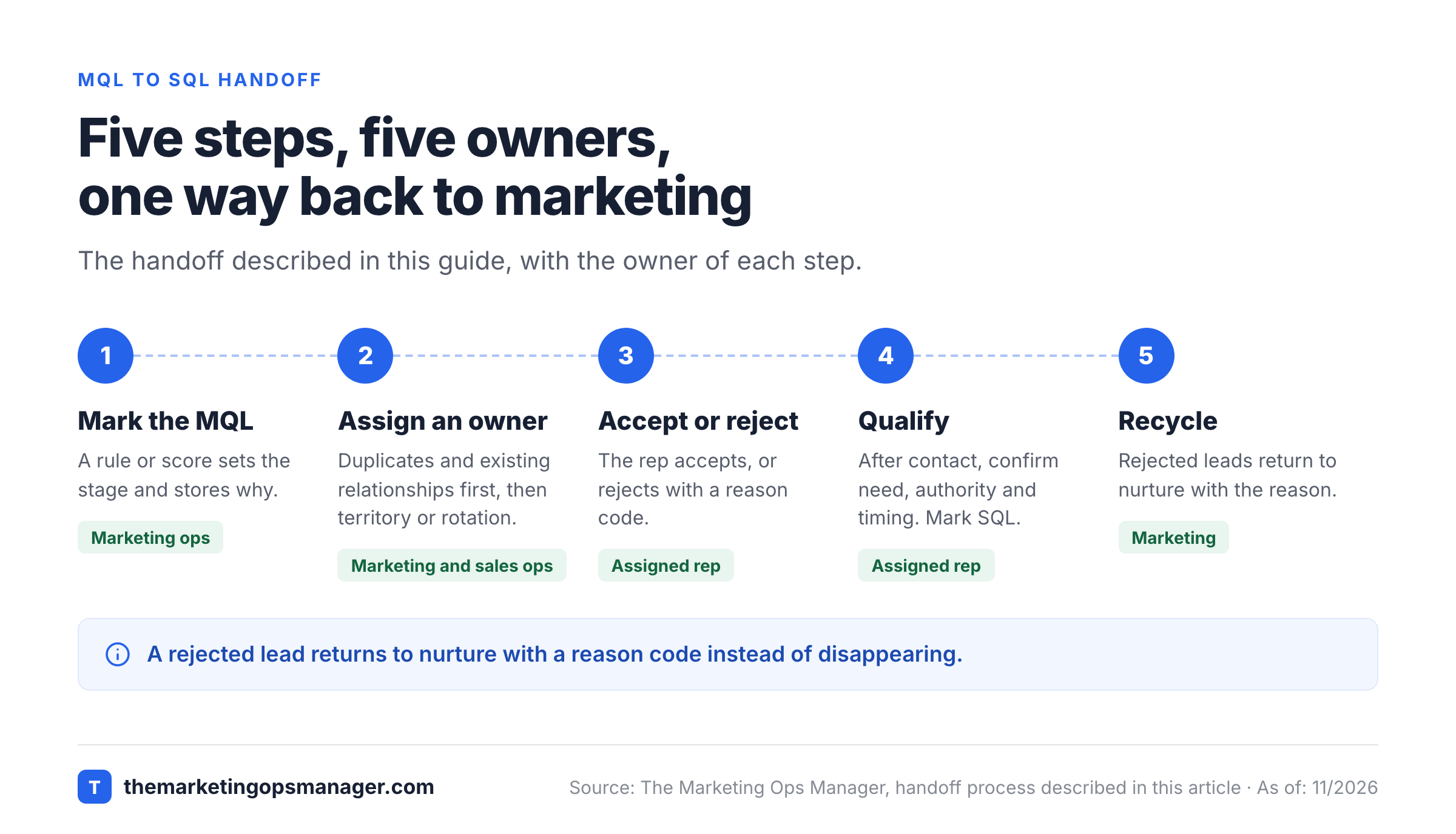
Marketing marks the MQL
A rule or score changes the lifecycle stage and writes down why: which action, which score, which date.
Routing assigns an owner
Duplicates and existing relationships are checked first, then territory or rotation. The lead routing workflow guide covers the order.
Sales accepts or rejects
The rep accepts the lead or rejects it with one of the reason codes. Silence isn't an answer.
Sales qualifies
After contact, the rep confirms need, authority and timing, then marks the lead as an SQL and opens an opportunity if it is real.
Rejected leads recycle
Rejected MQLs go back to nurture with the reason attached, so scoring and campaigns can change.
What SLA should sales and marketing agree on?#
An SLA between marketing and sales names who acts on an MQL, within what time, and what happens if nobody does. The aim is to stop leads from aging in a queue that nobody watches. The targets below are examples to adapt to your volume and team size, not industry benchmarks.
| Milestone | Example target | Owner | If missed |
|---|---|---|---|
| Lead assigned after it becomes an MQL | Within 5 minutes, automatic | Marketing ops | Alert to marketing ops |
| Lead accepted or rejected | Within 1 business day | Assigned rep | Reassign to the next rep or the team lead |
| First contact attempt | Within 4 business hours for demo requests, 1 business day for other MQLs | Assigned rep | Escalate to the sales manager |
| Qualification decision (SQL or return) | Within 5 business days of the first attempt | Assigned rep | Lead returns to nurture with a reason |
| Recycled lead re-engaged | At the next qualifying action | Marketing | Review the scoring rule |
Review the numbers after a quarter. If reps accept leads on time but rarely reach a decision, the problem is the quality of the MQL rule or the follow-up process, not the speed of acceptance. For conversion rates by cohort, see the MQL to SQL conversion benchmark guide.
How do HubSpot and Salesforce store MQL and SQL?#
HubSpot has built-in Marketing Qualified Lead and Sales Qualified Lead lifecycle stages. Salesforce treats a lead as one record that sales works and then converts. The practical effect is different on each side.
| Tool | Stage or status values | Behavior to remember |
|---|---|---|
 HubSpot Sales Hub | Lifecycle stages in order: Subscriber, Lead, Marketing Qualified Lead, Sales Qualified Lead, Opportunity, Customer and Evangelist. SQL sub-stages sit in Lead Status. | Automatic updates from imports, forms, the API and workflows only move the stage forward. A person can set an earlier stage by hand. |
 Salesforce Agentforce Sales | Lead status values that your admin defines. Converting a lead creates an account, a contact and optionally an opportunity. | MQL is usually a custom status or a field set by marketing automation. Conversion is the SQL event. |
Forward-only behavior in HubSpot has a consequence: a lead that sales rejects will not drop back to a lower stage on its own, so rejected leads need an explicit rule or a manual change. Write that rule into the handoff document, and test it, because a lead that stays at MQL after rejection will keep appearing in the next report.
What breaks the MQL to SQL handoff?#
Most handoff failures are quiet, and they're almost never dramatic. The form still submits and the lead still appears, but one field is empty, the owner is wrong or the stage did not change. A few causes show up again and again:
- A form field that carries the lead source stops mapping to the CRM, so the MQL arrives with no source.
- A routing rule sends leads to a rep who left or is out of office, and nobody reassigns them.
- A scoring rule counts the same action twice after a form change, so low-fit contacts cross the threshold.
- A sync error leaves the lifecycle stage as Lead in the CRM while the marketing tool says MQL.
Each of these is easy to find if someone looks at the handoff each week, and it's very hard to find if you wait for a complaint from sales. A test lead per form, checked for source, owner and stage, takes a few minutes. For teams that run campaigns on HubSpot and GA4, our product, The Marketing Ops Manager, runs that kind of check on a schedule across landing pages, forms, tracking, CRM contacts and lead owners, and opens an incident with evidence when a step fails.
Which metrics show whether the split works?#
The metrics that show whether the MQL and SQL split works are acceptance and progression, not raw MQL counts. A higher MQL number can mean looser rules, and a lower one can mean better filtering.
- Acceptance rate: accepted MQLs divided by all MQLs in the same cohort.
- Time to accept and time to first touch: measured from the MQL timestamp.
- MQL to SQL rate: SQLs from a fixed MQL cohort within a defined window.
- Rejection reasons: a count by reason code, reviewed monthly with sales.
Use the same cohort and window every time. The benchmark guide linked above explains why blended numbers move without any channel improving.
What is the difference between MQL and SQL?
An MQL is a lead marketing has qualified from fit and behavior. An SQL is a lead sales has qualified, usually after contact, as a potential customer.
How do you convert an MQL to an SQL?
Route the MQL to an owner, have the rep accept or reject it with a reason code, make first contact within the agreed time, then confirm need, authority and timing. If the lead is real, mark it as an SQL and open an opportunity.
What does SQL mean in sales?
In sales, SQL means sales qualified lead: a lead a salesperson has qualified as a real opportunity. It's unrelated to the SQL database language.
What is a PQL?
A product qualified lead is a user whose in-product behavior suggests readiness to buy. It still needs sales qualification before it counts as an SQL.
What is a good MQL to SQL conversion rate?
There isn't a single standard, because definitions and windows differ. Compare a fixed cohort over time against your own history rather than against another company's number.
Do you need an SAL stage?
Only if you want to measure acceptance separately from qualification. It is optional, but acceptance still needs a timestamp and a rejection reason.