Braze is a customer engagement platform for teams that need to coordinate personalized messages across mobile, email and other owned channels. Its biggest strength is connecting customer events to multichannel journeys in Canvas. Its biggest buying risk isn't the feature set; it's the work around the software: identity, event quality, campaign QA and a contract whose cost depends on usage.
This Braze review covers what the platform does, where it gets hard to operate and what a marketing operations team should verify before signing. Braze makes sense when lifecycle messaging is central to the business. It's a harder fit if your team only needs straightforward newsletters or lacks engineering ownership for event data.
- Best fit: established lifecycle teams coordinating app, web and messaging data.
- Strongest capability: Canvas journeys that combine channels, audience logic and behavioral events.
- Main trade-off: data instrumentation, governance and message-volume economics need dedicated owners.
- Pricing: public editions and usage drivers, but no public US dollar rate card.
- Buyer test: prove identity joins, suppressed-message behavior and warehouse exports before rollout.
Is Braze worth it for marketing operations teams?#
Braze is worth evaluating when customer engagement depends on timely behavior signals, coordinated channel choices and a reliable customer profile. The decision hinges on the quality of your event pipeline, the team's ability to govern Canvas changes and the commercial model for active users and messages.
The platform isn't a substitute for a CRM, a data warehouse or an independent check that a landing-page lead reached sales. It activates data and manages customer communications; it doesn't create them from nothing. Your surrounding systems still need to supply accurate identities, consent and business events.
For a subscription app, the case can be strong. An onboarding journey might react to an account-created event, wait for a product milestone and send a push or email only when the user qualifies. For a B2B demand generation team running occasional email nurtures, the same machinery may add more implementation work than the workflow needs, and that's a real cost.
The useful question isn't whether Braze has more features than an email tool. It's whether the extra orchestration prevents a measurable problem in your customer journey. If a delayed event, duplicate profile or incorrect subscription state would create a bad customer experience, investigate those failure modes before comparing editor screens.
What does Braze actually do?#
Braze combines customer data activation, segmentation, message creation and journey orchestration. Canvas is the visual workflow layer, while data ingestion and export connect Braze to the rest of the marketing stack.
- 1Collect signals
 Braze
Breaks when events arrive without a stable identity or consent state. - 2Resolve audience
- Braze
Breaks when segment rules rely on stale or mis-specified attributes. - 3Orchestrate
- Braze
Breaks when a delay or branch hides a path nobody tested. - 4Deliver
- Braze
Breaks when a message is suppressed but the journey keeps moving. - 5Measure and verify
- Braze
Breaks when an export fails and nobody reconciles it with the warehouse.
Braze supports email, push, SMS, MMS, RCS, WhatsApp, in-app messages, Content Cards and Banners. Those channels aren't interchangeable, and they don't fail the same way. An in-app card depends on the user returning to the product, while a push notification can interrupt the user outside the app. A mature channel strategy doesn't pick a channel first; it maps message urgency, consent and the user's recent actions and only then picks a delivery method.
Braze also offers Cloud Data Ingestion for warehouse-to-platform updates and Currents for exporting engagement events. Those capabilities matter to a marketing operations team because the lifecycle platform shouldn't become the only place where performance can be inspected.
The critical boundary is data ownership. Your team should decide which system owns email consent, which ID identifies the customer, how anonymous activity becomes known activity and what happens if a warehouse sync arrives late. Braze can use the data it receives, but a mis-specified event stays a mis-specified event after it enters a polished Canvas.
How good is Braze Canvas for lifecycle campaigns?#
Braze Canvas is well suited to multistep customer journeys with branches, delays and channel decisions. It becomes harder to maintain when teams build long paths without a naming standard, test scenarios or clear change ownership.
A typical journey starts with a meaningful trigger, not a broad segment that everyone enters. The next decision checks whether the customer has completed the desired action. Only then does the team decide whether a reminder, education message or suppression is appropriate. Braze supports Canvas path previews that let operators simulate eligible steps before launching.
Define the event contract
Write down the trigger name, source system, identifier, required properties and expected arrival delay. A journey shouldn't depend on an event nobody owns.
Model exit and suppression
Document the conversion event, consent rule, frequency cap and fallback channel. Decide what happens when a user changes status while waiting.
Preview representative paths
Use Canvas preview with a qualified user, an unqualified user, a missing attribute and a suppressed recipient. Compare the observed path with the intended journey.
Approve and monitor the launch
Require an owner, a rollback path and a post-launch check for entry volume, message sends and unexpected drop-offs.
Canvas previews support Message, Audience Paths, Decision Split, Delay, Action Paths and Experiment Paths, among other steps. Unsupported step types can be skipped during a preview. That matters because a green preview isn't proof that every production integration behaved correctly.
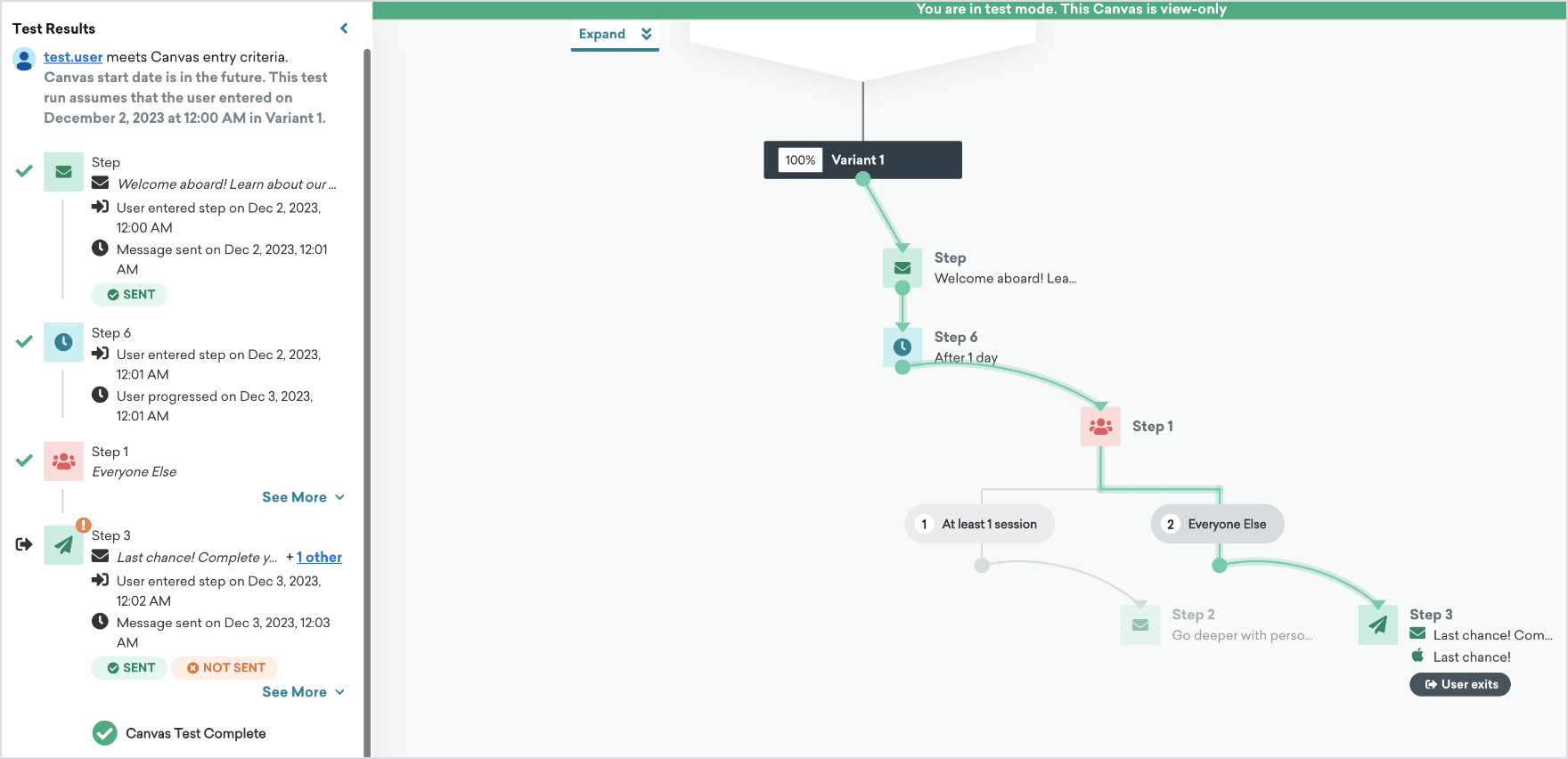
For a high-stakes journey, keep an explicit scenario matrix. Record the expected path for a returning user, a new user, an unsubscribed user and a user who converts during a delay. If the team can't explain the exit conditions in plain language, it isn't ready to launch.
The main operational weakness isn't unique to Braze. Any visual journey builder can hide complexity behind connectors and branches. A marketing ops lead shouldn't review only the campaign screenshot; the underlying event contract and the audit trail of changes matter just as much.
How strong are Braze segmentation and personalization?#
Braze segmentation can react to changing user attributes and behavior. Liquid personalization adds conditional content, but both features depend on clean identity resolution and stable field definitions.
Braze clearly documents that segments update in real time as data changes. Filters can combine conditions with AND and OR logic. That flexibility creates an easy-to-miss risk: a negative condition combined with OR can admit people the marketer intended to exclude. A segment QA process shouldn't stop at reading the filter builder; it should test actual sample users.
Liquid templates can insert profile attributes, custom attributes and event properties. They can also use Connected Content to fetch external information. A marketer might use this for a localized offer, a renewal date or a product recommendation. Each dynamic field adds a dependency, so teams shouldn't skip tests for missing values and fallback copy.
A useful personalization audit asks whether the message would still be accurate when the source value is blank, stale or changed between entry and send. If the answer is no, don't let the campaign ship with only a happy-path preview.
A common mistake is treating a segment as a fixed audience list. Dynamic segments change as data changes. That's often what you want for lifecycle messaging, but it complicates reporting if an analyst later tries to reproduce who qualified at a specific moment. Preserve the event and segment definitions alongside campaign results.
Where does Braze fit in a modern marketing data stack?#
Braze sits downstream of customer events and upstream of message delivery. It can receive warehouse data, trigger journeys and export engagement events, but the data flow still needs monitoring outside Braze.
Cloud Data Ingestion supports connections from sources such as Snowflake, BigQuery, Redshift and Databricks. It can sync user attributes and events on a schedule or on demand. The official documentation distinguishes ordinary ingestion from Connected Sources, which can query warehouse data without copying the underlying data into Braze.
Currents streams engagement events to analytics and data partners. Braze notes that connector access depends on entitlements and that many higher-level packages include a connector. Don't assume the number of connectors, event classes or retention terms; you'll only know from the quote and entitlement sheet.
The operating design should have a named owner for each arrow in the data flow:
| Data flow | Owner to assign | Failure to test | Evidence to retain |
|---|---|---|---|
| Product events into Braze | Product engineering | Missing or renamed event | Event contract and test payload |
| Warehouse attributes into Braze | Data engineering | Stale or late sync | Sync timestamp and row counts |
| Braze audience into Canvas | Lifecycle marketing | Wrong eligibility rule | Segment definition and sample profiles |
| Braze message into channel | Channel owner | Consent or delivery suppression | Delivery and suppression records |
| Braze events into warehouse | Analytics engineering | Missing export or schema drift | Currents event receipt and reconciliation |
The important comparison isn't the number of logos on an integration page. It's the behavior under failure. A team should test delayed events, retries, duplicate IDs, schema changes and a broken export destination, then write down what it didn't expect. The resulting runbook should say who's paged, what can be replayed and what must be corrected by hand.
What are Braze's main limitations?#
Braze's limitations for buyers are primarily implementation load, reporting design, campaign complexity and opaque total cost. Its core features are broad, but breadth can shift work into data engineering and operations rather than eliminating it.
Implementation requires an event plan. SDK or API events, customer identifiers, consent flags and attribute ownership must be designed before lifecycle journeys become dependable. If the data team can't commit to those contracts, the marketing team will end up debugging messages instead of improving them.
Canvas governance takes discipline. Branching makes it possible to express sophisticated journeys, but it also creates paths that are hard to audit visually. Give every journey a named owner, a purpose, an exit condition and a change log, because nobody remembers why a branch exists after six months. Keep a small set of reusable QA scenarios.
Native reporting may not answer every finance question. Braze engagement reports can aggregate campaign and Canvas statistics. For cross-channel customer value, attribution and revenue analysis, buyers should confirm which events can be exported and whether the warehouse model can join them to business outcomes. Treat a message open as an engagement signal; it isn't proof of incremental revenue.
Message suppression can surprise operators. Braze documents that users may continue through Canvas even when global frequency capping suppresses a message. A later step can still run when the earlier message wasn't delivered. Test this in journeys where the order of messages matters, because it won't be obvious from the canvas.
Pricing needs a scenario model. A platform with a flexible action-credit pool still needs a budget owner. Request usage assumptions for each channel, a clear definition of active users and a way to forecast a launch that increases message volume. Without that, a low initial quote can be hard to compare with what you'll pay at renewal.
What do actual Braze reviews say?#
Braze reviews tend to praise cross-channel orchestration and audience targeting while raising concerns about complexity, reporting and cost. Treat them as directional themes.
TrustRadius displayed a score of 8.7 out of 10 from 352 reviews and ratings when checked on November 2, 2026. Its summary highlights segmentation and multichannel campaigns as positives, with reporting, Canvas navigation and price among the recurring concerns. The count changes often, so it's a snapshot, not a permanent score.
Capterra's Braze review pages include accounts from marketers who like combining app and web messaging, alongside complaints about email costs and configuration effort. Individual experiences differ by implementation scope, contract and team maturity, so they aren't a forecast for your rollout. Review-site anecdotes aren't verified performance tests and shouldn't be converted into universal claims.
A useful way to read these reviews is by role. A campaign manager may value the Canvas editor. An analyst may be more concerned with export granularity. An engineering lead may care about SDK maintenance, event rate limits and user identity. Ask each function to rate the same trial scenarios, rather than accepting one team's favorable demo as a company-wide verdict.
How much does Braze cost?#
Braze doesn't publish a public US dollar price list on its pricing page. It describes Braze Go, Braze Select, Braze Pro and Braze Enterprise editions and asks buyers to request pricing. The platform's commercial model emphasizes monthly active users and Action Credits.
| Braze edition | Intended fit | Public price | Commercial question |
|---|---|---|---|
| Braze Go | Early-stage growth teams | Quote required | Which core channels and governance features are included? |
| Braze Select | Growing multichannel teams | Quote required | Which provisioning and orchestration capabilities change? |
| Braze Pro | Advanced personalization teams | Quote required | Which predictive and prioritization capabilities are licensed? |
| Braze Enterprise | Large-scale enterprise programs | Quote required | Which advanced experiments and infrastructure terms apply? |
Braze states that pricing scales with Monthly Active Users, and that Action Credits can be spent across channels and certain BrazeAI products. It also says it doesn't offer a free plan, although it mentions trials, startup programs and tailored entry plans. A free trial isn't the same thing as a permanently free tier.
Don't rely on generic annual-contract estimates from unrelated websites; they're guesses. The actual quote should specify the active-user measurement, credits, unit conversion by channel, data point treatment if applicable, add-ons, service scope, overage behavior and renewal mechanics. Ask for a worked example based on your own last-quarter volumes.
- Document the contracted MAU definition and measurement period.
- List every channel and its Action Credit consumption assumption.
- Identify optional Currents connectors and event entitlement pools.
- Confirm support, onboarding and migration responsibilities.
- Model baseline, peak and growth usage with an overage scenario.
- Record the renewal date, notice requirement and pricing adjustment language.
- Ask for a sandbox or trial that covers the actual integration path.
A fair comparison normalizes cost by the job performed. Email-only vendors may look cheaper because they don't include the same app messaging and decisioning scope. Conversely, Braze can look attractive in a feature matrix while carrying more engineering effort than a smaller team can support. Put implementation labor beside the license quote.
For the full edition, credit and contract detail, see our Braze pricing breakdown.
What changed in Braze in October 2026?#
Braze's October 15, 2026 release notes list AI decisioning, message prioritization and observability features. Buyers should distinguish generally available capabilities from beta features and confirm which edition grants access.
Braze listed Decisioning Studio Go as generally available for recurring email programs. It also listed Content Optimizer and Message Prioritization as generally available. Agentic Standards was listed as beta, which means a buyer shouldn't treat it as a universally available production control.
The operational significance is more important than the feature names. Per-recipient optimization increases the need for a clean control group and measurement plan. Prioritization changes how competing sends are resolved. Observability can help operators investigate a journey, but it doesn't excuse missing ownership for the underlying event stream.
Ask the vendor to show these features in the edition you're considering. If the demo uses a feature not included in your quote, write that discrepancy into the evaluation record before procurement. A feature's public launch status doesn't tell you it's available in your account or region.
How should you compare Braze with Iterable, Customer.io and Klaviyo?#
Braze, Iterable, Customer.io and Klaviyo can all support lifecycle messaging, but they serve different buying contexts. The right choice depends on channel breadth, data integration, team size and the complexity of the journeys you're actually running.
| Option | Where to focus evaluation | Reason to shortlist | Reason to pause |
|---|---|---|---|
| Braze | App and web lifecycle orchestration | Cross-channel Canvas and data activation | Quote complexity and integration ownership |
| Iterable | Cross-channel campaign orchestration | Alternative enterprise journey model | Verify event ingestion, governance and commercial terms |
| Customer.io | Event-triggered messaging | Consider for leaner product-led lifecycle teams | Compare advanced governance and channel needs |
| Klaviyo | Commerce-centered messaging | Evaluate for commerce segmentation and campaigns | Confirm fit for complex app-led orchestration |
No vendor here is universally cheaper or faster. A credible bake-off gives each vendor the same event payload, audience rule, consent requirement and reporting output. Then compare what the team could actually build, test and maintain.
If Iterable is on your shortlist, our Braze vs Iterable comparison covers pricing, features and buyer fit side by side.
How should a team run a Braze proof of concept?#
A Braze proof of concept should reproduce a real customer journey and its failure modes, not just show a successful send. The test should cover data arrival, audience eligibility, personalization, suppression, delivery and event export.
Start with a journey whose success condition can be observed outside Braze. An onboarding milestone or reactivation event is usually easier to inspect than a broad brand campaign. Use synthetic profiles and controlled test data; don't use live customer data where it isn't needed.
- An identified user enters the correct segment after a valid event.
- A duplicate or malformed event doesn't create an unintended send.
- An unsubscribed profile receives no promotional message.
- A missing personalization field uses approved fallback copy.
- A frequency-capped user follows the expected downstream path.
- A late warehouse sync doesn't silently corrupt eligibility.
- The warehouse receives the expected engagement event from Currents.
- A campaign change has an owner, approval and rollback note.
- Finance can reproduce the usage estimate from source volumes.
Assign owners before the demo: marketing ops owns the journey and campaign QA, engineering owns the SDK or API, data engineering owns warehouse sync and analytics owns outcome measurement. Procurement owns the quote comparison. A single enthusiastic administrator can't substitute for all of those roles.
Keep a test log with the input payload, expected result, observed result, timestamp and responsible owner. When something fails, record whether it was a product limitation, a missing entitlement, a data contract problem or a configuration error. The distinction matters because each category has a different fix and cost.
What does Braze not monitor for you?#
Braze doesn't replace independent checks of landing pages, form submissions, tracking tags and CRM lead routing. Braze manages engagement workflows, while campaign reliability monitoring tests whether the broader acquisition-to-handoff path still works.
A lifecycle message can be delivered perfectly even when the upstream lead source was misattributed or a downstream CRM integration stopped creating records. Those failures may sit outside the engagement platform, where Braze can't see them. Marketing ops teams should keep synthetic journey checks and incident ownership separate from campaign creation.
The Marketing Ops Manager, our own product, focuses on scheduled checks of campaign journeys and evidence-backed incidents, rather than creating Braze campaigns. It's a complementary monitoring workflow, not a Braze replacement, and it works in Claude and ChatGPT through MCP while a named person approves any change.
Who should buy Braze, and who should skip it?#
Braze is a sensible shortlist candidate for teams with meaningful owned-channel volume, reliable product events and dedicated lifecycle operations. Smaller teams with email-only requirements or uncertain data ownership should test simpler options first.
Choose Braze when: mobile or web behavior drives messaging, channels must work together and the business can staff data integration and campaign QA. The strongest justification is a journey you can't deliver reliably with disconnected point tools.
Pause the purchase when: the CRM data is inconsistent, event naming changes without notice, the team can't identify a consent owner or finance can't model usage. Buying a more capable orchestration platform won't fix those prerequisites, and it's expensive to learn that late.
Skip Braze for now when: your actual requirement is a newsletter, a few scheduled emails or a basic form-to-CRM nurture. The extra orchestration only earns its cost when the team can use it and maintain it.
The final decision should be based on a witnessed acceptance test and a written quote. Don't confuse a polished vendor demo with evidence that the platform will run cleanly inside your data stack.
Braze review FAQ#
Braze buyers often ask about the platform's learning curve, pricing, integrations and reporting. The answers separate documented platform behavior from decisions that depend on your contract.
Is Braze good for email marketing?
Braze supports email campaigns and can coordinate email with push, in-app messaging and other channels. If email is your only requirement, compare the operating overhead with an email-focused platform.
Does Braze have a free plan?
Braze doesn't offer a free plan according to its current pricing FAQ. The same FAQ mentions trials and startup programs, so ask which scope applies to your account.
Does Braze require developers?
Braze campaigns can be operated by marketers, but a dependable event-driven setup usually needs engineering ownership for identity, events and integrations. The amount of work depends on your existing stack.
Can Braze export events to a warehouse?
Braze Currents can stream engagement event data to warehouses and analytics partners. Confirm connector entitlements and event classes in the proposed package.
Does frequency capping stop a Braze Canvas?
Braze documents that global frequency capping can skip a message while the user continues through Canvas. Test the next step whenever message order matters.
Is Braze better than Iterable?
Braze isn't automatically better than Iterable. Compare the same event payload, consent rule, channel sequence, reporting output and commercial scenario before choosing.