Braze vs Iterable comes down to the data flow and the team running it. Choose Braze when mobile and product events drive complex, cross-channel journeys and you need a strong event-export pipeline. Put Iterable on the shortlist when lifecycle marketers own email-led programs, want flexible journey building, and already rely on a warehouse or customer data stack. Both can absolutely run substantial omnichannel programs. Neither deserves a win merely because a feature appears on a comparison checklist.
The important questions are operational. You need to know when a new event reaches a segment, whether your team can debug a missed trigger, who owns the identity mapping, and what the quote includes after adding channels, exports, AI, and support. This comparison separates documented capabilities from questions that require a vendor demonstration.
 Choose Braze when
- Mobile and in-app messaging are central to retention
- Your data team wants continuous engagement-event export through Currents
- You can support SDK, identity, and Canvas governance
 Choose Iterable when
- Lifecycle marketers own a broad email and messaging program
- Smart Ingest and journey-level live data fit your architecture
- You want built-in experiments and marketer-editable message workflows
Braze vs Iterable at a glance#
Braze and Iterable both support behavior-triggered customer messaging, but they expose different implementation choices. The table reflects documented features, not a universal performance ranking. A missing public price isn't evidence that one product is cheaper.
| Tool | Primary buyer fit | Journey workspace | Warehouse import | Outbound event data | Personalization language | Public US list price |
|---|---|---|---|---|---|---|
| Braze | App-led cross-channel engagement | Canvas | Cloud Data Ingestion | Currents continuous stream | Liquid and Connected Content | Not published |
| Iterable | Lifecycle and cross-channel marketing | Studio journeys | Smart Ingest | Data Sync and webhooks | Handlebars, Data Feeds, Live Data | Not published |
The short answer: Braze has a clearly documented continuous event-export product. Iterable has documented journey-level external-data retrieval and a warehouse import path. Those aren't mutually exclusive capabilities, and they shouldn't be confused with the speed of a warehouse batch sync.
A proof of concept should compare the same journey on both products. Use a real event, the same suppression rule, the same channel preference, and a shared definition of conversion. Otherwise, you're comparing demos rather than the operational system your team will maintain.
How do the data pipelines differ?#
A customer engagement platform sits between behavioral data and the next customer action. The pipeline's only as reliable as its weakest handoff: event collection, identity, profile update, audience decision, channel delivery, and reporting.
- 1Collect
- Braze
- Iterable
Breaks when Capture the event and a stable user identifier; reject anonymous-to-known mismatches. - 2Activate
- Braze
- Iterable
Breaks when Check whether the event arrives by SDK, API, or scheduled warehouse sync. - 3Orchestrate
- Braze
- Iterable
Breaks when Apply entry, suppression, frequency, and preference rules before sending. - 4Verify
- Braze
- Iterable
Breaks when Reconcile sends, skips, downstream events, and business outcomes.
For Braze, a typical product-led path starts with an app or web event. The profile and journey logic then determine whether the customer enters Canvas and which message they receive. Braze also supports warehouse ingestion. That path isn't automatically instantaneous: the official Cloud Data Ingestion documentation describes scheduled or on-demand syncs.
For Iterable, Studio can orchestrate triggered messages, while Smart Ingest imports warehouse data. Iterable also documents API-triggered campaigns and Live Data inside journeys. The latter retrieves temporary external data at the decision point. That means an Iterable journey needn't wait for a scheduled profile refresh when the specific decision can use a supported Live Data call.
The marketing ops test: Draw a box around each system that can change eligibility. Then name the owner, expected latency, retry behavior, and failure alert for every arrow. If nobody owns the gap between the warehouse and the journey, a polished campaign editor won't fix it.
Which platform is better for journeys and channels?#
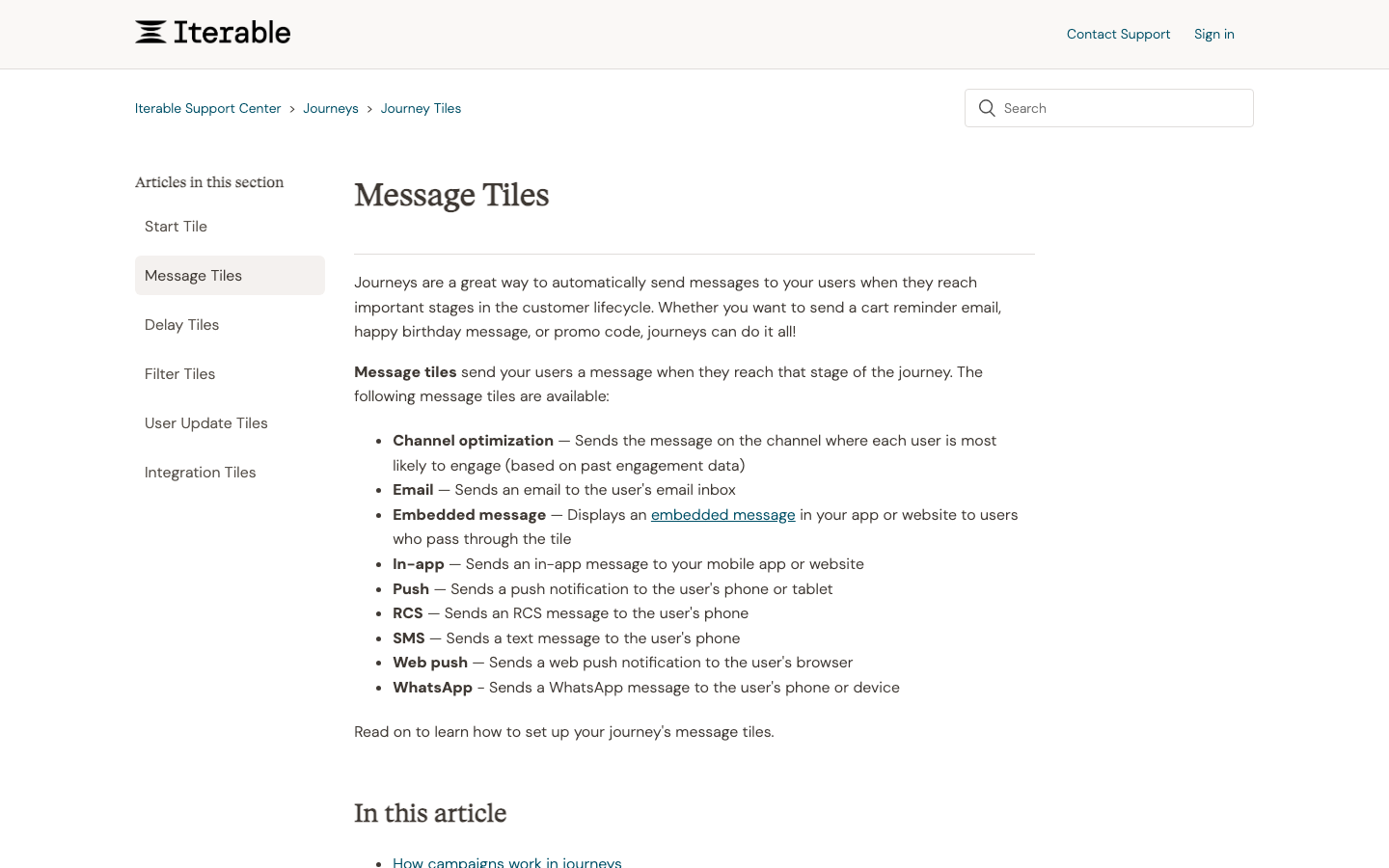
Both can coordinate email, push, SMS, in-app, web push, and WhatsApp. Iterable isn't an email-only product and it doesn't lack native WhatsApp. Its 2026 documentation lists WhatsApp among its message tiles, and its September product announcement describes it as an available add-on.
Braze's pricing documentation lists email, push, SMS, MMS, RCS, WhatsApp, in-app messages, banners, and Content Cards. Its Canvas workspace is especially relevant when product surfaces and mobile behavior belong in the same engagement strategy. For a subscription app, that might mean showing an in-app prompt, waiting for a qualifying action, and suppressing a redundant push.
Iterable Studio organizes entry rules, delays, messages, profile updates, and branching in journeys. Its message-tile documentation includes channel optimization, which can choose among supported channels based on engagement. The documentation notes that channel decisioning currently works only for email, SMS, and push. Iterable's campaign experiments can test messages and select a winning variant. That's useful for a lifecycle team that wants experimentation inside the regular production workflow.
Don't select a winner based on the longest channel list. Ask each vendor to show your actual fallback logic: a customer opted out of SMS, has no current push token, and already completed the desired action. The journey should avoid the unnecessary email, the operator should be able to explain why, and the team should be able to prove that suppression survived a profile merge.
Where Braze fits best#
Braze fits organizations where product instrumentation, real-time engagement, and governed cross-channel execution are closely connected. Its strength isn't simply sending more kinds of messages. It's keeping product activity, journey decisions, and event exports in a coherent operating model.
Braze
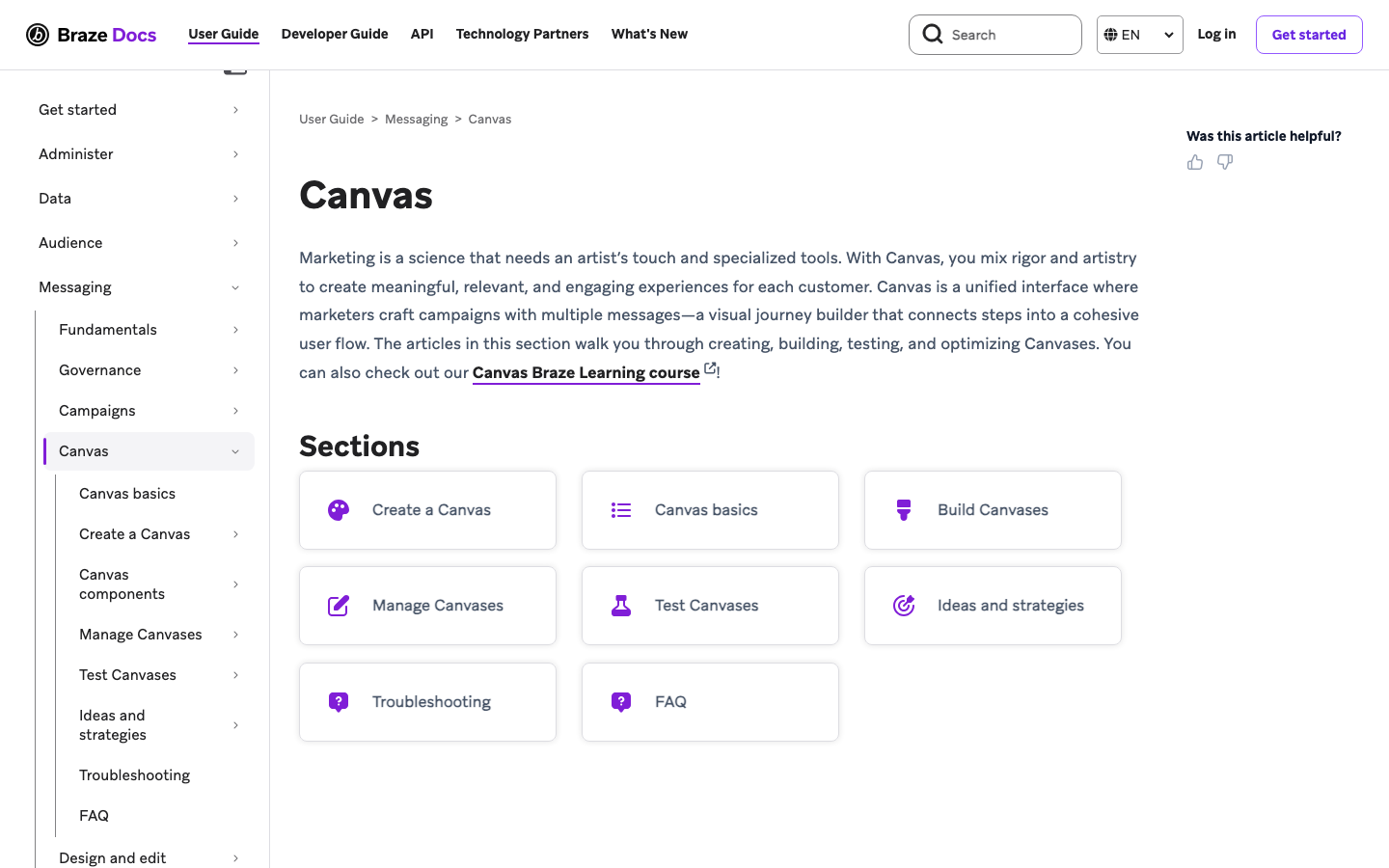
Braze is a customer engagement platform built for consumer apps: events from Braze's SDKs, its API or a warehouse sync trigger Canvas journeys across push, in-app, email, SMS and WhatsApp.
A strong fit for mobile-led teams that can invest in data instrumentation and cross-channel operations.
- mobile events and in-app experiences drive retention
- engineering can own SDK events, identifiers, and monitoring
- continuous engagement-event export is a selection criterion
- the program is limited to basic email sequences
- you need a fixed public US price before vendor contact
- nobody can maintain the event and identity contract
- Users like
- Ease of use
- Users dislike
- Learning curve
- Source: G2, 1,971 reviews
How it works in practice
In a practical evaluation, send a test event from an instrumented app, follow its user identity into Canvas, and verify the expected branch and suppression. Then confirm whether Currents exports the engagement event to your destination. Ask the vendor to show the exact entitlements in your proposed edition.
Braze's current pricing page lists Go, Select, Pro, and Enterprise editions. It also advertises a free trial, but it doesn't publish a complete US dollar rate card. Don't turn the existence of a trial into a promise that every enterprise feature is included.
- Starting price
- Quote only (Go, Select, Pro, Enterprise editions, priced on monthly active users plus message credits)
- Channels
- Email, SMS, MMS, RCS, mobile and web push, in-app, Content Cards, WhatsApp, LINE, webhooks
- Journey builder
- Canvas
- Pricing metric
- Monthly active users and profiles, plus Action Credits
- Warehouse input
- Cloud Data Ingestion
- Event export
- Currents
- Commercial model
- Edition, monthly active users, Action Credits
A meaningful downside is operational weight. If events arrive with inconsistent IDs or campaign teams don't understand Liquid and branching, the platform can amplify bad targeting.
Braze's pricing page describes Monthly Active Users and Action Credits as separate scaling dimensions. That matters for teams whose audience is steady but channel usage grows. Model a heavy-message month and a low-engagement month before accepting an annual commitment.
Where Iterable fits best#
Iterable fits teams that want marketers to own day-to-day journeys while still connecting to product, commerce, and warehouse data. Its documentation describes both scheduled warehouse ingestion and real-time decisions inside a journey. That distinction's more useful than calling the whole platform either batch-based or real-time.
Iterable
Iterable is a cross-channel marketing platform for B2C brands that runs event-triggered journeys across email, SMS, push, in-app and WhatsApp, fed by Iterable's API or a 15-minute warehouse sync.
A strong fit for lifecycle teams coordinating email and other channels with flexible data activation.
- marketers need to edit and test journeys regularly
- warehouse imports and event APIs are already part of the stack
- journey-level data retrieval helps with live eligibility decisions
- you need a published fixed price for procurement
- you expect warehouse sync alone to be instantaneous
- you can't assign an owner for identity, consent, and integration monitoring
- Users like
- Ease of use
- Users dislike
- Missing features
- Source: G2, 840 reviews
How it works in practice
During the proof of concept, trigger a journey with an API event, then use Live Data to retrieve a current eligibility value. Verify how the journey behaves when the endpoint times out, returns no match, or changes after entry.
Iterable's Smart Ingest is co-developed with Hightouch. The vendor says to discuss adding it with a customer success manager, so don't assume the capability is included in a base quote. Check whether your data source requires the Basic or Lightning sync engine and what permissions each needs.
- Starting price
- Quote only (no public pricing page)
- Channels
- Email, SMS, push, in-app, WhatsApp
- Journey builder
- Studio journeys
- Pricing metric
- Not published
- Warehouse input
- Smart Ingest
- External decision data
- Journey Live Data
- Commercial model
- Custom quote by audience, channels, and features
Iterable's email editor and template system deserve attention when the team has many languages, reusable components, and approval steps. Handlebars, snippets, catalogs, and data feeds support personalization. The operational risk's the same as with any sophisticated system: a template can be valid syntactically yet produce the wrong content when an attribute is absent.
Iterable's recent 2026 releases also matter for current buyers. Its release notes describe SMS support in Send Time Decisioning (October 6) and a Salesforce integration for inbound data (September 24, with outbound opt-in sync added in October). Confirm rollout and entitlement during a demo rather than assuming every account has every new feature enabled.
Braze vs Iterable pricing: what should buyers budget for?#
Neither vendor publishes a complete US dollar list price for an equivalent enterprise configuration. Braze explains its commercial structure; Iterable asks buyers to request a quote. Dollar estimates copied from third-party comparison sites aren't reliable substitutes for an itemized proposal.
Braze's current public editions are Go, Select, Pro, and Enterprise. Its pricing page says spend scales with Monthly Active Users, while Action Credits apply across channels and some AI functions. A buyer should ask which activities consume credits, whether unused credits carry forward, how overages work, and which capabilities require a higher edition.
Iterable's marketing automation page says quotes depend on audience size, channels, and required features. Its support documentation exposes usage by messaging channel, while Smart Ingest documentation asks customers to discuss access with their customer success manager. That makes the commercial question broader than the headline platform subscription.
| Quote component | Braze question | Iterable question |
|---|---|---|
| Audience | What counts as an active user? | Which profiles count and when? |
| Channel usage | Which sends and AI actions consume credits? | What are the message and provider charges? |
| Data movement | Is the required Currents connector included? | Is Smart Ingest included, and at what sync scope? |
| Governance | Which edition includes required permissions? | Which security and support terms are included? |
| Growth | What happens at the next usage threshold? | How does the quote change with more channels? |
For a credible total-cost comparison, add implementation work, email deliverability setup, template migration, QA, and ongoing data engineering. A cheap platform quote isn't cheap if every new campaign requires an engineer to repair events. Conversely, a broad platform isn't automatically worth its cost when most customers only receive a simple email sequence.
Braze's site advertises a free trial. The trial's scope and access terms still need confirmation. Iterable's public sales route is a demo and pricing estimate, not a published self-serve rate card.
Data freshness, warehouse sync, and reporting#
Warehouse ingestion speed and message-trigger speed are different metrics. A platform can react quickly to an API event while importing warehouse segments on a schedule. Ask for both timings and test them separately.
Braze's Cloud Data Ingestion documentation describes recurring syncs as often as every five minutes with vendor assistance. The default shortest dashboard interval is fifteen minutes. On-demand syncs can also run after a warehouse job finishes. Those figures apply to that ingestion path, not to every Braze SDK event.
Iterable's Smart Ingest documentation says scheduled syncs can run as often as every fifteen minutes. It uses change data capture to send new or updated records. Iterable also documents Live Data in journeys, which can retrieve external values at the moment a branch or message needs them. Those mechanisms solve different problems.
On the export side, Braze Currents is described as a continuous engagement-event stream to warehouses and analytics partners. Iterable's 2026 release notes describe Data Sync exports to external storage and warehouses, and its system webhooks cover message events. Don't assume identical delivery guarantees, schemas, or event timestamps. Request a sample payload and a replay procedure from each vendor.
A useful data-contract test has four checks: identity, freshness, completeness, and reconciliation. Identity means the same customer is recognized across app and email. Freshness means an updated eligibility value arrives before the decision. Completeness means you can account for skipped and failed sends. Reconciliation means the warehouse can match platform events to the original campaign and customer record.
If a stakeholder asks which platform has better reporting, answer with the intended question first. Campaign dashboards can tell you what was sent. Finance or product analytics may need a more complete view of retention or revenue. Neither vendor's messaging dashboard should automatically become your sole source of business truth.
Which AI and experimentation features matter?#
Both vendors offer AI-related optimization, but the meaningful comparison is control over a decision. A marketer should be able to define the objective, the team should be able to explain the chosen audience or send time, and an analyst should be able to compare results against a holdout. Confirm that the feature is available in the quoted edition.
Braze's pricing page identifies predictive AI capabilities in its Pro edition description and advanced experimentation in Enterprise. It also lists broader AI features across the platform. These statements don't prove that every capability is included without usage or entitlement limits. Ask for a plan-specific matrix, especially for agent-driven decisioning.
Iterable's product overview documents campaign experiments and automatic winner selection. Its October release notes say Send Time Decisioning expanded to SMS, with phased rollout. Its July release notes describe journey Live Data as generally available. Those details are more useful than a generic claim that Iterable has an AI suite.
Test both tools on the same eligible audience with a control group and a predeclared business outcome. Open rate isn't the same as incremental revenue. A result that looks impressive in a vendor dashboard still needs a defensible attribution window and consistent exclusions.
Does the announced Salesforce acquisition change the decision?#
Salesforce announced an agreement to acquire Braze on October 20, 2026, but the transaction hasn't closed. The announcement says completion is expected in Salesforce's fiscal 2028, subject to approvals. Buyers should treat future product integration as a possibility, not a feature available today.
The practical impact is procurement diligence. Ask Braze to document the current product roadmap, support obligations, data portability, and any contract provisions that could matter after a change of control. Ask Iterable to demonstrate its own Salesforce data path, including the inbound integration described in its fall 2026 release notes.
A planned acquisition shouldn't be the only reason to select or reject a platform. A platform that meets your channel, identity, and operational requirements today may remain the better choice. Don't credit either vendor with future capabilities until they're released and contractually available.
What would a fair proof of concept look like?#
A fair test starts with one customer journey and a small set of events, not a polished vendor sample. Choose a workflow with a measurable business outcome, such as trial activation or abandoned checkout recovery. Use the same data definitions and acceptance criteria for both platforms.
Define the identity contract
Specify the primary user ID, anonymous-to-known merge behavior, consent fields, and expected source systems.
Connect a real event
Send the same sample behavior through each supported event path and capture ingestion timestamps.
Build the journey
Add entry conditions, a suppression rule, a channel fallback, and an experiment or control group.
Break one dependency
Delay a warehouse sync or return an empty external-data response. Observe the operator alert and recovery path.
Reconcile the outcome
Compare sends, skips, conversions, and export records against a common source of truth.
The test should include negative cases. A customer who unsubscribes mustn't be sent the marketing message. A duplicate event mustn't create an unwanted second journey entry. A stale product attribute mustn't trigger a discount that no longer applies. If the platform can't show why a customer did or didn't receive a message, the team will struggle during a production incident.
Assign ownership before the test. Marketing owns the campaign rules and copy. Engineering owns event quality and the data contract. Security or privacy owns consent requirements. Analytics owns the outcome definition. Procurement owns the scope of the quote. This division prevents the common mistake of buying a powerful journey builder without funding the systems around it.
- Same sample customer and event in both systems
- Identity mapping and consent demonstrated
- Journey entry, suppression, and fallback verified
- Warehouse import timing measured separately from API triggers
- Outbound event export and failure handling demonstrated
- AI and experimentation entitlements shown in writing
- Quote includes data movement, support, overages, and renewal terms
Who should choose Braze or Iterable?#
Choose Braze for an app-led engagement operation where SDK events, product surfaces, and continuous event export matter most. Choose Iterable when lifecycle marketers need flexible cross-channel journeys, reusable content, and a practical connection to existing warehouse data. Neither's the default choice for a team that only needs a simple newsletter tool.
Don't let a polished demo decide this for you. If your data team can't commit to instrumentation work early, that's worth weighing before either contract is signed, and it isn't a question of which tool is more powerful. What matters is which one your team doesn't have to fight every week. Ask both vendors what they won't cover in the first rollout, because that's where hidden cost tends to sit, and get the answer in writing before signing. Don't skip that written scope, since it's the one record that doesn't change when the sales contact does, and it isn't something a demo can replace.
- Mobile app retention with in-app and push journeysBraze
- Continuous engagement-event stream is a hard requirementBraze
- Marketer-owned lifecycle journeys with reusable templatesIterable
- Journey decisions that retrieve external data on demandIterable
The deciding factor is often what breaks after launch. If your campaign fails because a user identity changed, neither vendor fixes your governance automatically. If your audience was selected from yesterday's warehouse table, a fast journey engine won't make the input fresh. If a team can't reproduce a missed send, more AI features won't repair its incident process.
For marketing operations, the durable purchase is the platform plus a documented operating model. Demand the same evidence from both vendors: real event timestamps, suppression proof, export samples, feature entitlements, and a complete commercial schedule. The vendor that can meet those conditions with the least organizational friction is the better fit.
Frequently asked questions#
Is Braze better than Iterable?
Braze is a strong fit for app-led, event-driven engagement and continuous event export. Iterable is a strong fit for marketer-owned lifecycle journeys and flexible data activation. The better choice depends on your architecture and operating team.
Does Iterable support WhatsApp and mobile push?
Yes. Iterable documents WhatsApp, push, in-app, SMS, web push, and other message tiles. WhatsApp is described as an add-on, so confirm commercial access.
Does Braze have a free trial?
Braze advertises a free trial on its pricing page. Confirm the trial's scope and feature access before assuming it covers your enterprise evaluation.
How much do Braze and Iterable cost?
Neither publishes a complete comparable US price list. Braze explains editions, active users, and Action Credits; Iterable quotes based on audience, channels, and features.
Can Iterable use real-time data?
Yes. Iterable documents API-triggered campaigns and Live Data inside journeys. Its Smart Ingest warehouse imports run on a schedule, which is a separate latency path.
Has Salesforce acquired Braze?
Salesforce announced a definitive acquisition agreement on October 20, 2026. The deal was not yet closed as of October 31, 2026 and remains subject to closing conditions.