RevOps, short for revenue operations, is the function that aligns the data, processes and systems of marketing, sales and customer success so the whole customer journey runs on one set of numbers. Instead of each team tuning its own tools and definitions, one group owns the handoffs between them.
For marketing operations people the practical question is where the line sits. Marketing ops keeps the marketing systems working, and that's a different job. RevOps owns what happens when a lead, a deal or a customer moves from one team's system to the next.
- RevOps (revenue operations) aligns marketing, sales and customer success around shared data, processes and goals. Salesforce also counts finance.
- Marketing ops runs marketing systems and sales ops runs sales systems. RevOps owns the handoffs and metric definitions across both.
- HubSpot describes four pillars: operations, enablement, insights, and tools and technology.
- Typical signals: teams argue about whose numbers are right, handoffs drop leads, and forecasts need manual cleanup.
- Start with one written definition per handoff, one owner, and one system of record.
What is RevOps?#
RevOps is a cross-functional function that aligns sales, marketing and customer success, and in some definitions finance, around shared data, processes and goals. The aim is predictable revenue growth rather than the best result in any single team.
Publishers phrase it differently, and the differences matter:
- Salesforce calls it a framework that brings all revenue-related activities under one umbrella with consistent processes and technology, and it names marketing, sales, customer success and finance as the teams involved.
- HubSpot defines it as aligning sales, marketing and customer success around shared data, processes and goals.
- TechTarget describes it as integrating sales, marketing and service for an end-to-end view of revenue, while day-to-day processes stay inside each department.
- Forrester frames it as a commercial execution strategy that aligns data, process, technology and people across the customer lifecycle.
Here's the common thread: it's the handoff. A marketing team can run a flawless campaign and still lose the lead between the form, the CRM and the sales team's queue. That's the path RevOps exists to own.
Forrester says the idea began circulating in the early 2000s as buyer behavior shifted and siloed operations functions failed to deliver value. It launched a dedicated revenue operations research service in June 2023.
RevOps isn't a tool category, a replacement for the marketing, sales or service teams, or a rebrand of sales operations. Salesforce treats sales operations as a subset of RevOps, while HubSpot lists it as a separate team with a narrower scope. The two sources clearly disagree on that one point, but both agree RevOps covers more of the journey, and neither says it's a tool.
What does a RevOps team do?#
A RevOps team owns four things across the revenue teams: process, enablement, insights and technology. These match the four pillars HubSpot lists, and Salesforce's list of responsibilities covers the same ground, from aligning revenue teams to improving forecast accuracy.
| Job | Example task | What goes wrong without it |
|---|---|---|
| Process | Write one lead-to-renewal flow with a named owner for every handoff | Each team works from its own process and leads stall between them |
| Enablement | Train reps and marketers on shared fields, stages and rules | Data entry differs by person, so reports can't be trusted |
| Insights | Define pipeline and funnel metrics once and publish the reports | Marketing, sales and finance each show a different number |
| Technology | Keep the CRM, automation platform and data connections consistent | Tools drift apart and nobody knows which system is the source of truth |
Salesforce also lists streamlining and integrating the revenue technology stack, consolidating revenue data and strategic planning. In smaller companies one or two people handle all of it, which isn't unusual. Larger companies split it by specialty because one person can't cover everything.
How is RevOps different from marketing operations and sales operations?#
RevOps owns the shared revenue system. Marketing operations improves campaign execution, and sales operations improves sales execution. Rework describes it as a difference of scope: each ops team optimizes its own function, while RevOps improves the handoffs, definitions, data and operating rhythm that connect them.
HubSpot adds who reports to whom. Sales ops reports to the sales leader, marketing ops reports to the CMO, and RevOps covers first touch through renewal and reports to the CRO or CEO.
| Marketing operations | Sales operations | RevOps | |
|---|---|---|---|
| Scope | Campaigns, lead scoring, automation, attribution | Pipeline, quotas, CRM hygiene, forecasting | First touch through renewal across all teams |
| Typical systems | Marketing automation, forms, analytics, ad accounts | CRM, sales engagement, quoting | The shared layer: CRM objects, definitions, integrations, reporting |
| Reports to | CMO | Sales leader | CRO or CEO |
| Owns | How a campaign is built, tracked and measured | How a deal moves through the pipeline | The rules that decide what a lead, an opportunity and a customer are |
Here's where the table comes from: HubSpot, "What is revenue operations", updated July 2026, and Rework, updated June 2026.
Where the reporting line sits matters a lot too. Rework notes that RevOps works best under a cross-functional leader such as a CRO, COO or CEO, because a RevOps team that sits only under sales or only under marketing can lose the trust of the other side. TechTarget adds that it can also sit under the CFO in some companies.
If you work in marketing ops, the practical effect is a shared contract: you're still the expert on campaigns and tracking, and RevOps owns the field definitions you both rely on. Our guide to what marketing operations is covers the six jobs marketing ops keeps.
Where do the systems of the three teams disagree?#
The three systems disagree about the same lead, because each one keeps its own record of it. Say a contact downloads a guide, talks to sales and later signs a contract. The marketing platform may still list the contact as a marketing qualified lead, the CRM shows an open opportunity, and the billing system has already created a customer. A report built from each system gives a different answer to "how many leads converted?". That's where the numbers split.
- Step 1Marketing platformRecords Lead stage: marketing qualified, last touch is the guide download
- Step 2CRMRecords Opportunity stage: proposal sent, owner is a named rep
- Step 3Billing and supportRecords Customer, plan and start date
- Across allRevOps decisionSettles Which stage counts as converted, which system wins, who fixes a mismatch
The lead example above is an illustration, not a quoted case, but it's the pattern the sources describe. Rework lists these signs, and you'll recognize them if you've sat in a forecast meeting: marketing and sales dispute lead quality, sales leaders distrust the CRM pipeline, finance keeps a separate forecast, and customer success receives incomplete handoffs. In every one of them the data isn't wrong in any single tool, and the definitions simply differ between tools.
Our guide to lead management software shows how that handoff works in several tools, and the UTM naming convention guide covers the tracking side that has to survive each step.
When does a company need RevOps?#
A company usually needs RevOps when problems at the handoffs keep coming back and no single team can fix them alone, because they don't belong to any single team. HubSpot lists three signals: inconsistent data, broken post-sale handoffs or unpredictable revenue; leadership debating whose numbers are right; and three or more disconnected point solutions in the revenue stack.
- Marketing and sales dispute what counts as a qualified lead
- Sales leaders don't trust the pipeline numbers in the CRM
- Finance keeps its own forecast because the CRM forecast is unreliable
- Customer success receives accounts with missing context from sales
- Forecast meetings are spent cleaning data instead of discussing deals
- Three or more tools hold part of the customer record and nobody owns the connections
The first five items come from Rework's list of warning signs and the last one is HubSpot's third signal. You don't need all six to be true. If two or three of them are, the cost is probably already visible in missed forecasts and slow follow-up, and it's worth a closer look.
There's also a too-early case, and it's very common. Of course, a small company doesn't need a department. A company with one product, one sales motion and a handful of people can often get the same benefit with a written lead definition and one person who's responsible for the CRM. The Pedowitz Group suggests that below about $10M in annual recurring revenue one person often covers marketing operations and RevOps together. Treat that as a rule of thumb. The deciding question is whether handoffs are breaking, not how large the company is, and it's one you can answer in a week.
How do you start with RevOps?#
You can start with RevOps without a new team: write down the definitions, assign one owner per handoff, pick a system of record for each object, and fix the worst handoff first. That order works because a new team or tool on top of disagreeing definitions only adds another layer.
Write one definition per stage
Agree in writing what makes a lead qualified, when it becomes an opportunity and when it counts as a customer. Put the definitions where all three teams can see them.
Name an owner for every handoff
For each point where a record moves between teams, name the person who fixes it when it breaks.
Pick a system of record
Decide which tool is the truth for each object and field, and make the others read from it rather than keep their own copy.
Fix the worst handoff and measure it
Choose the handoff that loses the most revenue, fix it end to end, and compare conversion before and after before moving to the next one.
Our marketing operations audit checklist is a good first pass for step two, because it lists every system and connection you'll have to cover.
Which metrics does RevOps track?#
RevOps tracks metrics that span teams rather than any one team's activity, and defines each of them once. You won't need all of them on day one. The aim is that marketing, sales, customer success and finance always read the same number, and nobody has to ask which version it is.
| Metric | The question it answers |
|---|---|
| Funnel conversion by stage | Where do leads and opportunities drop out between teams? |
| Pipeline coverage | Is there enough open pipeline to hit the target? |
| Win rate | How many qualified opportunities close? |
| Sales cycle length | How long does a deal take from first touch to close? |
| Forecast accuracy | How close was the forecast to the actual result? |
| Net revenue retention | How much revenue do existing customers add or lose? |
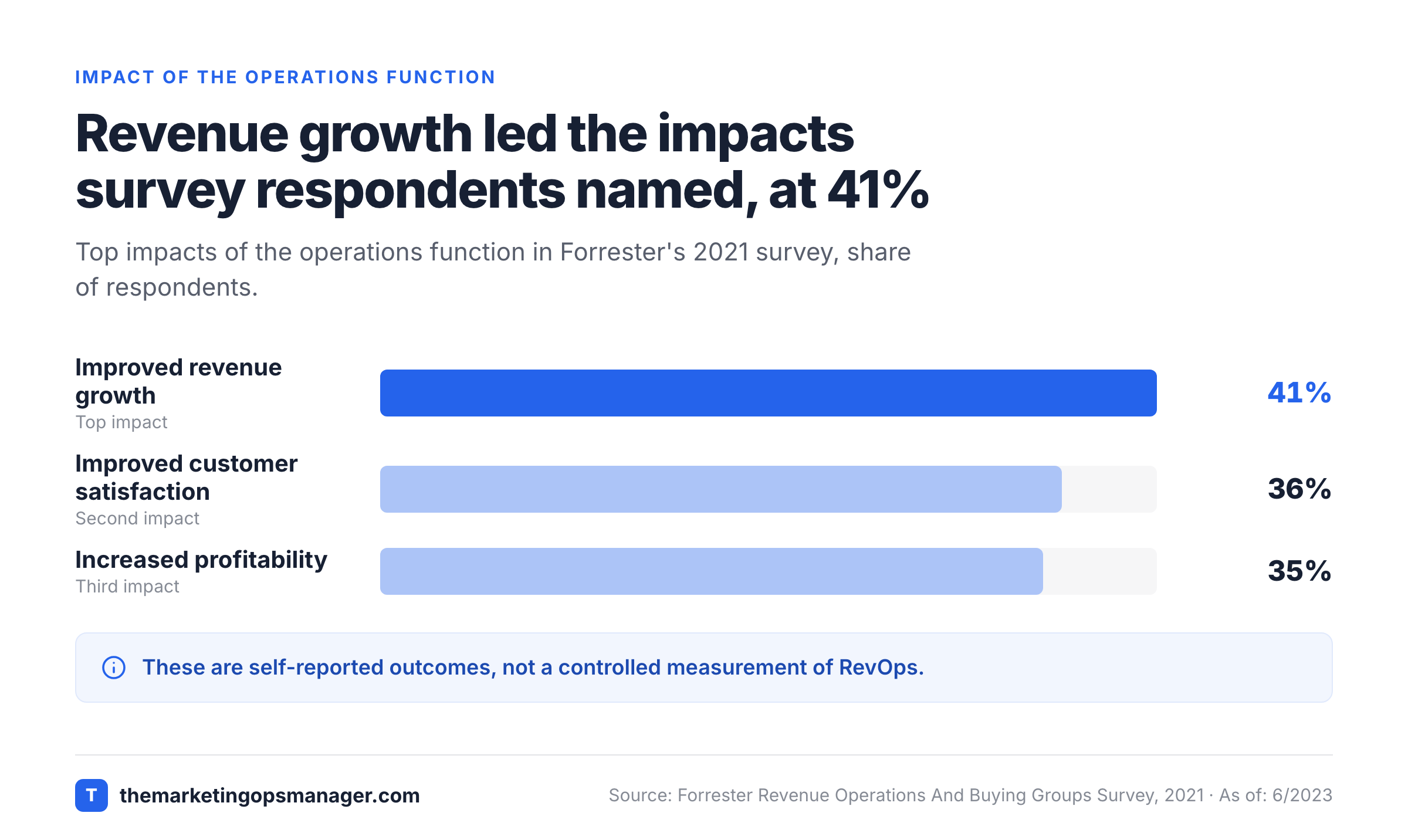
The impact data isn't deep. In Forrester's 2021 Revenue Operations and Buying Groups Survey, quoted in a June 2023 Forrester blog post, respondents named improved revenue growth (41%), improved customer satisfaction (36%) and increased profitability (35%) as the top impacts of their operations function. It's a survey of self-reported outcomes, not a controlled measurement.
What do RevOps jobs pay?#
RevOps roles run from analyst to manager to director, and US pay varies by source, city and seniority. HubSpot lists these titles: VP or Director of Revenue Operations, RevOps Manager or Analyst, and Systems Administrator, with the CRO as executive sponsor.
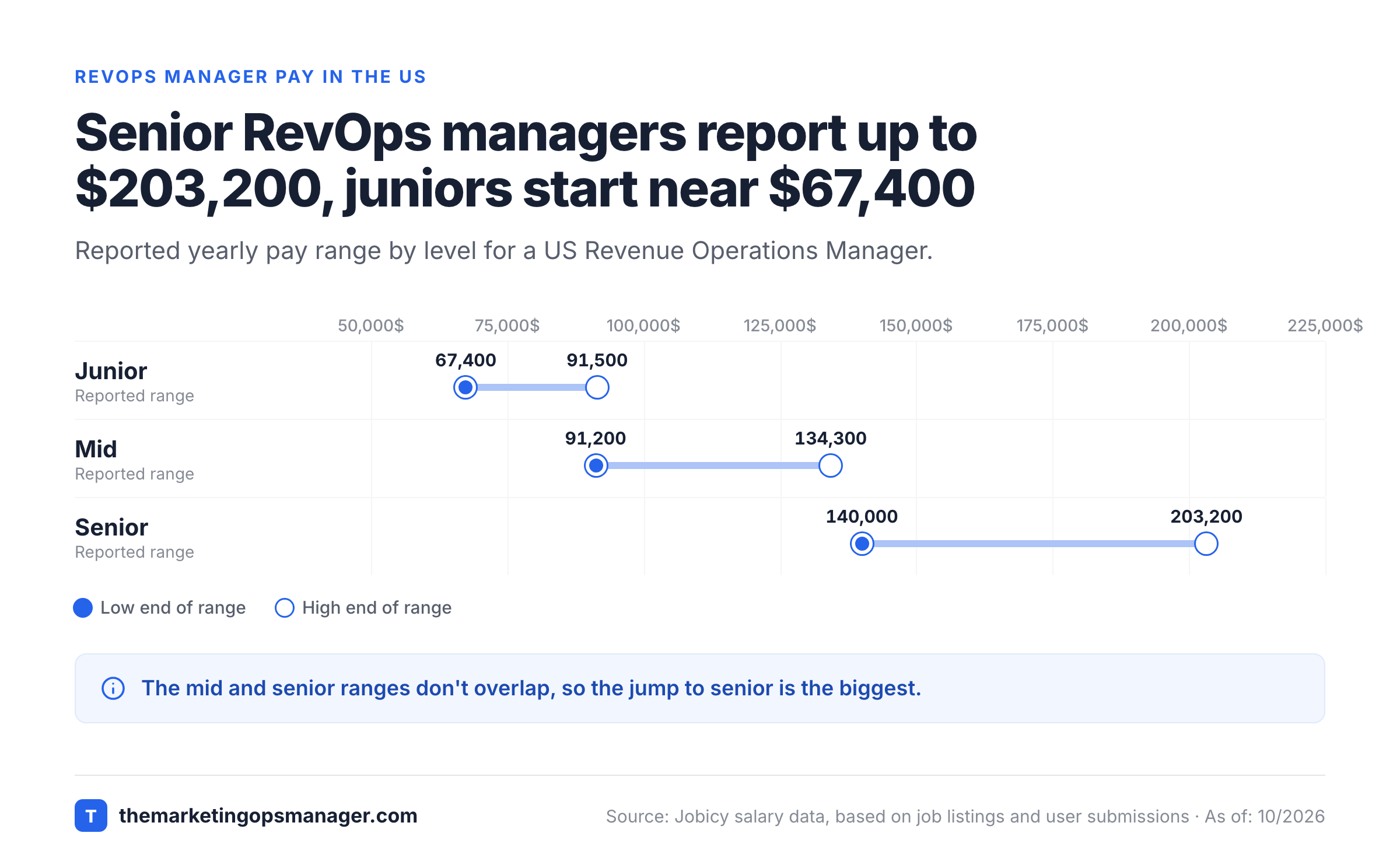
For pay, Jobicy reports an average of $113,700 a year for a US Revenue Operations Manager as of October 26, 2026, based on job listings and user submissions rather than government data.
| Level (as Jobicy defines it) | Reported US pay range (USD per year) |
|---|---|
| Junior | $67,400 to $91,500 |
| Mid | $91,200 to $134,300 |
| Senior | $140,000 to $203,200 |
A second data point comes from a Glozo report summarized by RevGuild: a median of $112,000 for the full US RevOps function across 2,211 postings in the first half of 2026. Only 43.1% of those postings disclosed pay, so both numbers likely lean toward employers that publish salaries. Use them as a starting range, and check what's posted in your own market.
Where an AI agent fits into the handoffs#
The handoffs are also where checking is repetitive. Whether a form still creates the right lead, whether the UTM survives the CRM sync and whether the sales owner is assigned can all be tested on a schedule, and nobody wants to do that by hand every week. Fixing a definition or a routing rule stays a human decision, and it shouldn't be automatic.
The Marketing Ops Manager monitors those handoffs between campaigns, tracking, forms and the CRM and opens an incident with evidence when one fails. It's not a RevOps platform, and it doesn't define your stages for you. It checks that the definitions you've set keep working.
FAQ#
What does RevOps stand for?
RevOps stands for revenue operations. It's the function that aligns marketing, sales and customer success operations around shared data, processes and goals, and in some definitions finance as well.
Is RevOps the same as sales operations?
No. Sales operations covers pipeline, quotas, CRM hygiene and forecasting for the sales team. RevOps covers the whole path from first touch to renewal. Salesforce treats sales operations as a subset of RevOps, while HubSpot lists it as a separate team.
Who does RevOps report to?
HubSpot says RevOps typically reports to the CRO or CEO. Rework says it works best under a cross-functional leader such as the CRO, COO or CEO, and TechTarget notes it may report to the CFO in some companies.
Does a small company need RevOps?
A small company usually doesn't need RevOps as a separate team. A written lead definition and one person who owns the CRM often cover it. The Pedowitz Group suggests one person can cover marketing operations and RevOps together below about $10M in annual recurring revenue.
How is RevOps different from marketing operations?
Marketing operations runs the marketing systems: campaigns, lead scoring, automation and attribution. RevOps owns the shared rules and handoffs across marketing, sales and customer success, so the two overlap but don't replace each other.
How much does a RevOps manager earn in the US?
Jobicy reports an average of $113,700 a year as of October 2026, and a Glozo report cited by RevGuild gives a median of $112,000 for the US RevOps function in the first half of 2026. Both come from job postings, so check what's listed in your market.