Braze pricing is custom-quoted, with no published US dollar rate for its Go, Select, Pro or Enterprise editions. The price depends on your platform edition, monthly active users, a shared pool of Action Credits and CX Services. Braze offers a trial, but it doesn't offer a permanent free plan. For a meaningful budget, request an itemized quote instead of treating a third-party annual estimate as a list price.
The central marketing operations question isn't simply what Braze costs. It's which customer activity, message volume and data flows the contract measures, and what happens when those change. A low initial license figure can still become a poor comparison if the proposal leaves out channel consumption, integrations, implementation or renewal terms.
How much does Braze cost?#
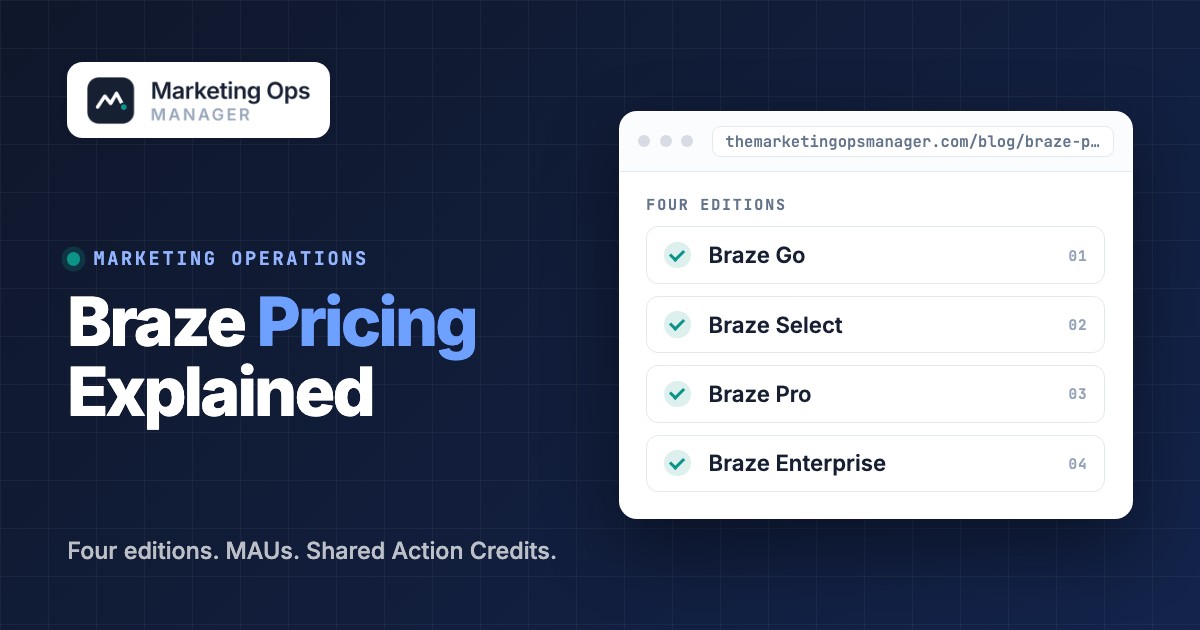
Braze doesn't publish a dollar price for any of its four current editions. The official US pricing page directs buyers to request pricing. It lists Braze Go, Braze Select, Braze Pro and Braze Enterprise, but not monthly or annual amounts. A quote must specify the actual edition, volume entitlements and contract period before you can calculate cost per active customer or per journey.
That means a claim such as "Braze starts at $X per month" isn't an official Braze price unless it's tied to an actual dated offer. Independent contract databases and consultants publish widely different spending estimates, yet their samples may mix company sizes, regions, legacy billing models and services. They don't tell you what your audience and channel mix will cost.
Use these three numbers in every buying conversation: the annual contracted amount in USD, the active-user allowance and the Action Credit allotment. Then ask for the unit prices and overage terms that connect them. Without those, the quote isn't comparable to another customer engagement platform.
- Braze GoCustom quote USD amount not published
- Core Braze features and functionality
- Entry point for personalized cross-channel engagement
- MAU, Action Credits and services scoped in order form
- Braze SelectCustom quote USD amount not published
- Everything in Go
- Increased orchestration capabilities
- Enhanced security and user provisioning
- Braze ProCustom quote USD amount not published
- Everything in Select
- Predictive AI and AI personalized recommendations
- Expanded dashboard user group administration and message prioritization
- Braze EnterpriseCustom quote USD amount not published
- Everything in Pro
- Enterprise-grade orchestration, infrastructure and governance
- Advanced experimentation with BrazeAI Agent Console
Braze's US pricing page lists four editions but no dollar amounts. Checked October 28, 2026. The feature descriptions are tier summaries, not a promise that every channel or add-on is included at unlimited volume.
Is there a Braze starting price or published annual minimum?#
There's no public Braze starting price or annual minimum on the US pricing page. A reported average contract isn't a guaranteed entry price. Published estimates vary sharply because the underlying audience, channels, support and contract vintages aren't standardized. Use them only as a reason to ask for a quote. They aren't a line item for your budget approval.
A procurement team shouldn't settle for one number. It should request the smallest eligible deployment and a realistic production deployment. The first might cover a narrow journey and limited audience; the second should cover your actual channels, projected active-user peaks and support needs. Ask whether the pilot price survives the transition to production and which assumptions trigger repricing.
Does Braze have a free plan or trial?#
Braze doesn't offer a free plan. Its pricing page links to a free trial and says companies can explore trials and tailored entry plans. Trial availability doesn't establish a universal trial length or production entitlement. Confirm the scope, permitted data, message limits and whether trial work can be transferred into the paid workspace.
For a serious evaluation, the trial should answer a technical question. Can you ingest the right events, resolve profiles, build a Canvas journey and reconcile delivery and conversion events with your warehouse or CRM? A trial that only demonstrates the editor doesn't validate your operating cost.
What is included in Braze Go, Select, Pro and Enterprise?#
The four editions describe growing capability, not four published price bands. Braze Go is the entry edition; Select adds orchestration and security controls; Pro adds predictive and recommendation features; Enterprise adds advanced governance and experimentation. The procurement distinction that matters is between platform capability and usage entitlement.
Braze's pricing page separately lists shared capability families such as the Braze Data Platform, cross-channel messaging, Campaigns and Canvases, security controls and BrazeAI. That page also says the contract can contain additional Data Platform and BrazeAI SKUs. So a feature that's on a marketing page doesn't establish the credit allowance, data export entitlement or implementation scope in your order form.
- Launch basic personalized cross-channel journeys with a small teamAsk Braze to quote Go first; confirm channel entitlements and actual usage rates.
- More journey orchestration, user provisioning and security controlsCompare Select with Go using your actual approval and access workflow.
- Predictive AI, recommendations or message prioritizationRequest a Pro feature demonstration and a separate AI consumption schedule.
- Enterprise governance, infrastructure or advanced experimentationEvaluate Enterprise, including service levels and the specific Agent Console entitlements.
- Only a few simple email or push automationsPrice a narrower alternative before accepting an enterprise contract.
When is Go enough?#
Go is the first edition to price when the primary requirement is to launch and operate a core engagement program. Document the journeys you need now: onboarding, reactivation, product education and a basic transactional communication flow. Ask Braze to show the exact permissions, data sources and channel usage each journey requires.
The decision shouldn't rest on a label such as "entry level." A small company with strict access requirements might need Select, while a large company running one simple journey may not need every Pro capability. Treat the edition as the minimum capability set that satisfies your use cases, not as a badge of company size.
When do Select and Pro justify their cost?#
Select becomes relevant when orchestration, governance and provisioning are concrete operational requirements. Pro is relevant when the team's going to actively use predictive AI, personalized recommendations or message prioritization. A feature is worth paying for only if someone owns its data inputs, tests its output and measures the business decision it changes.
For example, a lifecycle team might request Pro for recommendations. Marketing ops should ask where product or catalog data originates, how often it refreshes, what happens on an empty result and how the recommendation is represented in campaign analytics. If the data isn't ready, a higher edition may buy unused capacity instead of better results.
What should Enterprise buyers verify?#
Enterprise buyers should demand a capability and entitlement matrix, not a general promise of enterprise readiness. Include identity provisioning, approval roles, environment separation, data export, support escalation, implementation responsibilities and evidence of how advanced experiments are configured. Have the account team mark each row as included, usage-metered, add-on or not available.
Don't assume every BrazeAI capability is unlimited just because a platform page lists it under a common heading; availability and volume are two different questions. Ask which AI actions draw credits and which advanced products require separate SKUs. Your procurement document needs to distinguish a feature's availability from the right to run it at your planned scale.
How does Braze calculate monthly active users and profiles?#
Braze says pricing scales with Monthly Active Users (MAU), rather than charging solely for total stored profiles or dashboard seats. The official pricing FAQ describes an MAU as a unique person recording a session on a connected app or website during a calendar month. The product's analytics documentation describes a rolling 30-day MAU view, calculated nightly. Those descriptions aren't identical billing-period definitions, so use the exact measurement and entitlement language in your order form.
Anonymous sessions can matter, however small they look in a dashboard. Braze's documentation says anonymous users with a recorded session count toward the MAU metric, and web anonymous identities can depend on browser cache. Imported records can also count when a recent session timestamp's supplied, so a CSV upload isn't automatically free of MAU impact. A traffic-heavy public site shouldn't estimate cost from logged-in app users alone.
Profiles aren't the same thing as active users. Braze describes a profile as the stored record of a person's traits and behaviors, and says its MAU plans include a large allotment of profiles. Ask how many profiles your specific MAU tier permits, what happens if you exceed that ratio and how merges, aliases, guest sessions and deletes affect counts.
How do you forecast MAU without double-counting?#
Build a twelve-month forecast from your own app and web data. Start with unique users who meet the agreed activity definition, then model seasonality, acquisition spikes and product launches. Keep three views, not one: observed active users, an expected operating case and a high-water case. Compare each against Braze's definition rather than a generic analytics metric.
Don't add app MAU and web MAU without checking whether the same person appears in both. Test identity stitching and anonymous-to-known transitions with sample records. Ask Braze to demonstrate the usage dashboard and reconcile a historical period to your warehouse. Any unexplained gap belongs in the implementation risk register before signing.
What are Braze Action Credits, and how much do messages consume?#
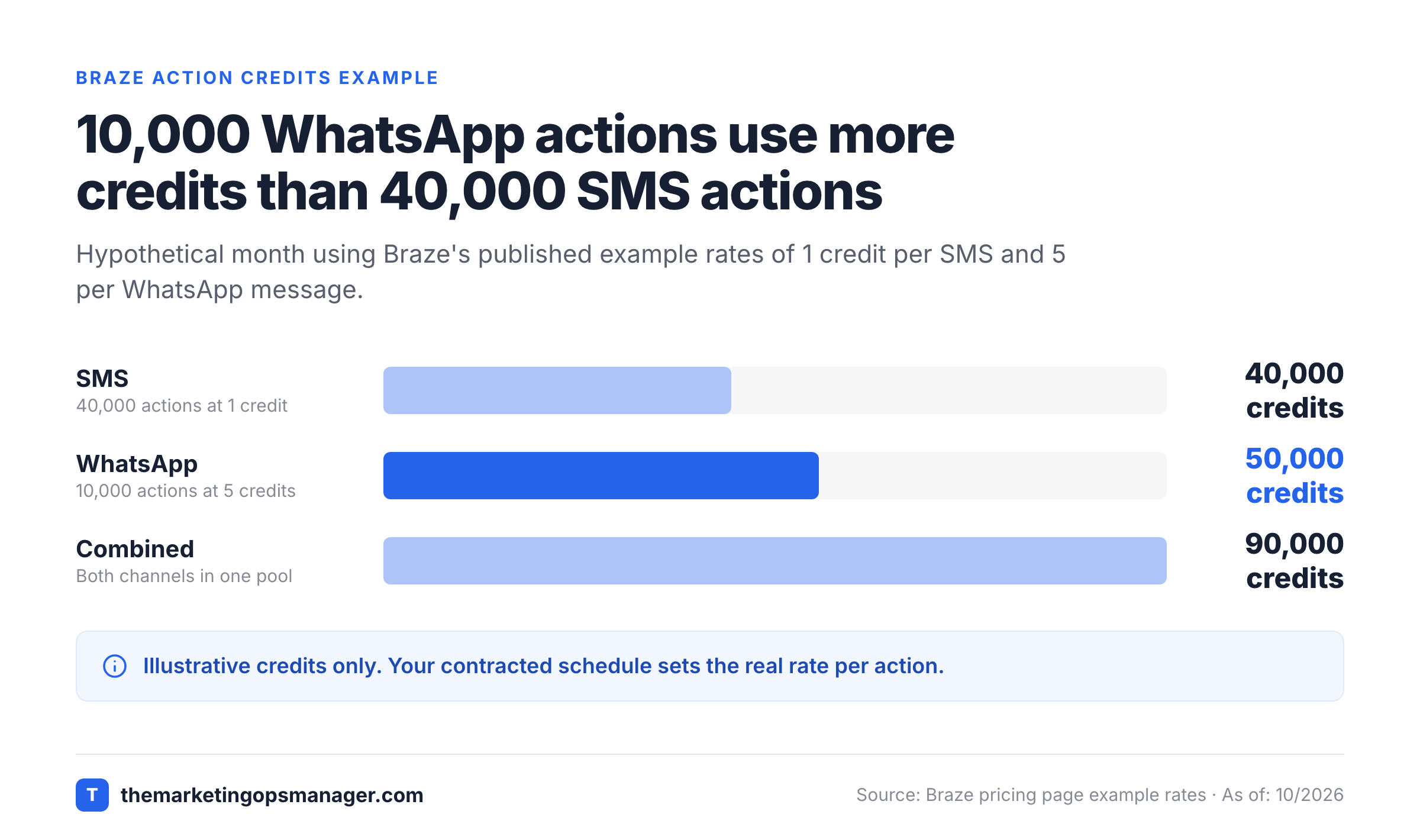
Braze Action Credits are a shared pool used across messaging channels and some BrazeAI products. Braze's own example says an SMS may cost 1 credit and a WhatsApp message may cost 5 credits. Those aren't a universal rate card, just illustrations. The signed schedule must state each action's rate, region, entitlement and treatment of failed or repeated sends.
The pool matters because an operational change in one channel can consume capacity intended for another. A campaign that shifts from email to WhatsApp may have a different credit profile, even if the number of contacted customers stays constant. On the other hand, a shared pool may let teams reallocate consumption without purchasing a separate fixed volume for each channel, although the contract decides whether that's allowed.
Braze lists email, SMS/MMS, RCS, WhatsApp, LINE, KakaoTalk, Content Cards, Banners, webhooks, Audience Sync and some AI products as credit-enabled. Don't infer that all actions cost the same or that every listed channel has identical third-party delivery charges. Ask for the current credit schedule as an attachment to the order form.
An illustrative SMS and WhatsApp credit calculation#
Consider a hypothetical month with 40,000 SMS actions and 10,000 WhatsApp actions. Using only Braze's published examples, SMS would consume 40,000 illustrative credits and WhatsApp 50,000 illustrative credits, for 90,000 illustrative credits total. This excludes email, other actions, pass-through charges and any contract-specific multipliers. It isn't a price quote, but it shows how quickly a mixed channel plan adds up.
| Braze example action | Hypothetical actions | Example credits per action | Illustrative credits |
|---|---|---|---|
| Braze SMS | 40,000 | 1 | 40,000 |
| Braze WhatsApp | 10,000 | 5 | 50,000 |
| Braze combined total | 50,000 | 1 and 5 | 90,000 |
Braze can't be modeled in dollars without a quote, so this calculator shows the one published reference point in this comparison. It estimates Customer.io's Essentials monthly cost for profiles above the 5,000 included, at its published overage rate. Use it to see how a self-serve price scales, then ask Braze for the same itemized view.
Based on Customer.io's US pricing page, checked October 28, 2026. Email overages and add-ons are excluded. This is a reference for how published pricing scales, not a Braze estimate.
What happens if you exhaust your Action Credits?#
Braze documents usage alerts at 50%, 75%, 90% and 100% of the period's allotment, currently as an early-access feature. The alerts don't pause sends. Braze says messaging continues at 100% and additional usage may be billed as overage according to the contract. That makes alert ownership a finance and operations issue, not just a marketing dashboard preference.
Assign one owner to review usage each week and another to approve changes that materially affect consumption. Track credits per channel and per journey where reporting allows it. If it doesn't, that's worth knowing before you sign. Forecast the period-end total using the observed pace, planned campaigns and seasonal peaks. The native alert reports consumption thresholds; it doesn't replace your forecast.
What extra costs should be in a Braze budget?#
Your total cost of ownership extends beyond the platform edition. Braze's pricing FAQ names MAUs and profiles, Action Credits, CX Services and optional Data Platform or BrazeAI SKUs as contract components. The Main Subscription Agreement also allows fees for excess usage when applicable. Treat every missing commercial line as a question; it's not a free inclusion.
| Braze cost component | Budget question | Evidence to request |
|---|---|---|
| Braze Platform Edition | Which features and governance controls are in the base license? | Signed edition and entitlement schedule |
| Braze MAUs and profiles | What audience volume is included and how are peaks counted? | Metric definition and overage rate |
| Braze Action Credits | Which channels and AI actions draw credits? | Credit schedule and period allotment |
| Braze CX Services | What onboarding, support and escalation are included? | Service description and SLA |
| Braze add-on SKUs | Is data export or advanced AI a separate purchase? | Itemized SKU list and feature limits |
| Braze implementation | Who configures SDKs, identity, journeys and data QA? | Statement of work with acceptance tests |
| Braze third-party channels | Who pays SMS carrier or WhatsApp delivery charges? | Pass-through fee schedule and invoicing rule |
Implementation and ongoing data operations#
Budget the work that makes the platform useful, since licenses alone don't produce results. Engineers may need to instrument app sessions, standardize identities, configure API or SDK ingestion and connect campaign events to the warehouse. Marketing ops must validate consent, audience logic, suppression rules, deliverability and conversion attribution. A complex Canvas isn't any more trustworthy than the events that trigger it.
Request a scoped implementation plan with owners, dependencies, test cases and a rollback process. Ask which tasks Braze's CX Services cover and which require your staff or a partner. A vendor implementation estimate isn't an engineering commitment unless the scope and acceptance criteria are written down.
Data exports, AI and channel pass-throughs#
The platform's capability list includes data export and AI features, while the contract FAQ explicitly mentions optional add-on SKUs. Don't assume an unlimited warehouse stream or advanced AI package is included in the edition. Specify event types, destinations, freshness, retention and expected volume for exports. For AI, define the exact workflow and whether each execution consumes Action Credits or a separate entitlement.
Channel pass-through charges also need their own row. Ask whether carrier, messaging network and third-party fees sit inside or outside Braze's credit allowance. Don't take it for granted either way. This matters when you're comparing a Braze quote with a competitor that bundles or itemizes channel delivery differently.
What contract terms affect the real Braze price?#
Braze's publicly posted Main Subscription Agreement says subscription fees are generally based on purchased entitlements rather than actual usage, unless an order form says otherwise. It says payment obligations are generally non-cancelable and paid fees non-refundable, with stated exceptions. Excess usage may be invoiced in arrears. Those provisions make entitlement sizing and overage negotiation part of pricing analysis.
The same agreement says subscriptions automatically renew for a period equal to the expiring term. It requires Braze to give 60 days' advance notice of renewal, including any price increase, which is capped at 7%, and allows written non-renewal notice at least 30 days before term end. The order form and negotiated amendments can change how these defaults apply, so legal and procurement should confirm the executed documents rather than rely on this summary.
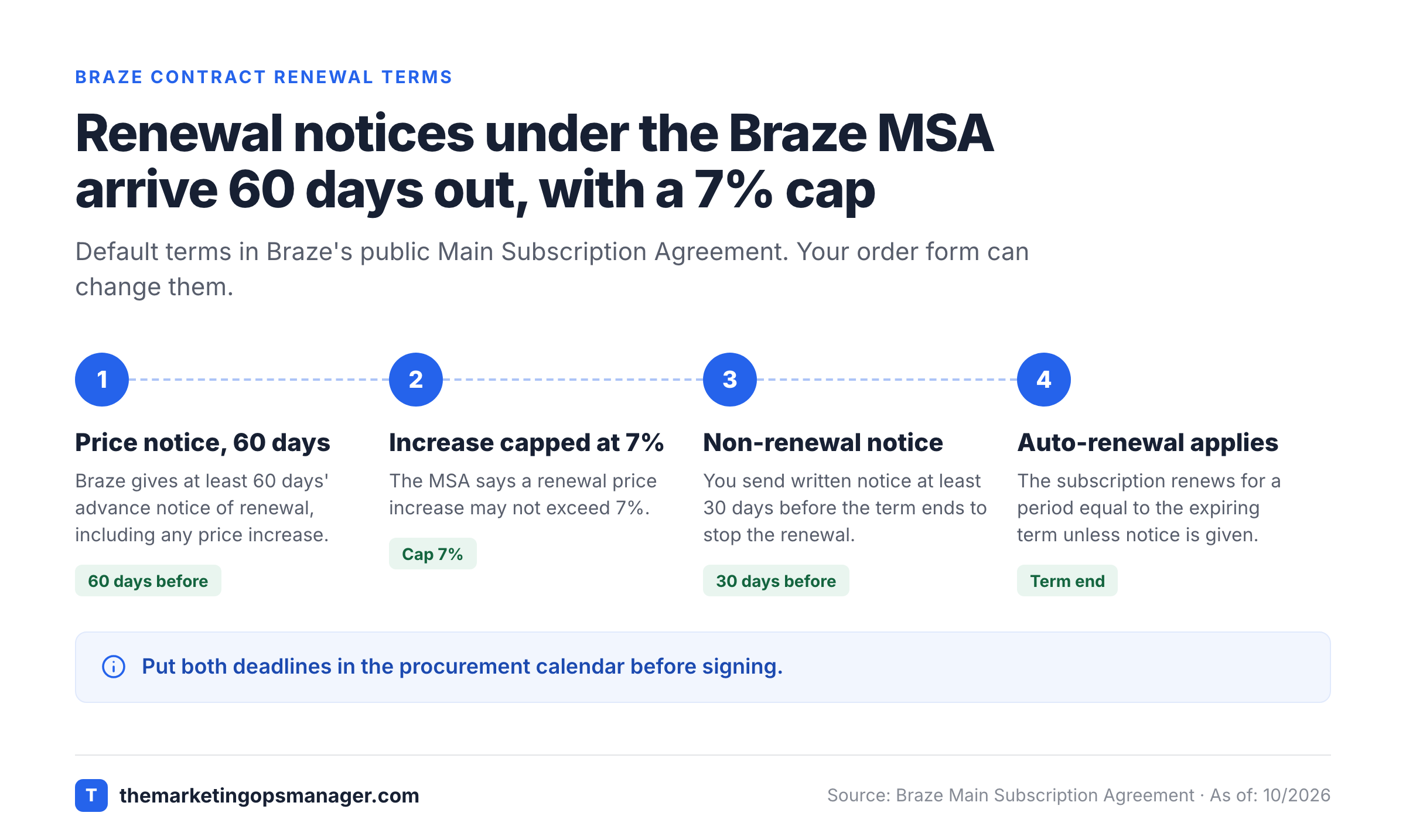
Ask for the contract's start date, end date, notice recipient and notice method. Don't leave any of them implied. Put the renewal decision deadline in the procurement calendar well before the contractual notice date. Define the owner who'll compare usage and outcomes against renewal pricing.
Can you reduce entitlements during the term?#
Braze's MSA says purchased subscription entitlements generally can't be decreased during the relevant term, except as otherwise specified. A forecast that assumes you can shrink the license after a seasonal peak may therefore be wrong. Negotiate a ramp, true-up schedule or other flexibility explicitly if your audience is uncertain.
How should you negotiate a Braze quote?#
Negotiate clarity first, and a headline discount second. Ask for a side-by-side quote with the same MAU forecast and channel mix across eligible editions. Require separate lines for edition, MAU entitlement, Action Credits, add-ons, services, implementation and overage rates. Model a high-usage case and a lower-usage case using the same assumptions.
Then ask which terms can be changed, even though some may be fixed: price protection, a staged MAU ramp, credit carryover, reallocation, renewal notice, service credits and implementation acceptance. These are negotiation topics, not promised Braze offerings. Have the vendor answer each in writing, and keep the response with the signed order form.
How do you build a defensible Braze cost forecast?#
A good Braze forecast begins with the data flow, not a vendor quote, and it doesn't end with a single number. Map the path from app or website event to identity, segment, Canvas, message channel and outcome. For each step, record its owner, failure mode and billable dimension. That map tells finance why the license exists and tells marketing ops where consumption can change unexpectedly.
Define the billable audience
Export twelve months of active users, segment web and app identities, and reconcile your count to Braze's MAU rules. Document anonymous traffic and expected peaks.
Inventory every planned journey
List triggers, channel sends, transactional messages, suppression paths and the owner of each journey. Separate committed launches from optional experiments.
Convert volumes into contracted credits
Apply the vendor's signed per-action schedule, not the illustrative SMS and WhatsApp examples. Include AI actions and a peak-month scenario.
Add services and nonlicense work
Cost SDK and API setup, identity mapping, data QA, channel fees, export workloads, training and the team operating campaigns.
Stress-test overages and renewal
Model high MAU, higher send frequency and a delayed launch. Check overage rates, contract term, renewal notice and any permitted reductions.
Create monthly governance
Give finance and marketing ops a shared view of MAUs, credit consumption, upcoming launches and committed spend. Investigate variance before approving new sends.
A forecast worksheet you can copy#
Create one row per month. Use the same calendar, user identity logic and action definitions for every scenario. The table below is a worksheet specification, not a statement about a typical Braze customer.
| Braze forecast field | Example input or formula | Owner |
|---|---|---|
| Braze MAU baseline | Unique active users under agreed definition | Analytics |
| Braze MAU peak case | Baseline plus planned launch and seasonality | Growth lead |
| Braze SMS actions | Eligible sends by journey and region | Lifecycle marketing |
| Braze WhatsApp actions | Eligible sends by template and region | Lifecycle marketing |
| Braze Action Credits | Sum of each action count times its contracted credit rate | Marketing ops |
| Braze excess usage (USD) | Contracted overage units times agreed unit rate | Finance |
| Braze services (USD) | Signed services fees plus scoped partner work | Procurement |
| Braze total cost (USD) | License plus overages, services and external costs | Finance |
An annual model should also include the months before launch. Data integration and consent work can start before the first campaign. A tool that takes longer to deploy can delay the expected return without reducing the contracted fee. Record the planned production date and the date at which each use case starts contributing measurable value.
How does Braze pricing compare with alternatives?#
Braze isn't self-serve; it's quote-based. Some narrower engagement platforms publish entry prices, but their billing units and capabilities differ. Compare like-for-like workloads rather than comparing Braze's unknown enterprise quote with another product's smallest self-service tier.
| Engagement platform | Published starting price (USD) | Billing basis to examine | Fit to test |
|---|---|---|---|
| Braze | Custom quote | Edition, MAUs, Action Credits, services | Broad cross-channel orchestration and governance |
| Customer.io | Essentials starts at $100/month, billed monthly | Profiles and email volume | Event-driven messaging with public entry pricing |
| OneSignal | Growth starts at $19/month plus usage | Mobile MAUs, web subscribers and sends | Push-led programs with a self-service entry point |
The prices above were checked against the vendors' US pricing pages on October 28, 2026. Customer.io's Essentials listing includes 5,000 profiles and 1 million emails per month at its entry configuration. OneSignal's Growth plan adds usage charges, so $19 isn't a total cost for an active deployment. Neither price should be used to imply equivalent feature coverage or volume.
If you primarily need email automation, a platform with public profile-based pricing may be easier to forecast. If you need app-first push, in-app journeys, cross-channel identity and complex orchestration, compare deeper feature and engineering requirements. Request the same journey demonstration from each vendor and compare the event-to-message-to-warehouse handoff.
What does a Braze quote not cover?#
A Braze contract prices message execution, audience data and services. It doesn't cover the handoffs around it: landing pages, forms, UTM tagging, CRM routing and reporting. Those checks still need an owner, whichever engagement platform you buy.
Start with the marketing operations audit checklist and the campaign tracking checklist. Use the UTM governance template to keep campaign metadata consistent when activity flows between channels and reporting systems.
What should you ask Braze before signing?#
Use the following list as a quote acceptance test. If an answer's missing, that's a finding. A complete response should let finance calculate spend, engineering estimate implementation and marketing ops identify which activity drives consumption.
- Which Platform Edition and exact SKU entitlements are quoted?
- What MAU definition, profile allowance and peak-period treatment apply?
- How many Action Credits are included in each contract period?
- What are the credit rates for every planned channel and AI action?
- Which third-party delivery fees are excluded from credits?
- What happens at 100% credit usage and what are the overage rates?
- Are data exports, advanced AI and CX Services included or separate?
- Who owns SDK, API, identity, consent and campaign QA work?
- What are the term, renewal date, notice method and price protections?
- Can MAU or credit entitlements change during the term?
- Who monitors usage, approves new journeys and receives alerts?
- Will the vendor provide a production and peak-case quote using identical assumptions?
Braze pricing FAQ#
The questions below cover decisions that a buyer should settle before accepting a custom quote.
What is the monthly price of Braze?
Braze doesn't publish a monthly US dollar price. Go, Select, Pro and Enterprise require custom quotes based on the contracted edition, audience, credits and services.
Does Braze charge for every stored customer profile?
Braze says its current pricing scales with monthly active users and includes a profile allotment. Check the exact ratio and any excess-profile terms in your order form rather than treating the total database as MAU.
Does Braze still charge for data points?
Braze says data-point billing is legacy for older multi-year contracts and no longer applies to new customers from Spring 2025. Existing customers should verify their signed billing metric before changing event ingestion.
Can Braze messages stop when Action Credits run out?
Braze says messages continue at 100% of the credit allotment and excess use may be billed under the contract. Its usage alerts are currently described as early access.
Is Braze cheaper than Customer.io or OneSignal?
A valid comparison needs the same audience, channels, messages, integrations and support. Customer.io and OneSignal publish entry prices, while Braze requires a quote, so their advertised floors alone don't establish a total-cost winner.
Can a Braze subscription be canceled at any time?
Braze's standard MSA generally treats subscription obligations as non-cancelable and includes automatic renewal provisions. Your signed order form and amendments determine the applicable terms, so confirm notice dates and termination rights before signing.