
Segment vs RudderStack is a choice between a managed customer data platform and a pipeline that builds profiles in your own warehouse. Twilio Segment bundles collection, routing, identity, audiences and journeys into one product family and prices it by monthly tracked users. RudderStack collects and routes events, then runs identity resolution and customer features as SQL inside your data warehouse, and prices its core pipeline by events. Neither is the better product in general. The better fit depends on who will own the data model: a marketing and product team working in a vendor interface, or a data team working in code.
This comparison uses the vendors' own pricing pages and documentation, plus G2 ratings, as of November 2026. It's built to separate what's documented from what a demo or a quote still has to confirm.
 Choose Segment when
- Marketing needs audiences and journeys in a managed product (Engage, Business tier)
- You can budget for Business-tier features such as tracking plans, consent and EU residency
- Pricing by monthly tracked users fits your audience better than pricing by events
 Choose RudderStack when
- A data team already models customers in a warehouse and wants profiles defined as YAML and SQL
- You want event-based pricing, with a free Core plan of 250K events per month
- A self-hosted option matters (the server is source-available under the Elastic License 2.0)
Segment vs RudderStack at a glance#
The table compares documented capabilities, not a ranking. A "quote" cell means the vendor doesn't publish the number, so don't read it as free.
| Tool | Core idea | Billing unit | First paid plan | Identity resolution | Tracking plans | G2 rating |
|---|---|---|---|---|---|---|
| Twilio Segment | Managed CDP: Connections, Unify, Engage | Monthly tracked users (MTUs) | Team from $120 per month | Unify (Business tier) | Protocols (Business add-on) | 4.5 from 568 reviews |
| RudderStack | Event pipeline plus profiles built in your warehouse | Events (Core); activated records (Lookout) | Growth $265 per month | Profiles, SQL in your warehouse | All plans, capped by plan | 4.7 from 52 reviews |
The short answer: If marketers need to build audiences and journeys without writing SQL, Segment's Engage and Unify products are the documented path, and they sit on the Business tier. If your data team already owns warehouse models and wants identity rules in version control, RudderStack's Profiles fits that way of working and its free plan is measured in events rather than users. Both tools can collect the same events and send them to the same ad and email tools. The difference isn't the event flow, but who owns it, how it's billed and what governance costs extra.
What does each platform actually do?#
Both platforms sit between the places where customer behavior is captured (a website, a mobile app, a server, a SaaS tool) and the places where it gets used (an email platform, an ad network, a warehouse, an analytics tool). Without a layer like this, every source needs its own integration with every destination, and nobody can say which version of an event reached which tool. That's the problem both products exist to solve, though they solve it differently.
- 1Collect
- Twilio Segment
- RudderStack
Breaks when web and app SDKs send different event names for the same action. - 2Govern
- Twilio Segment
- RudderStack
Breaks when a tracking plan exists on paper but nothing flags events that break it. - 3Resolve identity
- Twilio Segment
- RudderStack
Breaks when two IDs get merged wrongly and nobody can explain why. - 4Activate
- Twilio Segment
- RudderStack
Breaks when a destination rejects records and the failure goes unseen for days.
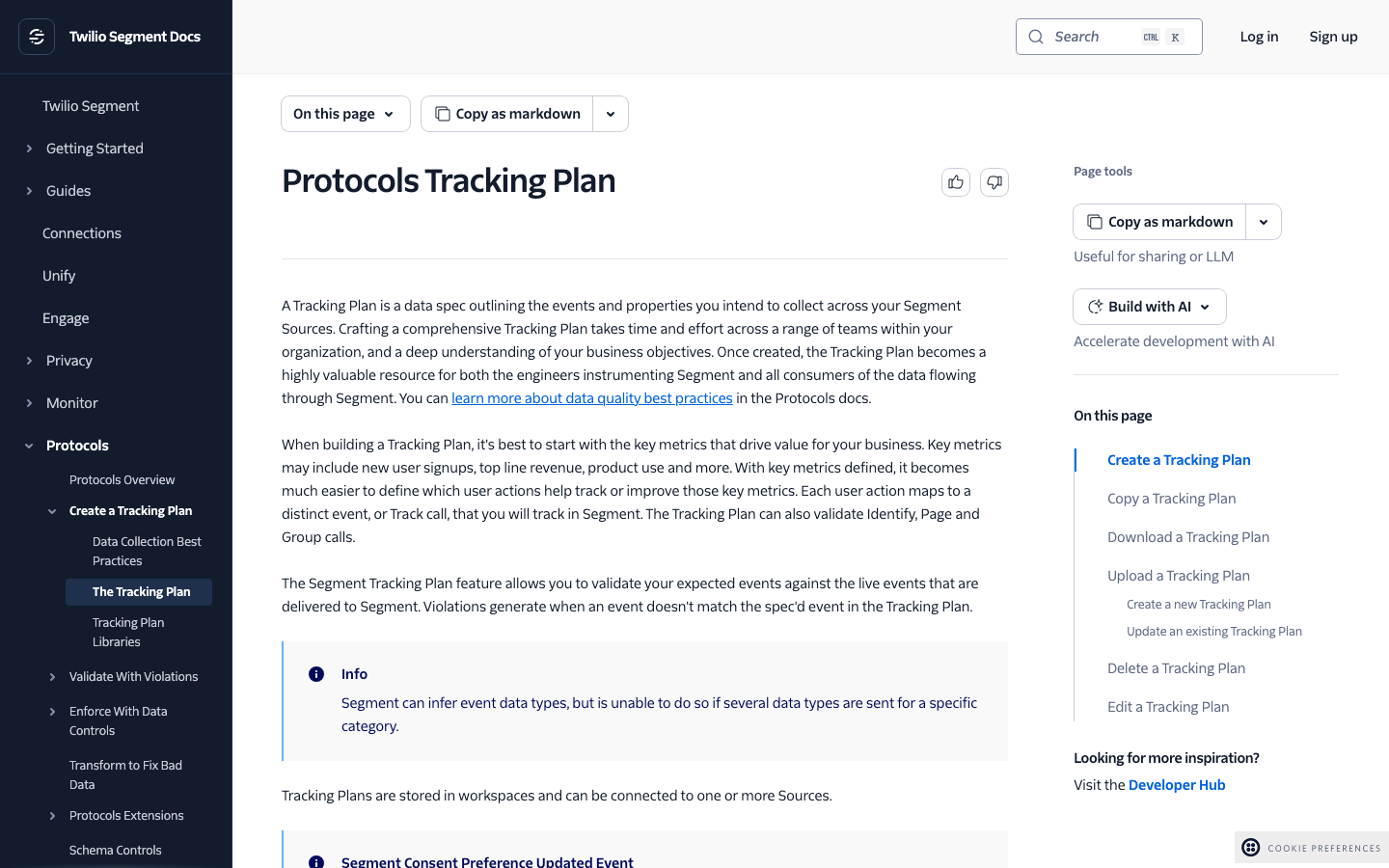
Segment is Twilio's customer data platform, and its public pages now sit on twilio.com. The pricing page separates a Customer Data Pipeline (Connections, which collects and routes data) from a full Customer Data Platform that adds Unify for identity and Engage for audiences. Protocols, the data quality product, is an add-on for either.
RudderStack's documentation describes a different shape. Event Stream collects data through SDKs and routes it to destinations. Reverse ETL syncs data out of a warehouse, data lake or database. Profiles builds identity graphs and customer features from declarative configuration that compiles to SQL and runs in your warehouse. Lookout, a separate product, is an AI-assisted analytics and activation agent for marketing teams, and its release notes list general availability on November 10, 2026.
How do Segment and RudderStack differ architecturally?#
The cleanest distinction isn't the feature list, it's where the customer profile lives. In Segment, Unify builds and stores profiles inside the platform, with a Profile explorer and a Profile API. For teams that want those profiles in a warehouse, Profiles Sync writes unified profiles to Snowflake, Redshift, BigQuery, Azure Synapse, Postgres or Databricks. Profiles Sync is a Business tier feature, and it syncs hourly according to the docs.
In RudderStack, the profile is a warehouse artifact from the start. Its Profiles documentation says you declare identity types, stitching rules and entities in version-controlled YAML, and the framework generates the SQL that handles identity resolution, incremental computation and feature aggregation. The identity graph, in other words, isn't a black box. It's a set of tables you own and can query.
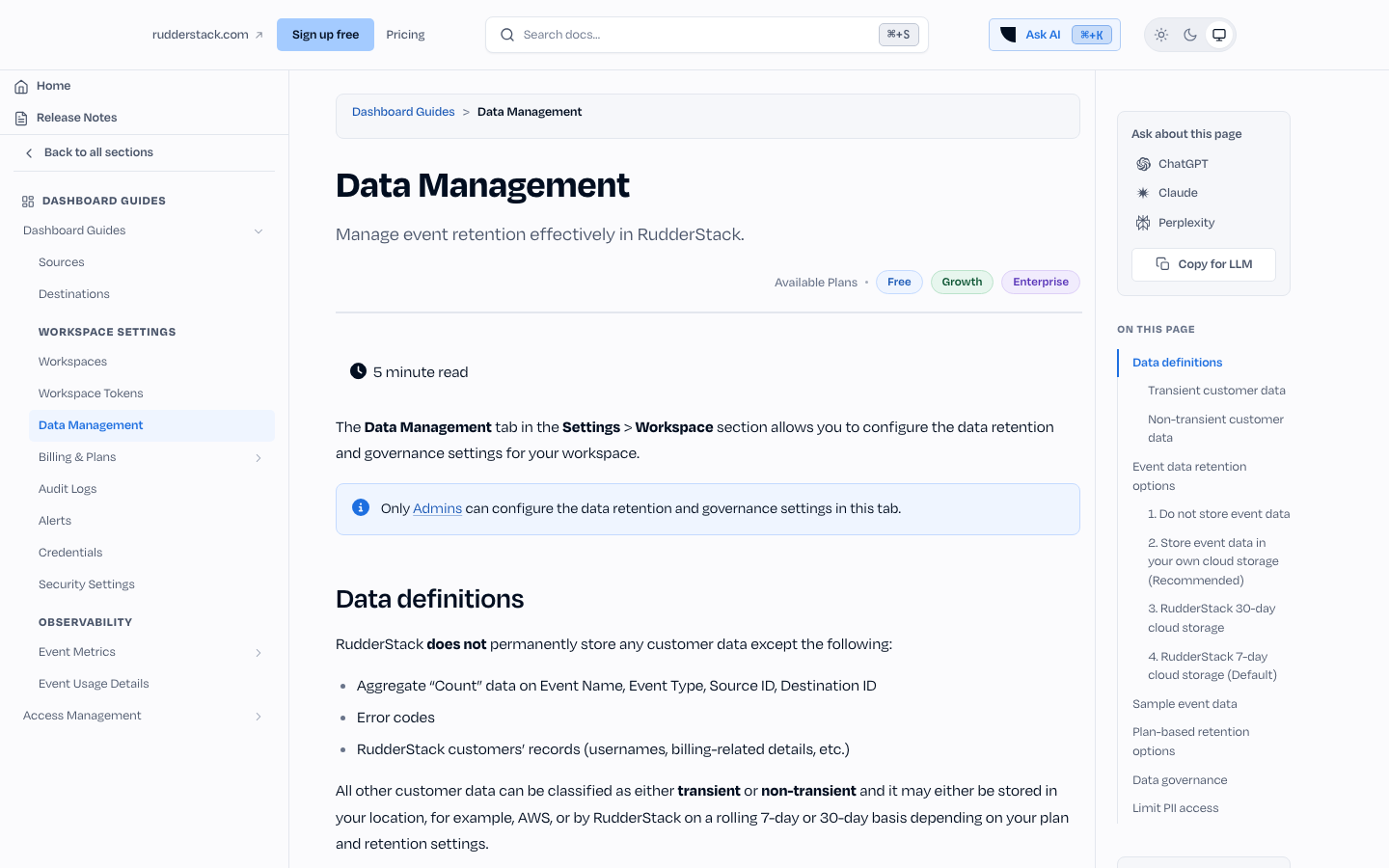
That's why the "warehouse-native" label matters, but it needs care. A heading on RudderStack's homepage says it doesn't store your data. Its own data management documentation is more precise: RudderStack doesn't permanently store customer data except aggregate count data, error codes and its customers' account records, and other event data is either transient or non-transient. By default, event data is kept on a rolling 7-day basis in RudderStack cloud storage, with an option to use your own cloud storage or not store events at all. A 30-day RudderStack storage option is Enterprise only, and Event Replay requires your own cloud storage. So "warehouse-native" describes where profiles are computed, but it doesn't mean no data passes through, or rests briefly in, the vendor's systems.
RudderStack also offers a self-hosted route. Its GitHub page says the server is released under the Elastic License 2.0, which is source-available rather than an OSI open source license, and that a self-hosted install depends on PostgreSQL.
Segment#
Twilio Segment
Twilio Segment collects customer events from sites, apps and servers, resolves them to users and routes them to marketing, analytics and warehouse destinations. Its pricing is based on monthly tracked users (MTUs).
A managed customer data platform: Connections for collection and routing, Unify for identity, Engage for audiences and journeys.
- marketing and product teams need one managed place to collect events and route them to many destinations
- you want pricing and limits tied to monthly tracked users and can model your MTU count
- you need tracking plans, identity resolution, consent management or EU data residency but can't budget for the Business tier
- your team wants customer profiles to live in your own warehouse by design
- Users like
- Easy integrations
- Users dislike
- Cost
- Source: G2, 568 reviews
How it works in practice
Segment counts an MTU as a unique userId plus any anonymousId not tied to a userId, across all sources in a workspace for a billing month. Each user is counted once per month, and events blocked by a tracking plan don't count toward MTUs. The docs also describe a throughput limit that works out per MTU: on a 10,000 MTU plan at 250 per MTU, that's 2.5 million API calls and objects per month, and Business plans often get custom limits.
The plan structure decides which features you get. Functions are available on all plans with a free allotment of usage hours. Protocols, Unify, Engage, Journeys, Profiles Sync and Consent Management sit on the Business tier or as add-ons, and the Free and Team plans don't include them. Regional Segment, which keeps an EU workspace's data in the EU with an endpoint in Dublin, is also Business tier, and the docs say it's limited to the EU.
- Starting price
- Free ($0, up to 1,000 MTUs); Team from $120 per month (10,000 MTUs included); Business by quote (vendor pricing page, as of 2026-11-19)
- Pricing unit
- Monthly tracked users (MTUs)
- Free plan
- 1,000 MTUs, 2 sources, 1 warehouse
- Team
- From $120 per month, 10,000 MTUs, unlimited sources
- Business
- Custom quote
Segment's strength is breadth in one vendor relationship. A marketing team can collect events, resolve identities, build an audience and run a journey without leaving the platform, and it's not short on destinations: the pricing page cites 550+ pre-built ones. G2 reviewers rate it 4.5 out of 5 across 568 reviews, and the most frequent praise on G2 is easy integrations and setup. Segment's audiences are one of eight segment builders compared in customer segmentation software.
The trade-off is cost and tier gating, not capability. The most frequent G2 complaint is price, both for initial implementation and for long-term running costs. That's consistent with the plan structure above. The Team plan covers collection and routing, but governance, identity, consent and residency features are Business tier, which you can't price from the website. Model the Business quote, not the $120 starting price, if you need any of those.
RudderStack#
RudderStack
RudderStack collects events with open SDKs, routes them to warehouses and tools, and builds unified profiles with SQL that runs in your own data warehouse. Core pricing is based on events.
An event pipeline with Reverse ETL and warehouse-based Profiles, priced on events and available as a self-hosted server.
- a data team already models customer data in a warehouse and wants profiles and identity rules defined as version-controlled code
- you want event-based pricing and a self-hosted option for the open-source server
- marketers need to build audiences and journeys without data engineering help
- nobody on the team can own warehouse models, pipeline monitoring and identity rules
- Users like
- Ease of use
- Users dislike
- Steep learning curve
- Source: G2, 52 reviews
How it works in practice
RudderStack's Event Stream has SDKs for web, mobile and server languages, including JavaScript, iOS (Swift), Android (Kotlin), Node.js, Python and Go. Its docs list 32 cloud app sources and 10 Reverse ETL sources, including Snowflake, BigQuery, Databricks, Redshift and PostgreSQL, and the docs index cites 200+ destinations.
Several limits scale by plan. JavaScript transformations are available on all plans, while Python 3.11 transformations are on Growth and Enterprise. The Free plan allows 5 transformations and Growth allows 25. Tracking plans allow 1 plan with 5 events on Free and 75 events per plan on Growth, and the alias call isn't supported. Consent management has native OneTrust, Ketch and iubenda integrations, and events that don't carry the expected consent IDs are dropped.
- Starting price
- Core Free ($0, 250K events per month); Growth $265 per month; Enterprise by quote; billed on events (vendor pricing page, as of 2026-11-19)
- Pricing unit
- Events (Core), activated records (Lookout)
- Core Free
- 250K events per month
- Growth
- $265 per month, 15% savings on annual billing
- Enterprise
- Custom quote
RudderStack's strength is control for teams with data engineering capacity. Because profiles, identity rules and features are code in your warehouse, they can be reviewed, versioned and tested like other data work. G2 reviewers rate it 4.7 out of 5, though from a much smaller base of 52 reviews, and the most frequent praise is ease of use and support.
The trade-off is the operating model rather than the feature set. The most frequent G2 complaint is a steep learning curve, especially during setup, and a few reviewers mention thin documentation for troubleshooting. A marketer who wants to build an audience will need a data teammate, or a product such as Lookout, to do it. If nobody owns the warehouse models, the warehouse-native design doesn't help, however clean the architecture looks.
Which is better for a marketing operations team?#
Marketing ops cares about the distance between "we decided who to target" and "that audience is in the ad platform and the email tool, and we can prove it". That distance depends on who can change the audience definition.
With Segment, the documented path for marketers is Engage: it's described as a personalization platform for building, enriching and activating audiences, and Journeys lets you define steps based on event behavior and traits. Both need the Business tier or an add-on. With RudderStack, audiences are built from warehouse data. Its older Audiences feature uses the Reverse ETL workflow, and its docs recommend Lookout for newer work, so check which one your quote includes.
The practical test isn't a demo, it's a change request. Ask each vendor to show a marketer changing an audience rule, then show where the change is reviewed, how membership can be inspected and how a missing delivery gets diagnosed. If the answer is "file a ticket with the data team" for every change, plan the staffing for that. It's cheap to find out now and expensive to find out after signing.
- Marketers build audiences and journeys without SQLTwilio Segment
- Identity rules need to live in version control next to other warehouse modelsRudderStack
- EU data residency for a workspace is requiredTwilio Segment
- Low-volume start with a free plan measured in eventsRudderStack
- Self-hosting the pipeline server is on the tableRudderStack
- Pricing should follow unique users rather than event volumeTwilio Segment
How do pricing models compare?#
The billing units differ, so the starting prices aren't comparable. Segment bills monthly tracked users. RudderStack's Core plans bill events. A site with many users who each fire a few events can be cheap on one model and expensive on the other, and the reverse for a high-engagement product.
| Plan | Segment | RudderStack |
|---|---|---|
| Free | $0, up to 1,000 MTUs, 2 sources, 500,000 Reverse ETL records per month | $0, 250K events per month |
| First paid plan | Team from $120 per month, 10,000 MTUs included | Growth $265 per month, 15% savings on annual billing |
| Overage | $12, $11 and $10 per additional 1,000 MTUs, by volume band | Not listed on the pricing page |
| Top tier | Business, custom quote | Enterprise, custom quote |
| Billing unit | MTUs | Events |
Segment's Team plan also includes 1,000,000 Reverse ETL records per month, unlimited sources and a 14-day free trial. Its pricing page says annual billing saves up to 20%. RudderStack's separate Lookout product is billed on activated records, which the pricing page defines as a person's first sync to a destination from an audience, with Lookout's own Growth plan starting at $1,000 per month billed annually.
To compare the two, build one workload definition and price it in both units. It's tedious, but it's the only fair method. Count monthly unique users (anonymous plus known), monthly events, number of sources and destinations, and the governance features you need. Then ask each vendor for an itemized quote. Segment's Team plan at $120 may not include the Business features you need, and RudderStack's Growth plan at $265 may not cover the event volume you expect, so neither starting price is the budget.
What about governance, consent and data residency?#
Governance is where plan structure matters most for both vendors.
Tracking plans. Segment's Protocols lets you define a tracking plan, see violations, and apply controls such as blocking events or quarantining a source. It's an add-on for Business plans, and events blocked by a tracking plan don't count toward MTUs. RudderStack's tracking plans are part of data governance on all plans, but limited by plan: 1 tracking plan with 5 events on Free, and 75 events per plan on Growth. The docs say violation context can be passed to destinations and used in transformations for filtering.
Consent. Segment's Consent Management is available on Business tier plans, attaches a per-category consent object to events and provides a wrapper for OneTrust. Other consent tools need a custom consent object. RudderStack supports OneTrust, Ketch and iubenda natively, plus a custom option in beta, and drops events that lack the expected consent IDs. The pre-consent tracking option applies to the JavaScript SDK only.
Residency. Segment's default is the US (Oregon), and an EU workspace on the Business tier keeps data in the EU. RudderStack's documentation describes data plane regions, and the live events view is stored in the same region as your data plane. Ask for the current region list for your plan, since the details differ by feature.
None of this settles legal compliance. Your legal and security teams need the vendor contracts, subprocessor lists and retention settings, because a feature page isn't a contract.
How should you run a proof of concept?#
Give both vendors the same workload, then compare operating effort as well as output. A demo that shows an event arriving doesn't tell you how the system behaves when a destination rejects records or a consent flag changes, and that's where the daily work sits.
Define the identity contract
Write down the primary user ID, how anonymous IDs merge into known users, which system owns email and consent, and what happens on a deletion request.
Send the same events to both
Use one set of synthetic events, one warehouse and one approved destination. Record setup time separately from run time.
Build one audience and one suppression
Create an audience from a trait, then add a consent change and confirm the person drops out of every destination.
Break something on purpose
Send an event that violates the tracking plan and reject a delivery at a destination. Note how each tool shows the problem and how recovery works.
Price the same workload
Ask each vendor to quote the same events, users, sources, destinations and governance features, and to list what the pilot didn't test.
Assign owners before the pilot starts. Marketing owns audience rules and consent expectations. Engineering owns event quality and SDK work. Data owns warehouse models. Privacy owns retention and residency answers. Procurement owns the quote. When nobody owns an item, it'll show up later as an incident.
- Same synthetic events and destinations in both tools
- MTU count and monthly event volume both measured
- Identity merge and deletion request demonstrated
- Consent change blocks delivery in every destination
- Tracking plan violation shown and handled
- Failed delivery recovered, with replay options and storage needs confirmed
- Plan features the pilot used matched against the quoted tier
- Quote lists overages, renewal terms and support level
What should you check before migrating?#
Moving between the two means moving the event contract, not just the SDK. Inventory your tracking calls, event and property names, identity rules and destinations. Map old events to new ones, and decide how you'll handle the alias call, since RudderStack's tracking plan feature doesn't support it.
Run both pipelines in parallel for a short period if the destinations can tolerate it, and compare record counts and key properties. You'll catch mapping errors before customers do. Parallel pipelines can double-send to ad and email tools, so suppress one path or use a test destination. Decide your rollback criteria and a named incident owner up front, and update tracking plans, dashboards and documentation at cutover.
A pipeline that moves customer data between systems also needs monitoring in its own right. When an event stops flowing, the failure doesn't announce itself. It usually shows up days later as a drop in leads or a campaign that quietly stopped measuring.
Who should choose Segment, and who should choose RudderStack?#
Choose Segment when the people who use customer data most are marketers and product managers who work in a vendor interface. It makes the most sense if you'll buy Business-tier features such as Unify, Engage, Protocols and Consent Management, and if the MTU model matches how your audience grows. Confirm in writing which of those features are in your quote, because the Free and Team plans don't include them.
Choose RudderStack when a data team owns customer data in a warehouse and wants the pipeline, identity rules and features to follow the same review process as the rest of its code. It fits teams that prefer event-based pricing, want a self-hosted option, or are happy to staff the warehouse models. Confirm which Profiles, Lookout and governance features your plan includes, and what you'll operate yourselves.
If you can't say which of those two descriptions fits, run the pilot. It's rarely the feature list that decides it, but who ends up doing the daily work.
Frequently asked questions#
Is RudderStack a Segment alternative?
Yes. RudderStack's own GitHub description calls its server a privacy and security focused Segment alternative. Both collect events and route them to destinations. They differ in where profiles are computed and in how they bill: RudderStack Core bills events, while Segment bills monthly tracked users.
How much does Segment cost?
Segment's pricing page lists a Free plan at $0 for up to 1,000 MTUs, a Team plan from $120 per month with 10,000 MTUs included, and a Business plan by custom quote. Protocols, Unify, Engage and consent features sit on the Business tier or as add-ons.
How much does RudderStack cost?
RudderStack's pricing page lists Core Free at $0 with 250K events per month, Growth at $265 per month, and Enterprise by quote. Lookout, its activation product, is priced separately on activated records.
Does RudderStack store my data?
RudderStack's documentation says it doesn't permanently store customer data apart from aggregate counts, error codes and its own customers' account records. By default, event data is kept on a rolling 7-day basis in RudderStack cloud storage, and you can choose your own cloud storage or no storage.
Can I self-host RudderStack?
Yes. The rudder-server repository is released under the Elastic License 2.0, which is source-available, and a self-hosted install depends on PostgreSQL. Check the license terms with your legal team.
Which is easier for a marketing team to use?
Segment documents Engage and Journeys for marketers, but they require the Business tier. RudderStack is built around warehouse models, so marketers usually depend on a data teammate or on Lookout. G2 reviewers rate RudderStack 4.7 for ease of use but also mention a steep learning curve, while Segment reviewers praise easy integrations and criticize cost.