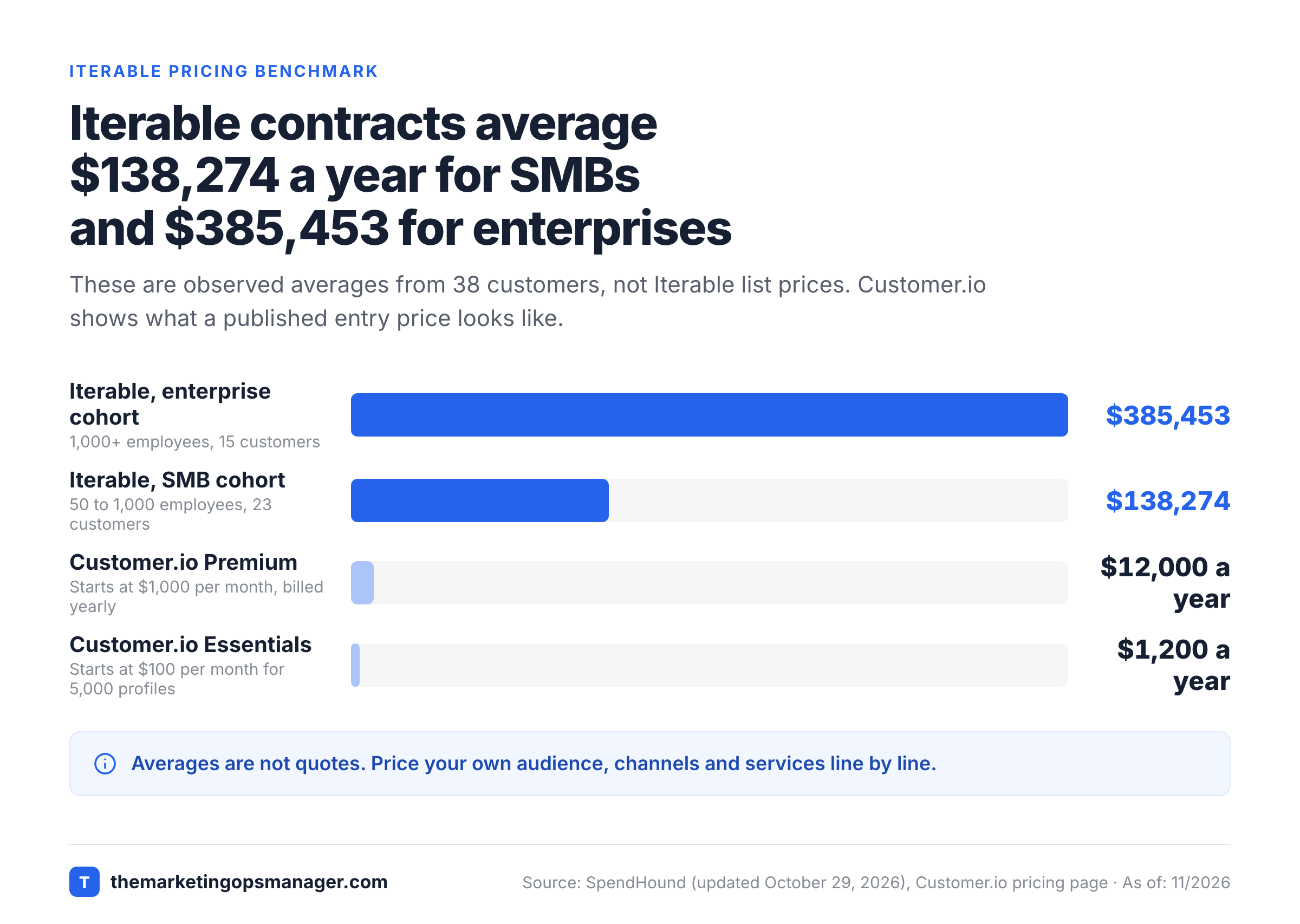
Iterable pricing is custom-quoted, not a public monthly subscription with a published starting price. Iterable says the quote depends on audience size, channels, and features. For a useful reality check, SpendHound's contract-data page (updated October 29, 2026) reports average annual spending of $138,274 for its SMB group and $385,453 for its enterprise group. Those are observed averages from one dataset. They aren't Iterable list prices, they aren't a quote for your company, and they don't guarantee what a similar company will pay.
The procurement question isn't so much "Which advertised plan should I buy?" and more "What will the order form charge for our audience, messages, channels, data connections, and growth?" Ask for a line-item proposal, a usage definition, a renewal schedule, and a testable statement of what's included. Otherwise the platform fee looks precise while the operating cost stays fuzzy, and that's where budgets slip.
How much does Iterable cost in 2026?#
Iterable doesn't publish a USD price card on its current public site. Its marketing automation FAQ says pricing is tailored to the brand using audience size, channels, and required features. Its public pricing page redirects to the main site rather than showing a tier table. A demo and commercial proposal are therefore the practical route to a current price.
- Iterable custom enterprise quoteContact sales per contracted orderNo public USD list price
- Audience scope specified in the proposal
- Messaging channels and entitlements specified in the proposal
- Feature access and usage limitations specified in the proposal
This is a buyer-facing quote category, not a verified Iterable tier name. The vendor doesn't publish a comparable self-serve plan matrix as of November 1, 2026.
An important distinction: directories and resellers sometimes show a "Basic" plan or labels such as Growth, Premier, and Enterprise. Those labels aren't a substitute for an Iterable-issued order form. Capterra currently displays a Basic listing with a custom quote, but that's directory presentation, not confirmation of an official public Iterable package with fixed entitlements.
SpendHound says its benchmark covers 38 Iterable customers (23 SMB and 15 enterprise). It groups businesses by employee count, with 50 to 1,000 employees in the SMB category and more than 1,000 in enterprise. These are company-size cohorts, not message-volume tiers. Don't take the SMB average as a minimum or use the enterprise average as a price for a specific audience size.
| Public evidence | What it actually tells you | What it doesn't tell you |
|---|---|---|
| Iterable's own pricing FAQ | Audience size, channels, and features influence quotes | A list price, tier threshold, or included volume |
| SpendHound, October 2026 | Average annual spend of $138,274 for its SMB cohort | What your contract will cost |
| SpendHound, October 2026 | Average annual spend of $385,453 for its enterprise cohort | An enterprise minimum or fixed package |
| Iterable's master services agreement | The Enterprise Order controls fees and usage limits | The terms of an unsigned proposal |
The most defensible budget is built from your own usage forecast and an itemized quote. Published buyer benchmarks are helpful for challenging a proposal, but can't establish feature-by-feature equivalence between contracts.
What determines your Iterable quote?#
Iterable identifies audience size, channel mix, and required features as its public pricing inputs. Its master services agreement separately says the fees and usage limitations are defined in the Enterprise Order. That makes the written order form more important than a generic online estimate.
Audience definition and the active-user question#
Ask sales to define the billed audience in writing; sales won't volunteer it. The answer should name the metric: stored profiles, reachable contacts, active profiles, monthly active users, or something else. It should also say what action makes a profile count, how anonymous identities are handled, and whether a duplicate profile counts twice. Don't assume that an analyst's "MAU-based" description is the metric your contract will use.
Bring a monthly distribution, not just a yearly average, since sales needs to see your peaks. A retail brand may have quiet months and sharp seasonal spikes. A product-led business may have a large registered population but a much smaller reachable cohort. The pricing discussion changes depending on whether the meter follows stored records, activity, message delivery, or a contracted allowance.
Your proposal should define what happens when the audience grows, whether unused allowance carries forward, how a new region or brand is counted, and how to view consumption before a billing dispute. These are questions you'll want settled, and they aren't statements about Iterable's universal billing rules.
Email, mobile, and conversational channels#
Iterable's current product overview describes email, SMS, push, in-app, web push, embedded messaging, RCS, and WhatsApp. Availability in the platform doesn't prove that every channel is included in every commercial order. The product-specific terms explicitly make SMS usage and charges dependent on the Enterprise Order, including possible carrier and regulatory surcharges.
Ask for each channel's entitlement, and don't accept a verbal answer: transport charges, sender setup, country coverage, throughput, and approval requirements. SMS can create extra work even if the software fee is fixed: sender registration, consent records, number provisioning, and carrier behavior are operational responsibilities. For WhatsApp and RCS, ask whether third-party network or conversation fees appear separately and which party invoices them.
Data ingestion, integrations, and identity#
A journey platform depends on timely customer events. Iterable's marketing automation page describes warehouse ingestion from Snowflake, BigQuery, Databricks, and Redshift, alongside APIs for real-time events. The existence of an integration doesn't confirm the same connector is licensed, configured, or supported in your proposal.
Map each handoff before negotiating: application or storefront to event collector, event collector to Iterable profile, profile to segment, segment to journey, journey to channel provider, and message event back to analytics or CRM. For every step, ask who owns the connection, what its latency target is, how errors are surfaced, and whether a third-party bill applies.
The data model matters to cost and reliability. A campaign may appear to "work" while its conversion event arrives too late to change a journey, or while identity merges inflate the reachable audience. Test these failure modes in the trial instead of paying for integrations nobody has validated.
Advanced intelligence and feature entitlements#
Iterable promotes Nova intelligence and adaptive journeys. That marketing description establishes the product direction, not the precise entitlements of your order. Request a feature schedule showing which AI, experimentation, decisioning, catalog, analytics, and access-control capabilities are included, excluded, or separately priced.
Have a marketer show you the specific workflow you need. Check that a nontechnical operator can edit a branch, preview personalized content, compare two experiments and diagnose a failed trigger. Have IT verify permissions, event delivery and data governance, and don't skip the failure cases. The procurement win is a proven workflow, not a long list of feature names.
What can make the total bill higher than the platform fee?#
The biggest budgeting error is to treat a recurring software quote as the entire cost of operating cross-channel campaigns. Iterable publishes professional services packages for implementation, integration, migration, training, and go-live guidance. Its July 2026 services description includes Bronze, Silver, Gold, and larger packages, but the page doesn't provide a universal dollar price for those services.
Implementation and migration work#
Migration is more than copying contacts. A safe transition includes event schema mapping, consent and suppression logic, sender-domain configuration, template conversion, journey rebuilding, attribution continuity, and a rollback plan. Iterable's Bronze implementation outline describes an engagement of up to 90 calendar days; Silver describes up to 120 calendar days. Those are the scopes written into the published packages. They don't promise that every deployment takes that long.
Ask whether the vendor or a partner will do each task, since that's rarely obvious from a quote, how many consulting hours are included, and who pays when source data needs repair. Include an acceptance test: the same customer event should enter the new platform, select the correct journey, send through the intended channel, and produce an observable outcome.
Messaging, carriers, and sender infrastructure#
Iterable's product-specific terms state that SMS charges follow the Enterprise Order and may vary by destination country, segment count, and number type. Carrier surcharges can also be passed through with notice. This means a quote that includes the SMS feature still needs a separate answer about actual delivery economics.
Request a country-by-country usage model; it's the only way to see real SMS economics. For each market, include promotional and transactional sends, expected message segments, opt-outs, and sender registration. For email, clarify whether dedicated IPs, warming support, and deliverability services are part of the base package or separate services. The published implementation descriptions mention dedicated-IP setup when dedicated IPs are purchased.
Support, governance, and internal operations#
A platform with advanced journey logic still requires people to monitor data, approve campaigns, resolve failures, and maintain permissions. Model the internal effort of marketing operations, engineering, privacy, and customer support. Those costs aren't necessarily Iterable invoices, but they belong in a total-cost comparison.
Use an evidence register for incidents: source event ID, expected audience membership, actual journey branch, send result, and downstream CRM outcome. It helps identify whether a problem is a contract entitlement, data failure, campaign setup, or delivery issue. Our marketing operations audit checklist offers a broader audit structure for this kind of handoff.
How should you calculate Iterable's first-year cost?#
Calculate the first-year total from your actual proposal, not from an invented entry price. The formula is recurring platform commitment + contracted usage or channel charges + one-time implementation + internal migration costs + expected third-party charges. Keep recurring and one-time costs separate, and run a high-usage scenario before signing.
| Budget component | Source of the number | Year-one treatment | Renewal treatment |
|---|---|---|---|
| Platform subscription | Iterable Enterprise Order | Recurring commitment | Reprice or renew per contract |
| Audience or usage allowances | Order form and usage schedule | Included volume plus modeled excess | Reforecast using recent activity |
| SMS, RCS, WhatsApp, or other transport | Vendor and provider schedules | Channel-specific estimate | Volume and route sensitivity |
| Implementation and migration | Statement of work | Usually a project budget | Only if ongoing services are purchased |
| Internal marketing ops and engineering | Team capacity plan | Build and stabilization effort | Monitoring and maintenance |
| Support and governance | Order and staffing plan | Confirm included scope | Review entitlements and staffing |
For perspective, dividing SpendHound's reported $138,274 annual SMB average by 12 gives $11,523 per month as an arithmetic equivalent. The $385,453 enterprise average is about $32,121 per month on the same basis. These are not advertised monthly plans, monthly invoice amounts, or a reliable estimate for your business. They simply make annual benchmark figures easier to compare with a monthly budget.
Arithmetic on published figures, checked November 1, 2026. Iterable publishes no list price, so replace these rows with the line items from your own order form.
A practical spreadsheet should have separate rows for contracted recurring cost, pass-through messaging, services, and internal labor. Add columns for baseline, seasonal peak, owner, evidence link, and renewal action. Finance can then identify whether an increase comes from audience growth, more messages, new channel scope, or a change in commercial terms.
What contract terms should you check before signing?#
Iterable's published master services agreement says fees are specified in the Enterprise Order, are quoted in US dollars, and are generally nonrefundable and noncancelable during the contracted term. It also says increased usage limitations or additional services can create additional fees. The exact signed order and any negotiated changes control your deal, so legal and procurement should review the executed documents rather than relying on this summary.
The published agreement also describes renewal terms and a notice period of at least 30 days in its renewal and termination terms. The wording is tied to the then-current renewal term. Don't treat that as a universal notice rule for every customer, because your signed Enterprise Order may alter the arrangement. Put the actual notice date on a calendar with enough lead time for procurement, legal, and the budget owner to review alternatives.
- Identify the exact audience and usage meter in the Enterprise Order.
- Record included channels, send allowances, and provider pass-through charges.
- Confirm which AI, analytics, integrations, and security features are included.
- Price implementation, migration, dedicated IP work, and support separately.
- Obtain written overage, true-up, and added-service rules.
- Record renewal term, notice deadline, and any price-change mechanism.
- Insist on an acceptance test, it's cheap insurance: for data, journey, message, and CRM handoffs.
- Assign an owner to monthly consumption and incident reporting.
Ask for a renewal worksheet before the first signature. It should show the initial commitment, contracted allowance, actual usage, unused capacity, expansion requests, and the last date to negotiate or exit. Even if the software works well, that evidence stops a rushed renewal that's based only on the prior year's spend.
How does Iterable pricing compare with alternatives?#
The relevant comparison is commercial model plus workflow fit, not simply the lowest visible starting price. Customer.io publishes a smaller entry point. Braze and Iterable both require enterprise sales discussions for comparable deployments. The right comparison doesn't stop at price. It normalizes the same audience definition, message mix, feature scope, implementation, and support obligations.
| Platform | Public price evidence checked November 1, 2026 | Important buying difference |
|---|---|---|
| Iterable | Custom quote, no published USD list price | Quote must specify audience, channels, features, and limits |
| Customer.io Essentials | Starts at $100/month billed monthly for 5,000 profiles | Public profile and email allowances for a smaller starting scope |
| Customer.io Premium | Starts at $1,000/month billed yearly | Annual commitment with custom profile and email volumes |
| Braze | Enterprise quote, not a comparable public fixed price | Request a matched cross-channel proposal rather than infer cost |
Customer.io's public pricing page lists 1 million emails per month with Essentials, plus overage prices for additional profiles and emails. Those allowances don't prove feature parity with Iterable. An enterprise buyer should compare the specific orchestration and governance requirements rather than assume that one platform's starting plan replaces the other's contracted scope.
For a deeper feature comparison, see Braze vs Iterable. If the central decision is cost, ask both vendors to price the same scenario: identical audience cohort, countries, channels, annual sends, integrations, support level, and migration scope. An apples-to-apples request for proposal's more useful than mixing an estimated Iterable enterprise contract with a Customer.io entry-tier list price.
When is Iterable worth the cost?#
Iterable's worth shortlisting when cross-channel customer journeys are central to revenue or retention, the team can supply reliable behavioral data, and marketing operations can own a sophisticated program. Its public documentation supports journeys with behavioral triggers and messages across multiple channels. The business case should still come from a measured pilot with your own events and campaigns.
It's a weaker fit when the team needs only a basic email sequence, can't maintain event quality, or lacks an owner for segmentation, consent, and delivery monitoring. A large platform can't repair an unreliable source event or an unowned CRM handoff. Start by writing down the business outcome and the evidence you'd accept as proof. If that's vague, the contract will be too.
- Published entry-level subscription priceEvaluate a vendor with public pricing such as Customer.io Essentials; Iterable requires a quote.
- Enterprise cross-channel journeysRequest an Iterable proposal and a matched Braze proposal with identical scope.
- Strong event and identity controlsPilot data ingestion, profile identity, suppression, and CRM handoffs before contracting.
- Predictable renewal budgetNegotiate the usage definition, expansion rules, notice date, and evidence reporting in writing.
- Only campaign monitoring and failure detectionUse a separate monitoring workflow; an engagement platform isn't a substitute for end-to-end campaign QA.
The last row matters for marketing ops. Sending a message and proving that the campaign's landing page, tracking, form, CRM connection, and sales handoff all work are different jobs. If those handoffs fail silently, a larger engagement-platform contract doesn't solve the operational gap by itself.
How can marketing ops control costs after implementation?#
Track the unit of activity that appears in the signed order, plus the operational metrics that make it useful. If the agreement counts an audience, reconcile the count against the source system. If it counts messages, compare sends by channel and country. Keep a record of suppressed profiles, identity merges, failed API requests, and campaigns whose conversion data never reaches the CRM.
A monthly operating review should cover four things: what you bought, what you consumed, which failures affected outcomes, and what will change before renewal. Use the same data dictionary in the vendor dashboard, warehouse, and finance model. If each team defines "active" differently, the forecast will drift even when the underlying activity is stable.
A campaign-monitoring product can complement an engagement platform by checking the downstream path from landing page to form, tracking, CRM, and sales handoff. It doesn't replace Iterable's message orchestration, and it shouldn't be represented as an alternative to a customer engagement suite.
For teams standardizing campaign data, the UTM governance template helps keep tracking names consistent. Consistent identifiers make it easier to connect a send, a visit, a form submission, and a CRM record when diagnosing a missing conversion.
What should you ask Iterable sales for?#
Ask for a proposal that someone who wasn't in the room could audit six months later. Include the audience definition, data residency requirements, named integrations, channels, monthly usage profile, peak periods, support requirements, and target launch date. Require an order-form appendix showing the same assumptions as the budget model.
Create a usage baseline
Export a representative year of audience counts, sends, countries, and event volumes. Flag seasonal peaks and consent exclusions.
Define the operating workflow
Document how a source event becomes a profile update, journey decision, message, and downstream conversion. Assign an owner to each handoff.
Request an itemized quote
Separate platform fees, channels, services, support, usage limits, and third-party costs. Require written definitions of each meter.
Run a controlled proof of concept
Test identity merges, suppression, delays, error handling, reporting, and CRM attribution with realistic data.
Review commercial and renewal terms
Have finance, legal, and marketing ops confirm expansion charges, renewal dates, and a plan for measuring realized value.
Don't accept a comparison that mixes different audience definitions. If one proposal measures stored profiles and another measures active users, request a normalized scenario for each. Keep all assumptions visible. A transparent quote can still be expensive, but an opaque quote can't be evaluated fairly.
Frequently asked questions#
Does Iterable have a public starting price?
No public USD starting price was visible on Iterable's current site as checked November 1, 2026. Iterable says it creates custom quotes based on audience, channels, and features.
How much do companies spend on Iterable?
SpendHound's October 2026 dataset reports average annual spend of $138,274 for its SMB group and $385,453 for enterprise. Those are cohort averages, not list prices or an estimate for a particular company.
Is Iterable priced by monthly active users?
Some third-party comparisons describe MAU pricing, but Iterable's public explanation only names audience size, channels, and features. Ask for the precise billable audience definition in the Enterprise Order.
Are SMS charges included in Iterable pricing?
Don't assume so. Iterable's product-specific terms say SMS fees and carrier-related charges are governed by the Enterprise Order and can vary by destination, segment count, and number type.
Does Iterable charge for implementation?
Iterable publishes implementation services packages, but no universal dollar price for them on the reviewed package page. Ask whether your quote includes migration, training, deliverability setup, and consulting.
What is the Iterable cancellation notice period?
The public master services agreement describes at least 30 days of notice in its renewal and termination terms, but your signed Enterprise Order may modify the arrangement. Review the executed terms with legal before relying on any date.