The best Amplitude alternative depends on what made you look. If the bill is the problem, PostHog and Mixpanel publish usage prices you can calculate. If setup is the problem, Heap and Fullstory capture behavior automatically, so you can define events later. If marketing wants acquisition reports and Google Ads audiences, Google Analytics 4 is the free base. This page starts with why teams leave Amplitude, shows what each tool costs where Amplitude's free plan ends, and covers what most lists skip: what to check before you move your tracking.
We compared six tools: Mixpanel, PostHog, Google Analytics 4, Heap, Fullstory and Pendo. For each one we read the pricing page, a product page, a docs or help article and the G2 pros and cons summary on November 11, 2026. We didn't run hands-on tests, and where a vendor doesn't publish a price we say so instead of estimating one. If you're picking a reporting layer rather than leaving an analytics tool, our guide to marketing dashboard software is the better starting point.
Which Amplitude alternative fits why you're leaving?#
The best Amplitude alternative depends on the reason you're leaving, because each of the six fixes a different problem and creates a different one, so the picks name the number that decides it.
 Best for a bill that starts at zero and follows usagePostHogFree covers 1M events, 5K session recordings and 1M feature flag requests every month, with no per-seat charge. Beyond that, events cost $0.00005 each from the second million.
 Best like-for-like with a public price listMixpanelFree covers 1M events a month. Growth is $185 a month on annual billing at 2M events and $1,635 at 20M, with unlimited seats on every plan.
 Best free base for acquisition reportingGoogle Analytics 4The standard version is free, with native links to Google Ads, and raw events can go to BigQuery. Retention is 2 or 14 months.
 Best for analyzing behavior you didn't tag in advanceHeapOne snippet captures every click, view and form fill. Free covers 10K sessions a month with 6 months of data.
 Best for seeing why users drop offFullstorySession replay and funnels from automatic capture. Free covers 30,000 sessions a month with 12 months of retention and up to 10 users.
 Best for in-app guides next to analyticsPendoPriced by monthly active users, with guides included from the free plan up to 500 users. Paid tiers are quote only.
 Our product · for the gaps after the switchThe Marketing Ops ManagerIt isn't an analytics tool. It checks that landing pages, tracking events, forms and CRM handoffs still work after you move.
Why do teams leave Amplitude?#
Teams leave Amplitude mainly because it's hard to learn and hard to keep tidy, and because the cost above the free plan isn't visible up front. Amplitude isn't a weak product. G2 gives it 4.4 out of 5 from 3,111 reviews, and the most mentioned strengths are insights, with 336 mentions, and ease of use, with 315. The complaints are more specific than "too expensive", and none of the five biggest G2 themes is price.
Cost shows up in a different way. Amplitude's pricing page lists a Free plan with 2M events a month and a Plus plan that starts at $0 for the first 2M events, but the Plus price above that sits behind a bill estimator, and Growth and Enterprise are "contact sales". You can't work out what a team with 10M events will pay without asking. Support is plan-gated as well: the Free plan lists no customer support, Plus lists online support, and Growth lists a two business day response.
Event management is the other recurring theme. Amplitude's own taxonomy guidance says casing variants count as separate events, and one G2 reviewer at a mid-size company named data volume and taxonomy management as the biggest challenge when event naming rules aren't strict from the start. That's a tracking-plan problem more than a tool problem, and it follows you to the next tool if you move the mess as it is.
How much does Amplitude cost, and what do the alternatives charge?#
Amplitude's Free plan covers 2M events a month with unlimited seats, and Plus starts at $0 with the first 2M events free and scales to 70M events, but neither Plus above 2M nor Growth has a published price. That makes a like-for-like comparison impossible past 2M events, so the table shows what each tool gives you free and what it publishes for the first paid step. The billing unit differs per tool, which is why a single total would mislead.
| Tool | Billing unit | Free allowance | Data history on the free plan (time) | First published paid price (USD) |
|---|---|---|---|---|
| Amplitude | Events a month, unlimited seats | 2M events, 10K session replays | 1 year | Plus starts at $0 with 2M events free; price above that only in a bill estimator |
| Mixpanel | Events a month, unlimited seats | 1M events, 10K session replays | 2 years by default | Growth: $185 a month at 2M events, annual billing |
| PostHog | Usage per product, billed monthly | 1M events, 5K recordings, 1M flag requests | 1 year for events | Pay-as-you-go: $0 base, events $0.00005 each from the second million |
| Google Analytics 4 | Events, free standard version | Free | 2 or 14 months | Analytics 360 by contract, no published price |
| Heap | Monthly sessions | 10K sessions | 6 months | Growth by estimate after install; Pro and Premier by quote |
| Fullstory | Sessions | 30,000 sessions a month, up to 10 users | 12 months | Business, Advanced and Enterprise by quote |
| Pendo | Monthly active users | 500 MAU, with in-app guides | Not stated on the pricing page | Base, Core and Ultimate by quote |
Two of the six publish a usable paid price, so the first decision is whether you want to see your bill before you buy. At 5M events a month, Mixpanel Growth costs $438 on annual billing and $613 on monthly billing. PostHog's published per-event rates come to about $152.90 for the same 5M events, which is one million at $0.00005 and three million at $0.0000343. That's our arithmetic, not a PostHog quote, and it covers events only: PostHog charges separately for add-ons such as identified events, group analytics and data pipelines, so treat it as a floor.
Amplitude alternatives compared#
The table lists Amplitude first, so every row reads as a trade against it. Prices are the starting prices each vendor publishes, and ratings are G2 scores out of 5 with the review count.
| Tool | Where your data goes | Starting price (USD) | G2 rating |
|---|---|---|---|
 Amplitude | Cohorts out by sync or webhook, warehouse delivery on all plans, MCP server on every plan | Free to 2M events; Plus above that by estimator | 4.4 (3,111) |
| Mixpanel | Cohorts out to Google Ads, Facebook Ads, Braze and Salesforce Marketing Cloud; warehouse connectors on Growth | Free to 1M events; $185 a month at 2M, annual | 4.5 (1,399) |
| PostHog | Realtime destinations to Google Ads, Meta Ads, HubSpot and Salesforce; SQL on warehouse sources | Free to 1M events; usage-based after | 4.5 (1,057) |
| Google Analytics 4 | Audiences and conversions to Google Ads; raw events to BigQuery | Free; 360 by contract | 4.5 (6,858) |
| Heap | Segments to tools such as Marketo; warehouse export through Heap Connect on Pro and Premier | Free to 10K sessions; paid by quote | 4.4 (1,097) |
| Fullstory | Data out through Anywhere to cloud storage or a warehouse; MCP server | Free to 30K sessions; paid by quote | 4.5 (1,058) |
| Pendo | In-app guides and surveys out to users; Data Sync to Snowflake, Databricks and BigQuery | Free to 500 MAU; paid by quote | 4.4 (1,830) |
| The Marketing Ops Manager Our product | Checks every handoff in the campaign journey on a schedule | Starter $199 per month (up to 10 campaigns, checks every 15 minutes), Growth $499 per month (up to 50 campaigns, checks every 5 minutes); billed monthly in advance through Stripe, card required at checkout, cancel anytime (vendor homepage, as of 2026-11-02) | No reviews yet |
Prices checked on vendor pages on November 11, 2026, and on November 8, 2026 for Google Analytics 4. Ratings are G2 scores out of 5 with the number of reviews, read on G2 on November 11, 2026, and Google Analytics 4 on November 8, 2026.
Which Amplitude alternative is best for marketing teams?#
Google Analytics 4, Mixpanel and PostHog have the clearest marketing paths in the vendor material we read. Mixpanel captures UTM parameters and click IDs (gclid, fbclid, ttclid) automatically and syncs cohorts to Google Ads, Facebook Ads and Braze, with multi-touch attribution on Growth. PostHog sends realtime events to Google Ads, Meta Ads, HubSpot and Salesforce, but its Marketing Analytics feature is an opt-in beta that matches utm_campaign and utm_source only. Google Analytics 4 links natively to Google Ads, and it's free. Heap, Fullstory and Pendo are stronger on behavior and in-app experience than on campaign reporting, and we found no named ad platform or CRM sync on their vendor pages.
The 6 best Amplitude alternatives#
Each entry follows the same order: what carries over from Amplitude, what you rebuild, what it costs at the edge of Amplitude's free plan, and what reviewers say. Review numbers come from G2's pros and cons summaries, read November 11, 2026, and the counts are only comparable within a tool.
Mixpanel#
Mixpanel
Mixpanel is an event-based analytics tool for funnels, retention and flows, with session replay, experiments and feature flags, and a public price per event tier up to 20M events a month.
Mixpanel fits a team that wants the closest like-for-like swap, with funnels, retention and flows on events, and a price list you can read.
What carries over from Amplitude: the event model. Mixpanel is event-based, with user profiles, event properties and flows, session replay and experiments on every plan, and unlimited seats like Amplitude. Autocapture is one setting in the JavaScript SDK, and UTM parameters and the click IDs gclid, fbclid and ttclid attach to events automatically.
What you rebuild: saved cohorts and audience syncs. Behavioral cohorts and saved metrics are limited on Free, so a cohort-heavy setup needs Growth. Cohort sync has native destinations for Facebook Ads, Google Ads, Braze and Salesforce Marketing Cloud, and a webhook for anything else. HubSpot and Salesforce CRM aren't named in the sync docs.
Cost at the edge of Amplitude's free plan: Free is 1M events a month, so Amplitude's 2M is already past it. Growth costs $185 a month at 2M events on annual billing, $438 at 5M, $840 at 10M and $1,635 at 20M, and monthly billing runs $259, $613, $1,176 and $2,289 at the same volumes. Above 20M events it's a quote.
What reviewers say: G2 gives Mixpanel 4.5 out of 5 from 1,399 reviews. The top strengths are ease of use (96 mentions) and flexible dashboards (81). The complaints are a steep learning curve with advanced features (37), clumsy event tracking (22), cost and the effort of managing A/B tests (22), and overwhelming complexity (20).
- you want self-serve prices you can read: Growth costs $185 a month on annual billing at 2M events and $1,635 at 20M
- marketing ops wants UTMs and click IDs captured automatically and cohorts synced to Google Ads, Facebook Ads or Braze
- you need HubSpot or Salesforce CRM audience sync without a webhook: the cohort sync documentation names neither
- you need governance such as data standards, event approval or anomaly detection: those are Enterprise only
- Users like
- ease of use, flexible dashboards, clean interface for non-technical teams
- Users dislike
- steep learning curve, clumsy event tracking, cost and complexity
- Source: G2, 1,399 reviews
- Starting price
- Free: 1M events a month, unlimited seats. Growth: from $0, then on annual billing $185 a month at 2M events, $438 at 5M, $840 at 10M and $1,635 at 20M; monthly billing is $259, $613, $1,176 and $2,289. Enterprise: custom (vendor pricing page, read 2026-11-11)
- Pricing metric
- Events a month, unlimited seats
- Free plan
- 1M events, 10K session replays, 10 feature flags
- Multi-touch attribution
- Growth and Enterprise
- Warehouse connectors
- Growth and Enterprise
- SAML SSO
- Growth and Enterprise
PostHog#
PostHog
PostHog bundles product analytics, session replay, feature flags, experiments and surveys in one product, with a free monthly allowance for each, usage-based prices beyond it and an MIT-licensed self-host option.
PostHog fits a team that wants product analytics, session replay and feature flags in one place, and a bill that starts at zero and grows with usage.
What carries over from Amplitude: funnels, retention, user paths, lifecycle analysis and static or dynamic cohorts, plus session replay, experiments and surveys on the same events. Autocapture records clicks and pageviews without manual tagging, and one SDK handles custom events. The data warehouse can pull in Stripe, Postgres, Salesforce and HubSpot tables and query them with SQL.
What you rebuild: campaign reporting. Marketing Analytics is an opt-in beta that syncs ad spend from eight ad platforms and matches utm_campaign and utm_source to conversions, and the docs describe attribution as UTM matching only. Realtime destinations cover Google Ads, Meta Ads, HubSpot and Salesforce conversion data.
Cost at the edge of Amplitude's free plan: Free is 1M events, 5K recordings and 1M feature flag requests every month. At 2M events the event charge is $50, and at 5M it's about $153, before add-ons. Billing limits per product stop usage at a cap you set. SAML sits in the $750 Scale package and role-based access in the $2,000 Enterprise package.
Self-hosting: the code is MIT licensed and you can run it with Docker Compose, but it's unsupported, the paid features are Cloud only, and PostHog says the hobby setup suits under roughly 300,000 events a month.
What reviewers say: G2 gives PostHog 4.5 out of 5 from 1,057 reviews. Reviewers like ease of use (226 mentions), easy setup (188) and its analytics (176). The complaints are a steep first learning curve (120 and 95 mentions), initial complexity for less technical people (70) and missing features (59).
- you want a $0 entry with 1M events, 5K recordings and 1M flag requests free every month and no per-seat charge
- you want analytics, replay, flags and SQL on warehouse data from Stripe, HubSpot or Salesforce in one tool, with an MCP server for Claude
- you need mature campaign attribution: Marketing Analytics is an opt-in beta and matches utm_campaign and utm_source only
- marketers must self-serve without technical help: G2 reviewers repeatedly call the learning curve steep, and SAML and role-based access sit in $750 and $2,000 packages
- Users like
- ease of use, easy setup, analytics and session recordings
- Users dislike
- steep initial learning curve, overwhelming interface, missing features
- Source: G2, 1,057 reviews
- Starting price
- Free: 1M events, 5K session recordings and 1M feature flag requests a month, no card. Pay-as-you-go: no base fee, events $0.00005 each from the second million and $0.0000343 each from 2M to 15M. Optional packages: Boost $250, Scale $750, Enterprise $2,000 a month (vendor pricing page, read 2026-11-11)
- Pricing metric
- Usage per product, billed monthly in arrears, unlimited seats
- Free plan
- 1M events, 5K recordings, 1M flag requests, 1,500 survey responses
- Retention
- Events 1 year on Free, 2 years on pay-as-you-go
- Self-host
- MIT licensed, unsupported, paid features are Cloud only
- Marketing Analytics
- Opt-in beta, UTM matching, ad spend from 8 platforms
Google Analytics 4#
Google Analytics 4
Google Analytics 4 is Google's event-based analytics product for measuring customer behavior across websites and apps, available as a free standard version and a paid Analytics 360 version.
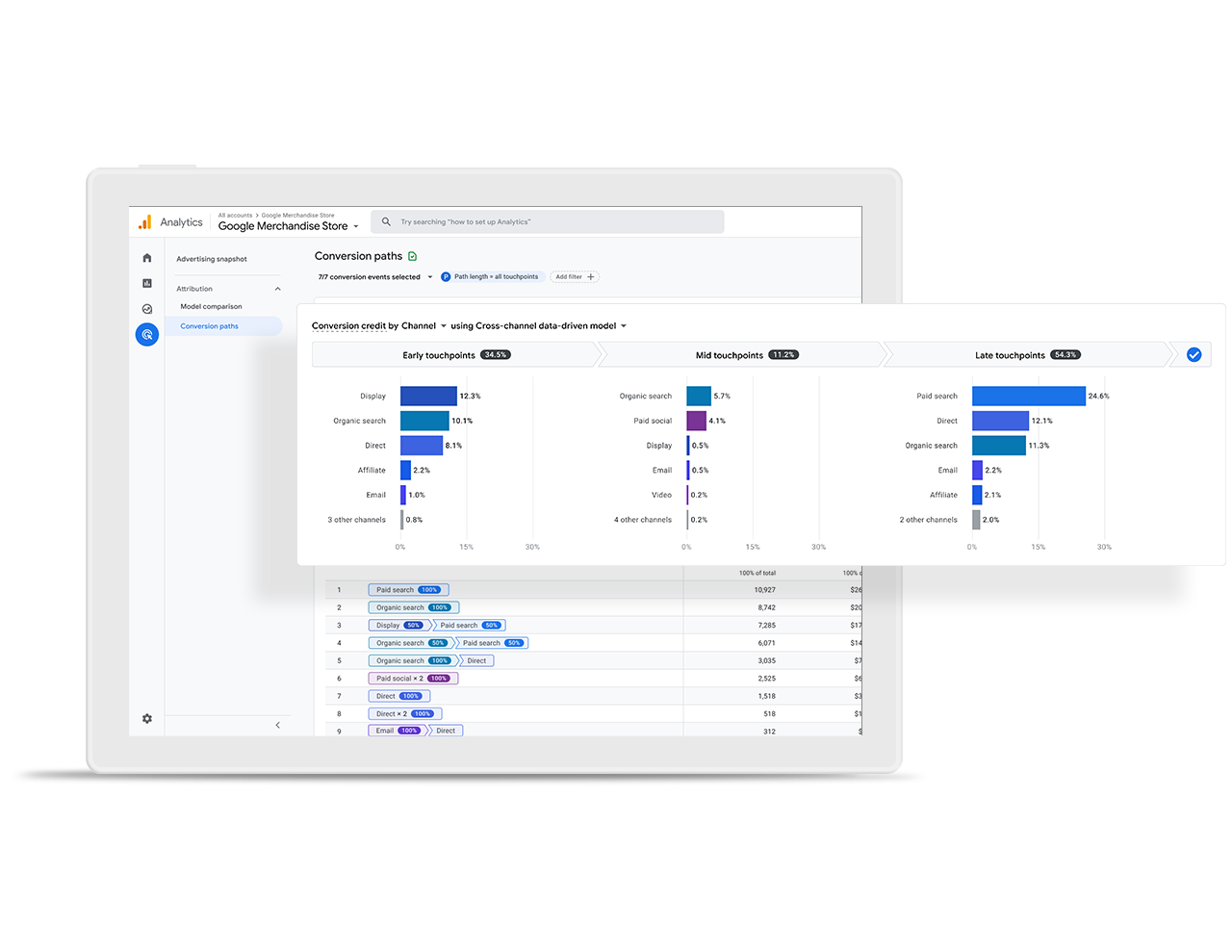
Google Analytics 4 fits a marketing team that mostly needs acquisition and conversion reporting tied to Google Ads, and doesn't need product-led funnels or cohorts at depth.
What carries over from Amplitude: event-based measurement across websites and apps, with exploration reports for funnels and paths. Audiences and conversions flow to Google Ads and other Google products natively, which is the part many marketing teams pay a second tool to do.
What you rebuild: product analytics at depth. Standard properties keep event data for 2 or 14 months, explorations are sampled above 10 million events, and the daily BigQuery export is capped at 1 million events per day. Google applies data thresholds that can hide rows in reports that use demographic or search query data.
Cost at the edge of Amplitude's free plan: the standard version is free at any event volume. Analytics 360 needs a contract and Google's help pages state no price, and BigQuery streaming export costs $0.05 per GB on the BigQuery side.
What reviewers say: G2 gives it 4.5 out of 5 from 6,858 reviews, read on November 8, 2026. Reviewers praise the depth of insight into traffic and behavior, the price and the integrations, and the repeated complaint is a steep learning curve and a confusing interface.
- You want a free analytics base with native links to Google Ads, Search Ads 360, Display & Video 360, Google Cloud and Search Console.
- You need raw event data in your own warehouse: BigQuery export is available on standard properties (daily export up to 1 million events per day) and on 360 (up to 20 billion per day).
- Standard limits are tight for larger sites: event data retention is 2 or 14 months, exploration queries are sampled above 10 million events, and daily BigQuery export is capped at 1 million events per day.
- G2 reviewers repeatedly cite a steep learning curve and a confusing interface, and Google applies data thresholds that can hide rows in reports using demographic or search query data.
- Users like
- depth of insight into traffic and behavior, free price, integrations
- Users dislike
- steep learning curve and confusing interface
- Source: G2, 6,858 reviews
- Starting price
- Free for the standard version; Analytics 360 needs a contract and Google's help pages state no price. BigQuery streaming export costs $0.05 per GB on the BigQuery side
- Standard price
- Free (positioned as free by Google)
- Analytics 360 price
- Contract, no price published
- Data retention
- Standard: 2 or 14 months selectable; 360: 2, 14, 26, 38 or 50 months
- BigQuery export
- Daily: 1 million events/day standard, 20 billion/day 360; streaming has no volume limit, $0.05 per GB
- Sampling quota
- 10 million events per query standard; 360 up to 1 billion (default 100 million)
- Data thresholds
- System defined, cannot be adjusted; can hide rows using demographic or search query data
Heap#
Heap
Heap, now sold by Contentsquare, captures every click, view and form fill automatically so you can define events after the fact, and prices by monthly sessions.
Heap fits a team that doesn't want to maintain a tracking plan before it can ask a question, because it records first and lets you define events afterwards.
What carries over from Amplitude: charts, funnels, journeys, retention, segments and dashboards. A single snippet captures every view, click, swipe and form fill on web and mobile, and events defined later apply to data Heap already holds, back to the install date. UTM parameters are captured from the first pageview of a session, and Influence analysis uses session touchpoints once you define a Channel property.
What you rebuild: replay and warehouse sync, if you used them. Session replay, heatmaps and error analysis aren't in Free or Growth and are add-ons on Pro and Premier. Heap Connect, the warehouse export to Snowflake, BigQuery, Redshift, S3 or Databricks, is a Pro add-on and included in Premier. Segment exports name Marketo, Optimizely and CSV, and the integrations page names Salesforce, Iterable and Intercom, but we found no Google Ads or Facebook Ads destination.
Cost at the edge of Amplitude's free plan: Heap bills by sessions, not events. Free is 10K sessions a month with 6 months of data, and past the session limit you have to upgrade before you can view your data again. Growth shows no price until you install the snippet, and Pro and Premier are contact sales, so we can't give you a number.
What reviewers say: G2 gives Heap, now sold by Contentsquare, 4.4 out of 5 from 1,097 reviews. The counts behind its themes are small, with automatic event tracking and ease of use at 7 and 5 mentions and data inaccuracy, data management and slow performance at 4 or fewer, so read them as a hint, not a verdict.
- you want to analyze behavior retroactively without tagging events first, starting on a free plan with 10K sessions a month
- you need Salesforce or Marketo data blended with behavior, or enterprise controls such as SCIM and audit logs on Premier
- you need a dollar amount before installing: Growth is priced by an estimate after you install the free snippet, and Pro and Premier use custom session pricing via Contact Us
- you need session replay or warehouse sync on a small budget: replay, heatmaps and Heap Connect are Pro add-ons, and no ad platform destinations appear on the integrations page
- Users like
- automatic event tracking, ease of use for non-technical team members
- Users dislike
- data inaccuracy, data overload, slow performance
- Source: G2, 1,097 reviews
- Starting price
- Free: up to 10K sessions a month, 6 months of data. Growth: estimate after install, no public price. Pro and Premier: contact sales (vendor pricing page, read 2026-11-11)
- Pricing metric
- Monthly sessions
- Free plan
- 10K sessions a month, 6 months of data, SSO
- Session replay
- Pro and Premier add-on
- Warehouse sync
- Heap Connect, Pro add-on and included in Premier
- Ownership
- Contentsquare
Fullstory#
Fullstory
Fullstory records sessions automatically and adds funnels, retention and journeys on top, with a free plan of 30,000 sessions a month and quote-only paid plans.
Fullstory fits a team that wants to see what users did on a page, with funnels and journeys on the same automatically captured data.
What carries over from Amplitude: conversion funnels, retention charts, journeys and dashboards with metric alerts, built on Fullcapture, which collects behavior on web and mobile without tagging. Events you define in Fullstory apply to past and future data in search, though not in Journeys or Data Quality Monitoring.
What you rebuild: user identity and activation. Developers call the Identify Users API after login so earlier anonymous sessions attach to the user. Fullstory's marketing page talks about tying sessions to your CRM and marketing automation platform and syncing signals to a CDP, but it names no HubSpot, Salesforce or ad platform, and we couldn't confirm which plan includes which feature.
Cost at the edge of Amplitude's free plan: the free plan gives 30,000 sessions a month, 12 months of retention and up to 10 users, with dashboards and StoryAI on paid plans. Business, Advanced and Enterprise are all request-a-demo, so there's no number to compare with Amplitude's.
What reviewers say: G2 gives Fullstory 4.5 out of 5 from 1,058 reviews. Reviewers like easy setup (63 mentions), deep insight into customer interactions (58) and responsive support (52). The complaints are a steep learning curve (32), filter limits (27) and missing features such as flexible time frames (17).
- you want session replay and funnels from automatic capture, starting free with 30,000 sessions a month and 12 months of retention
- you want to ask questions about behavioral data from Claude or ChatGPT and an admin can enable StoryAI
- you want a self-serve upgrade: every paid Fullstory plan sits behind a Request pricing & demo button, and Capterra reviewers call it expensive for startups and high-traffic sites
- you need documented HubSpot, Salesforce or ad platform audience sync: the marketing page names none of them
- Users like
- ease of setup, deep insight into customer interactions, responsive support
- Users dislike
- steep learning curve, filter limitations, missing features such as flexible time frames
- Source: G2, 1,058 reviews
- Starting price
- Free plan: 30,000 sessions a month, 12 months of retention, up to 10 users. Business, Advanced and Enterprise: request pricing and a demo, no public prices (vendor plans page, read 2026-11-11)
- Pricing metric
- Sessions; paid quotas not published
- Free plan
- 30,000 sessions a month, 12 months, up to 10 users
- Capture
- Fullcapture autocapture on web and mobile
- AI
- StoryAI and an MCP server, StoryAI enabled by an admin
- Paid plans
- Business, Advanced, Enterprise, quote only
Pendo#
Pendo
Pendo combines product analytics with in-app guides and surveys, and prices by monthly active users, with a free plan up to 500 users and quote-only paid tiers.
Pendo fits a SaaS team that wants analytics and in-app guidance in one tool, and cares more about adoption inside the product than about campaign reporting.
What carries over from Amplitude: paths, funnels and retention across web and mobile, plus session replay on the Core tier and above. Pages and features are tagged retroactively from the install date, and a JavaScript snippet handles setup. Pendo adds in-app guides, which are included from the free plan, and surveys on higher tiers.
What you rebuild: custom events and marketing sync. Track Events, Pendo's custom API events, have no history before they're set up and are processed in hourly batches. We found no named HubSpot or Salesforce sync, audience sync or campaign attribution on the vendor pages. Data Sync, the one-way export to Snowflake, Databricks and BigQuery, is on the Ultimate tier.
Cost at the edge of Amplitude's free plan: Pendo prices by monthly active users, not events. Free covers up to 500 MAU with analytics and guides, and beyond that you can't create new guides, surveys or segments until you upgrade. Base, Core and Ultimate are request-pricing, and the vendor lists no dollar price.
What reviewers say: G2 gives Pendo 4.4 out of 5 from 1,830 reviews. Reviewers like ease of use (202 mentions) and the join between analytics and in-app guides (165). The complaints are missing features such as better notifications and guide metrics (67), no self-restore for deleted guides (63), a steep learning curve (59 and 47) and data inaccuracy (44).
- you want analytics and in-app guidance in one tool for a SaaS product, with guides included from the free 500 MAU plan
- you want pricing by monthly active users instead of sessions, and a Data Sync export to Snowflake, Databricks or BigQuery on higher tiers
- you need a public price or a mid-size self-serve plan: Free stops at 500 MAU and every paid tier is quote-only
- you need marketing audience sync or campaign attribution: none was found on the vendor pages, and custom Track Events have no history before they are set up
- Users like
- ease of use, analytics joined with in-app guides, customization
- Users dislike
- missing features, no self-restore for deleted guides, steep learning curve
- Source: G2, 1,830 reviews
- Starting price
- Free: up to 500 monthly active users with analytics and in-app guides. Base, Core and Ultimate: request pricing, MAU volume custom (vendor pricing page, read 2026-11-11)
- Pricing metric
- Monthly active users, quote only
- Free plan
- 500 MAU, analytics and in-app guides
- Session replay
- Core tier and above
- Data Sync
- Ultimate tier, one-way export to Snowflake, Databricks and BigQuery
- Capture
- Autocapture with retroactive page and feature data
Do Amplitude alternatives have an MCP server?#
Yes, four of the six do, and Amplitude itself includes one on every plan, so an MCP server is no longer a reason to switch. Heap's isn't confirmed for its own data, and we didn't check Google Analytics 4. It matters because a marketing ops team can ask questions about funnels or cohorts from Claude or ChatGPT instead of building a chart. Our guide to the Model Context Protocol explains what that connection does and doesn't let an agent do.
| Tool | MCP server | Condition |
|---|---|---|
| Amplitude | Connects to Claude, Cursor, Lovable, Figma Make and any tool that supports MCP | On every plan |
| Mixpanel | Mixpanel Agent, MCP server and Headless | On all plans |
| PostHog | Hosted server for Claude Code, Claude Desktop, Cursor and others; runs trends, funnels, retention and SQL | Free, but some AI-powered tools bill as PostHog AI spend |
| Fullstory | Answers natural-language questions about behavioral data from Claude, ChatGPT and Gemini | StoryAI must be enabled by an admin |
| Pendo | Public MCP server for AI clients | Plan not stated in Pendo's vendor material |
| Heap | Contentsquare hosts an MCP server | Not confirmed for Heap data |
What should you check before you leave Amplitude?#
Before you leave, export your event list, clean the names, decide which history you need, and run both tools side by side for one full cycle. The riskiest part of a switch isn't the new tool. It's the numbers that quietly change when event names, UTM values or user IDs don't carry over, and nobody notices until a report looks off.
- List every event, property and owner before the move. Amplitude lists a Taxonomy API on every plan, so you can pull the event list instead of copying it by hand, and mark which events still feed a report or an audience someone uses
- Clean the names first. Amplitude counts casing variants as separate events, so moving them as they are carries the mess into the new tool
- Decide which history you need. Amplitude keeps 1 year of data on Free and 2 years on Plus, and a new tool starts blank unless you backfill. Heap and Fullstory apply new event definitions to data they already hold, but only from their own install date, and Pendo's Track Events have no history before they're set up
- List the cohorts and audiences you sync out, then check that each destination exists in the new tool. Mixpanel names Google Ads, Facebook Ads, Braze and Salesforce Marketing Cloud, and PostHog names Google Ads, Meta Ads, HubSpot and Salesforce
- Keep UTM values identical. Mixpanel's UTM matching is case sensitive, so use our guides to UTM parameters and UTM naming convention before you rename anything
- Re-implement the identify call so anonymous and known users join the same way, with the user ID sent after login
- Run both tools side by side for one full cycle and compare counts for sign-ups, demo requests and other key events with your CRM and with Google Analytics 4
- Find the contract end date and the renewal notice period in your own order form if you're on Growth or Enterprise, because Amplitude publishes no standard terms for those plans
A new tool starts with a blank report history, so keep an export of the old reports for year-over-year comparisons and set a fixed cutover date. If your attribution depends on the events you're about to move, read our guides to marketing attribution software and attribution models first, and test a live link end to end with the campaign tracking checklist.
Where The Marketing Ops Manager fits#
The Marketing Ops Manager fits after the switch, because none of the six tools tells you that a landing page lost its tracking event or that a form stopped sending leads to the CRM. It checks landing pages, tracking, forms and CRM contacts on a schedule, and it opens an incident with evidence when a step fails. It's built for teams that run campaigns on HubSpot and GA4, and it works through Claude, ChatGPT or any MCP client. It isn't an analytics tool, it doesn't replace any tool above, and the tools it names on its homepage are HubSpot, GA4, Google Ads, Slack, Jira and Asana. Every change an AI agent proposes needs a named person's approval.
Frequently asked questions#
What is the best alternative to Amplitude?
The best alternative to Amplitude depends on why you're leaving. Mixpanel is the closest like-for-like with a public price list, PostHog has the lowest entry cost and an open source option, and Google Analytics 4 is the free base for acquisition reporting. Heap and Fullstory suit teams that want automatic capture, and Pendo suits SaaS teams that want in-app guides next to analytics.
Is there a free alternative to Amplitude?
Yes, all six have a free route. PostHog's free plan includes 1M events, 5K recordings and 1M feature flag requests a month, Mixpanel's includes 1M events, and Google Analytics 4's standard version is free. Heap's free plan covers 10K sessions, Fullstory's 30,000 sessions and Pendo's 500 monthly active users. Amplitude's own Free plan covers 2M events a month.
How much does Amplitude cost?
Amplitude's Free plan covers 2M events a month with unlimited seats. Plus starts at $0 with the first 2M events free and scales to 70M events, but the price above 2M is shown only in a bill estimator. Growth and Enterprise are custom prices from sales.
Why do people leave Amplitude?
People leave Amplitude mainly over the learning curve (139 and 138 G2 mentions), missing features across plans (78) and complex event management (71). Cost above 2M events is hard to predict because Plus above that and Growth have no published price.
Is Mixpanel or PostHog cheaper than Amplitude?
We can't give a like-for-like answer because Amplitude doesn't publish a price above 2M events. Mixpanel Growth is $185 a month at 2M events and $438 at 5M on annual billing. PostHog's events alone come to $50 at 2M and about $153 at 5M by our arithmetic, before add-ons.
Which Amplitude alternative works with Claude?
Amplitude, Mixpanel, PostHog and Fullstory all offer an MCP server, and PostHog's and Fullstory's documentation names Claude as a supported client. Pendo lists a public one. Fullstory's needs StoryAI enabled by an admin, and some of PostHog's AI-powered tools bill as PostHog AI spend.