HubSpot Marketing Hub pricing ranges from a free entry plan to Starter seats and Professional or Enterprise subscriptions with separate onboarding charges. The price on the first screen isn't the full budget, so teams have to account for marketing-contact tiers, Core Seats, credit usage and commitment terms before signing.
For a US marketing operations team, the practical decision is whether the automation and reporting requirements justify Professional, and whether data hygiene prevents contact tiers from climbing. A cheaper license doesn't help if campaign attribution fails between forms, the CRM and the sales handoff, and that's where most surprises start.
For the CRM side of the decision, see HubSpot vs Salesforce, which prices Sales Hub seats against Salesforce editions.
HubSpot Marketing Hub prices at a glance#
HubSpot sells Marketing Hub as Free, Starter, Professional and Enterprise editions. The US pricing page shows two figures for Starter and for Professional. Starter's $7 is special pricing for new customers, while Professional's $800 sits with annual commitment and $890 with pay-monthly, so a quote should name the billing selection, offer eligibility and contract period instead of assuming the lower figure applies to everyone.
- Free$0 /month
- Basic lead generation and email tools
- Up to 2 free users
- Starter$7 new-customer offer / $20 regular /seat/month$7 offer is for new customers only
- 1,000 included marketing contacts
- 500 included HubSpot Credits
- Professional$800 annual commit / $890 monthly /month
- 3 Core Seats included
- 2,000 included marketing contacts
- 3,000 included HubSpot Credits
- Enterprise$3,600 /month
- 5 Core Seats included
- 10,000 included marketing contacts
- 5,000 included HubSpot Credits
USD prices observed October 18, 2026. Discounts and billing terms are conditional; Professional and Enterprise onboarding fees are excluded.
| HubSpot plan | Published price (USD) | Included marketing contacts | Core Seat arrangement |
|---|---|---|---|
| HubSpot Free | $0 per month | Check free-tool constraints | Up to 2 free users |
| HubSpot Starter | $7 new-customer offer or $20 regular, per seat monthly | 1,000 | Per paid seat |
| HubSpot Professional | $800 with annual commitment or $890 pay-monthly | 2,000 | 3 included |
| HubSpot Enterprise | $3,600 monthly | 10,000 | 5 included |
The table reflects the US page checked October 2026. Neither the offer rate nor the higher rate should be substituted for a binding quote.
What each Marketing Hub plan really buys#
Each Marketing Hub plan buys a different level of capacity: Starter's an entry point for basic campaign execution, while Professional changes the economics for teams that need a more substantial automation and reporting setup. Enterprise adds capacity and governance, but the sensible upgrade test is the workflow the team must actually operate rather than the longest feature list.
Free and Starter: keep the stack simple#
The Free edition is a low-friction starting point, while Starter's priced by paid seat. HubSpot advertises special Starter pricing for new customers on select offers for a limited time, but that display isn't a commitment about renewal pricing.
Start by mapping where a prospect enters the system, which form collects consent, how a campaign source is stored and who responds when an integration stops passing fields. Buying an additional seat won't solve missing campaign ownership, and it doesn't fix a form that's lost its field mapping.
Professional: budget the onboarding and the contact tier#
Marketing Hub Professional includes 3 Core Seats in its published base and requires a one-time $3,000 onboarding fee. It also includes 2,000 marketing contacts and 3,000 HubSpot Credits, with the subscription showing $800 a month next to annual commitment and $890 next to pay-monthly on the observed page.
A marketing operations team should request a line-item quote with the renewal rate, the full contact tier, any separate integrations and the seat inventory. Without a clear contact-classification process, the first renewal can be harder to forecast than the original launch. That's the part most buyers don't plan for.
Enterprise: evaluate governance before scale#
Marketing Hub Enterprise starts at $3,600 a month on the US page, includes 5 Core Seats and carries a required one-time $7,000 onboarding charge. The plan lists 10,000 included marketing contacts and 5,000 HubSpot Credits.
Enterprise should be judged against your internal control model: account access, approval ownership, regional administration and evidence needed to explain a changed workflow. Those are procurement questions as much as marketing questions. They're also the ones that decide whether the extra $2,710 a month over Professional pays off.
The cost drivers missing from the headline price#
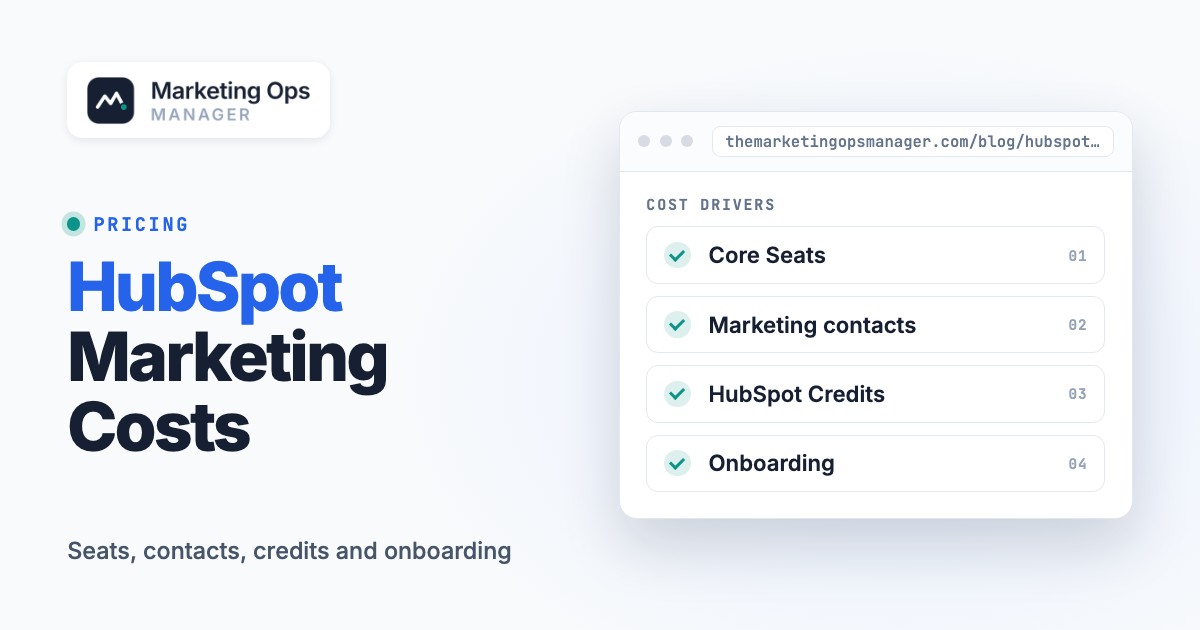
HubSpot's monthly edition price is just one part of the total. The other drivers are marketing-contact classifications, extra Core Seats, additional HubSpot Credits and mandatory onboarding at the higher tiers; each one needs its own line in the purchase worksheet.
Marketing contacts can raise the bill after launch#
HubSpot distinguishes marketing contacts, who can be targeted by marketing activity, from non-marketing contacts. The former count toward a paid marketing-contact tier; the latter can stay in the CRM without those marketing-contact charges, subject to product limits.
HubSpot's billing documentation says that automatic tier upgrades don't downgrade mid-term. A cleanup after the audience spikes therefore won't necessarily reduce the contracted contact-tier cost until renewal. Assign someone to inspect contact status before each major list import and campaign sync, rather than handing ownership to whichever team last touched the CRM.
Additional Core Seats aren't the same as view access#
Professional includes 3 Core Seats, and additional Core Seats start at $45 per month on its pricing display. Enterprise includes 5 Core Seats and shows extra Core Seats starting at $75 per month.
A good seat audit starts with activities rather than job titles. Identify who must edit workflows, contacts or integrations, then separate them from stakeholders who only need to see reports.
Credits are usage-based, not an unlimited AI allowance#
HubSpot Marketing Hub Starter includes 500 credits, Professional includes 3,000 and Enterprise includes 5,000. HubSpot lists extra credits at $0.010 per credit. Included credits reset monthly and unused credits don't roll over.
Treat credit spending as a separate usage budget with an owner, a measured baseline and stop thresholds. A team that's new to AI-powered tasks shouldn't expand automated workloads before it's seen a month of real consumption.
Contract and onboarding terms need a quote-level review#
Starter doesn't require the paid onboarding charged to Professional and Enterprise customers. The higher editions do, and the visible monthly rates won't show that one-time expense unless you've added it to the implementation budget.
Don't assume a public pricing-card value answers renewal notice periods, cancellation rules or future promo eligibility. Ask procurement to reconcile the order form, current service terms and renewal calendar before the purchase is approved. A verbal discount isn't a contract term, period.
HubSpot cost examples with transparent assumptions#
Illustrative annual budgets can be calculated from the public rate card, but they aren't vendor quotes. They deliberately exclude any extra marketing-contact tier, tax, implementation partner, add-on or extra seat that isn't specified below.
| HubSpot Marketing Hub scenario (USD) | Calculation (USD) | Illustrated first-year cost (USD) |
|---|---|---|
| Professional at $890 pay-monthly | $890 x 12 + $3,000 onboarding | $13,680 |
| Professional at $800 annual commitment | $800 x 12 + $3,000 onboarding | $12,600 |
| Enterprise at $3,600 monthly | $3,600 x 12 + $7,000 onboarding | $50,200 |
The three scenarios are annualized planning figures, not a promise that the annual-commitment rate fits your contract. The exact billed term and any credit or contact charges come from the order form, so ask for it early.
Illustrative. Adds the published $3,000 onboarding to the $890 pay-monthly rate; excludes contacts, extra seats and credits.
Which Marketing Hub plan fits a marketing ops team#
The right Marketing Hub plan for a marketing ops team is the cheapest edition that supports your real process. Then price the contact and seat footprint separately. The deciding questions are automation ownership, handoff reliability and how quickly growth can change the paid contact tier.
- Experiment with a small lead capture setupFree, within its usage limits
- Publish basic campaigns with a small paid teamStarter; confirm new-customer offer eligibility
- Operate significant multichannel automationProfessional; budget required onboarding and contact-tier risk
- Coordinate sophisticated governance across larger teamsEnterprise; validate controls, seats and contract scope
A procurement review should also test the work that happens outside the subscription, because that's where the real cost hides. For each campaign, trace the landing page, attribution tags, form submission, CRM field and downstream sales assignment. If the field exists but the sales team can't act on it, you've got an operational gap rather than a missing HubSpot edition.
- Record pay-monthly and annual-commit rates separately
- Confirm whether the offer is new-customer only and who qualifies
- Document the marketing-contact tier and upgrade rules
- Count editing users separately from View-only users
- List onboarding, partner services and add-ons separately
- Assign ownership for credit limits, forms and CRM handoffs
Monitoring the campaign handoffs around HubSpot#
Marketing operations isn't finished when the automation is configured; it's finished when the handoff works. A change to a landing page can break attribution, a form can stop reaching the CRM and a working CRM integration can still produce an unowned sales handoff. Those failures don't show up in a pricing comparison, and they're rarely anyone's named job.
Our campaign-monitoring workflow checks the landing page, tracking, form, CRM connection and sales handoff on a schedule and opens an incident with evidence when a step fails. It's read-only by default, fixes need approval, and it works in Claude and ChatGPT via MCP. It's not a replacement for HubSpot Marketing Hub or an automation suite, and signup is invite-only.
HubSpot Marketing Hub pricing FAQ#
The FAQs distinguish public prices from decisions the buyer must confirm directly. Edition totals can be planned from the public rate card, while contact overages and contractual renewal language belong in the written quote.
How much does HubSpot Marketing Hub cost per month?
HubSpot Marketing Hub offers a free option and paid Starter, Professional and Enterprise plans. The US page displays two amounts for Starter and Professional, so the final rate depends on the selected offer and billing terms.
Is HubSpot Marketing Hub Starter really $7 a month?
HubSpot shows $7 per seat monthly next to $20 for Starter, under a banner about special Starter pricing for new customers. Select offers are available for a limited time.
Does Marketing Hub Professional include onboarding?
Marketing Hub Professional requires onboarding charged separately. The US pricing display identifies a $3,000 one-time fee.
Can a HubSpot marketing-contact tier go down mid-contract?
HubSpot says marketing-contact tiers don't downgrade during the contract term. A lower tier can take effect at renewal, and you'll need to request it before the renewal date.
Do unused HubSpot Credits carry forward?
Unused HubSpot Credits don't roll over to the next month. HubSpot states that included credits reset monthly.
Is Marketing Hub the same as campaign monitoring?
Marketing Hub runs marketing workflows, while campaign monitoring checks whether connected campaign steps continue to work. The second function complements the first rather than replacing it.