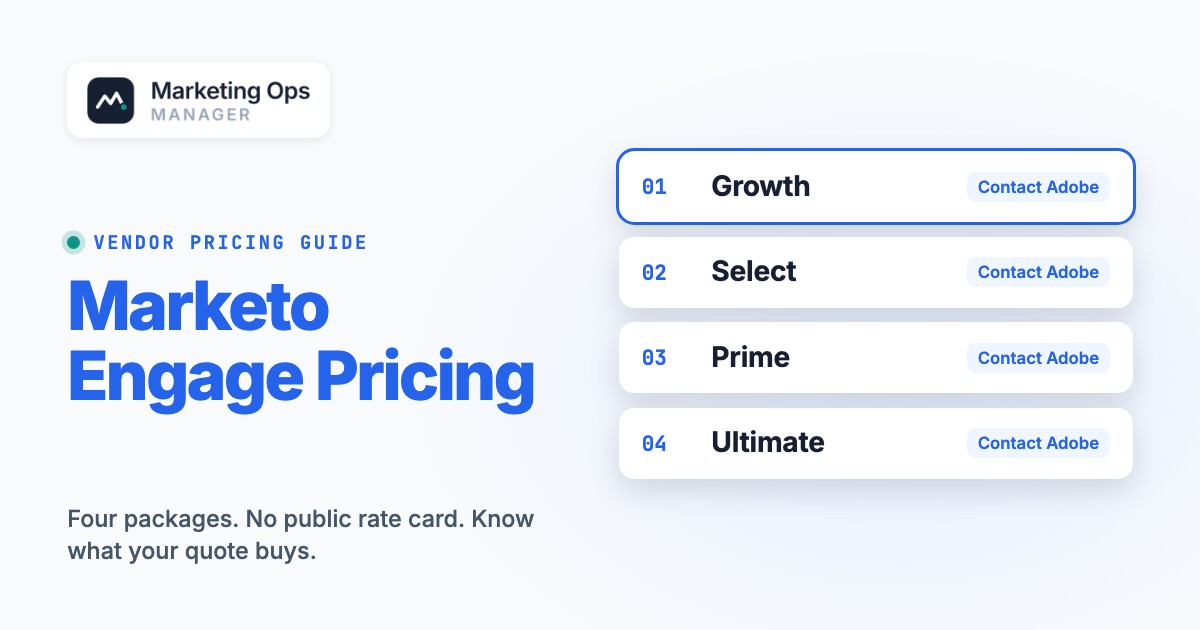
Marketo Engage pricing is quote-based. Adobe publishes four packages, Growth, Select, Prime and Ultimate, but it doesn't publish a monthly or annual dollar rate for any of them. Your quote needs to specify the licensed contact volume, included capabilities, usage allowances and implementation scope before a price comparison means much.
The useful starting point isn't an unsourced monthly estimate from a pricing directory. It's Adobe's published package matrix, which shows where the real purchasing decisions sit: core automation, CRM handoffs, advanced journey tools and attribution. Marketing operations teams should compare the total first-year commitment and the renewal-year run rate, not just a sales representative's license figure.
How much does Marketo Engage cost?#
Adobe doesn't disclose a standard Marketo Engage subscription price, and that's by design. Its current packaging page puts a Get pricing action on every package, so a dollar figure quoted by an independent directory isn't a confirmed Adobe rate. Contact Adobe for an order-specific quote and insist on a written breakdown.
The following plan table separates published features from pricing that Adobe hasn't disclosed. It isn't a rate card, and a package name alone doesn't determine your contact entitlement or total contract value.
- GrowthQuote Contact Adobe
- Core email, segmentation and automation
- 10 users on the public matrix
- 20,000 daily API calls on the public matrix
- SelectQuote Contact Adobe
- Core automation and measurement
- 25 users on the public matrix
- 50,000 daily API calls
- Event and webinar marketing included
- PrimeQuote Contact Adobe
- Target account management
- Advanced journey analytics
- Sandbox and workspaces included
- UltimateQuote Contact Adobe
- Prime-level capabilities
- Marketo Measure included on packaging matrix
- Premium attribution positioning
Adobe's US packaging page, checked October 21, 2026. The page lists no USD subscription amounts. Confirm SKU-specific limits in the order form.
Two organizations can select the same package yet need different database allowances, integrations and professional services. A quote that doesn't identify those line items can't support a reliable budget.
What is included in each Marketo Engage package?#
Marketo Engage packages share the essential campaign engine, while Select adds operational tools, Prime adds advanced account and journey capabilities and Ultimate includes Marketo Measure in Adobe's public matrix. The buying decision should follow your actual workflow requirements rather than the apparent order of the package names.
The comparison below focuses on the features that change implementation and governance for marketing operations. "Included" here means a checkmark on Adobe's public package page, not a promise that every related use case or capacity is unlimited.
| Marketo Engage package | Published users | Published daily API calls | Differentiating capability | Public USD rate |
|---|---|---|---|---|
| Marketo Engage Growth | 10 | 20,000 | Core campaigns; several advanced tools offered separately | Not published |
| Marketo Engage Select | 25 | 50,000 | Event and webinar marketing; custom data objects | Not published |
| Marketo Engage Prime | 25 | 50,000 | Target account management; sandbox; advanced journey analytics | Not published |
| Marketo Engage Ultimate | 25 | 50,000 | Marketo Measure included | Not published |
Growth: core automation with narrower allowances#
Growth is the entry package for email, segmentation, campaign automation and measurement. Adobe's matrix lists 10 users and 20,000 daily API calls, while custom data objects, event marketing and several advanced features appear as separately available rather than included. Growth can make sense when the team needs a central campaign engine but isn't yet running complex account programs or extensive integration traffic. Don't assume it covers your desired webinar, attribution or sandbox workflow without seeing those entitlements on the order.
Select: the operational baseline for many B2B teams#
Select adds included event and webinar marketing, a marketing calendar, attribution dashboards and custom data objects to the common automation foundation. The public matrix lists 25 users, 50,000 daily API calls and a custom-object allowance of 10 objects with 2 million records. That makes Select a practical quote to request first if your requirements are CRM synchronization, campaign operations, webinar handoffs and reporting. Select also lists 50 predictive content assets, which is a capped allowance rather than open-ended use, so check that limit if predictive content matters to the purchase.
Prime: account programs and controlled change management#
Prime adds target account management, predictive audiences, advanced journey analytics, a sandbox and workspaces with partitions in Adobe's public packaging. Those capabilities matter when multiple regions or business units share one marketing automation estate but need clearer operating boundaries. A sandbox can reduce the risk of changing a live scoring or routing process, but it doesn't eliminate the need for deployment procedures and test records. Ask whether the proposed sandbox, partition design and advanced analytics scope match your actual instance architecture.
Ultimate: attribution becomes part of the package#
Ultimate includes Marketo Measure in Adobe's published matrix, while the lower packages show it as separately available. The legal product description says the precise Marketo Measure entitlement depends on the scale of the purchased license and the sales order.
Ultimate is worth evaluating when multi-touch attribution is a real reporting requirement with named owners and usable CRM opportunity data. If the attribution inputs aren't trustworthy, paying for the package doesn't repair them.
- Basic campaign automation with a small operator groupAsk for Growth, then confirm every required add-on and the contract's contact allowance.
- Webinars, custom data objects and a larger marketing teamUse Select as the first commercial baseline.
- Target accounts, journey analysis, sandboxes or business-unit partitionsRequest a Prime quote and a documented configuration scope.
- Marketo Measure as an included package capabilityRequest Ultimate and verify the Marketo Measure entitlement in the sales order.
How does contact database size affect Marketo pricing?#
Contact database size is a licensing dimension, and it's definitely not a detail to settle after procurement. Adobe's July 2026 product description identifies a per 1,000 contacts license metric for Select, Prime and Ultimate, and says customers must keep their databases within the contact quantity stated in the sales order.
That doesn't mean Adobe publishes a universal dollar amount per thousand contacts. It means the order's contact entitlement and the method for measuring it belong in your pricing model. Get definitions for marketable versus non-marketable records, duplicate people, archived records and changes during the term in writing.
A database audit before requesting a quote should separate CRM people, Marketo people, suppressed contacts, duplicates and expected imports. If sales and marketing disagree on what constitutes a licensed contact, the contract comparison is already compromised.
A contact-volume worksheet for the sales call#
A usable worksheet captures the current database and the changes you expect. The figures below are blank buyer inputs, not claims about Adobe's default tiers.
| Marketo Engage sizing input | Current count | Renewal forecast | Evidence owner |
|---|---|---|---|
| Total people in Marketo Engage | Enter count | Enter count | Marketing operations |
| Net new leads expected | Enter count | Enter count | Demand generation |
| Imported event or partner records | Enter count | Enter count | Campaign operations |
| Duplicate and inactive records | Enter count | Enter count | CRM administrator |
| Contracted contact entitlement | Request quote | Request quote | Procurement |
Don't infer that removing a record immediately reduces a contractual fee, because it often doesn't. Ask Adobe whether the order uses a fixed tier, a true-up, a renewal adjustment or another mechanism, and document the answer alongside the quote.
What limits and credits should buyers check?#
Marketo Engage has several distinct capacity controls: users, API calls, contact entitlements, custom objects and AI credits. They aren't interchangeable, and the signed order can clearly outweigh a marketing comparison chart.
Adobe's public packaging lists 20,000 API calls per day on Growth and 50,000 on Select, Prime and Ultimate. Its July 2026 legal product description separately states that each instance includes 50,000 daily calls and 25 marketing users, without listing Growth in the main licensed-product table. Those documents don't fully reconcile Growth.
API traffic is a shared integration budget#
An API allocation affects more than one integration. Lead enrichment, custom connectors and reporting extracts can consume a shared budget, while Salesforce synchronization introduces its own separate system limits.
Adobe's developer guidance says most Marketo subscriptions receive 50,000 API calls per day and recommends batching, caching and conservative request rates. It also documents a 100-call limit per 20 seconds and a 10-concurrent-call limit for a typical instance. Your integration architect should test peak demand against the contractual entitlement rather than treating an average daily count as sufficient.
AI credits and custom-object capacity#
Adobe's July 2026 legal description lists AI credit allowances included in each package of 100,000 for Growth, 250,000 for Select and 500,000 each for Prime and Ultimate. It warns that exceeding an allowance may require moving to a higher package, so ask which product features consume credits and whether they reset within your contract term.
Select, Prime and Ultimate each show 10 custom objects and 2 million records on the public packaging page. If the account data model needs more, ask for the incremental object and record pricing instead of assuming that a package upgrade solves the capacity problem.
What adds to the first-year Marketo Engage bill?#
The first-year Marketo Engage bill can include the platform license, purchased capabilities, implementation work and internal operating labor. Adobe doesn't publish a universal fee schedule for those items, so a credible budget starts with a scope-of-work and a quote rather than a guessed onboarding percentage.
The biggest practical distinction is between one-time implementation and recurring operation. A migration project ends, but data hygiene, workflow change control, CRM synchronization, permissions and reporting ownership continue after launch.
License and package add-ons#
The legal product description lists additional marketing users in packs of five, additional API calls in packs of 10,000 and Sales Insight in packs of five users. It also lists items such as dedicated IP addresses, extended data retention, website personalization and additional instances as separate entitlements.
Don't assume every listed add-on is chargeable in every contract.
Some capabilities appear included in a higher package and separately available below it. The commercial question is which exact SKU and quantity the proposed order includes.
Implementation, migration and integration services#
A Marketo migration may require field mapping, program recreation, scoring and routing redesign, CRM permission checks, domain configuration and deliverability preparation. None of those tasks should be hidden inside a vague implementation line.
Ask the implementation partner for a deliverables-based statement of work. Specify who will clean the source database, who will configure Salesforce or Dynamics synchronization, how many programs will be rebuilt and what constitutes acceptance after launch.
The ongoing cost of ownership#
Marketing operations will own the workflows after implementation. Budget capacity for campaign QA, integration monitoring, lifecycle governance, reporting reconciliation, incident handling and vendor administration even if you don't buy a managed-service package. A system with no named owner can be expensive despite a favorable license discount. The clearest internal budget model assigns time and accountability to each handoff, then compares that labor with any outsourced support proposal.
How can you calculate Marketo Engage total cost of ownership?#
Marketo Engage total cost of ownership is the contracted recurring charges plus one-time setup and the operating resources required to keep the stack reliable. Calculate year one and renewal years separately, then test contact growth and add-on scenarios.
Use the following formula with your actual quote, not a published estimate:
Year-one TCO = annual Marketo license + contracted add-ons + implementation + integration work + internal administration + other agreed services.
Renewal-year TCO = renewed license + recurring add-ons + ongoing services + internal administration + any new change projects.
A hypothetical procurement exercise illustrates why the separation matters. If an organization receives a fictional $40,000 annual license quote, $12,000 of implementation work, $6,000 of integration services and allocates $30,000 of internal operating labor, the first-year planning total is $88,000. These are example inputs only, not Adobe prices or market benchmarks.
| Marketo Engage TCO component | Example year-one amount (USD) | Example renewal-year amount (USD) |
|---|---|---|
| Marketo Engage license, hypothetical | $40,000 | $40,000 |
| Implementation, hypothetical | $12,000 | $0 |
| Integration project, hypothetical | $6,000 | $0 |
| Internal administration allocation, hypothetical | $30,000 | $30,000 |
| Total hypothetical cost | $88,000 | $70,000 |
The worksheet is a negotiation aid, and it isn't a claim that Adobe will offer those rates. Replace every illustrative input with a written quote or an approved internal budget before using the total for a purchase decision.
How do Marketo Engage prices compare with alternatives?#
Marketo Engage is harder to compare on subscription price because Adobe doesn't publish one. HubSpot Marketing Hub and Salesforce Marketing Cloud Account Engagement do publish starting prices, but their contact allowances, packaging and onboarding terms differ, so a simple monthly-price ranking would be misleading.
The following published anchors are current US page figures, not feature-equivalent quotes. They can help set a budget discussion, but they can't prove that either alternative is cheaper for your actual data model.
| Marketing automation option | Published starting price (USD) | Important qualification |
|---|---|---|
| Marketo Engage Growth | Custom quote | Contact entitlement and extras require Adobe sales |
| HubSpot Marketing Hub Professional | $800/month | Annual commitment displayed; $3,000 required one-time onboarding; 2,000 marketing contacts included |
| Salesforce Account Engagement Growth+ | $1,250/org/month | Billed annually; 10,000 contacts included on the current feature table |
HubSpot's published Professional example works out to $12,600 for the first 12 months, which is $9,600 in subscription fees plus the required $3,000 onboarding, before additional contacts or seats. Salesforce Growth+ at its published starting rate works out to $15,000 for 12 months, before any other contract-specific charges. Those calculations don't establish Marketo's relative price, since its license rate is unknown.
Use the slider below to see what the two published starting prices add up to over a chosen term. It uses only the figures in the table above, and Marketo is absent because Adobe publishes no rate to enter.
Starting prices only, before extra contacts, seats or add-ons. Check each vendor's pricing page before you budget.
The functional distinction matters as much as the invoice. Marketo's Smart Campaigns use Smart List, Flow and Schedule, and its Salesforce synchronization has specific direction rules. Evaluate whether that operational model is worth the configuration effort for your team, not whether a comparison site labels it enterprise software.
For a deeper fit discussion, see HubSpot vs Marketo. That comparison focuses on CRM ownership, automation logic and operational tradeoffs rather than invented Marketo list prices.
What should marketing operations verify before signing?#
Marketing operations should verify the purchased package, licensed contacts, feature entitlements, API limits, CRM ownership and implementation acceptance criteria before signing a Marketo Engage order. Procurement should then translate those requirements into line items and renewal language.
The checklist below is designed for a joint review by marketing operations, IT, the CRM owner, finance and procurement. Treat any unanswered item as an open contract question, not a post-purchase configuration task.
- Identify the exact package and SKU, plus every included and optional capability.
- Record the licensed contact count, counting method, growth tiers and any true-up mechanism.
- Confirm the contractual user count and daily API allowance, including the Growth documentation discrepancy.
- List AI credit, custom-object, data retention, domain and sandbox entitlements.
- Confirm the Salesforce or Dynamics sync owner, permission model and failure escalation path.
- Request a scoped migration and implementation statement of work with acceptance criteria.
- Separate recurring fees from one-time charges and document renewal assumptions.
- Define who owns production QA, monitoring and incident response after launch.
- Obtain written terms for additional API capacity, contact growth and new instances.
- Keep a signed order and a configuration baseline together for future audits.
Test the handoffs, not only the feature list#
A landing page can submit a record successfully while the CRM handoff fails later. Adobe documents that Salesforce synchronization runs repeatedly, pauses between cycles and is bidirectional for leads, contacts and Salesforce campaigns, while other synchronized objects flow from Salesforce into Marketo.
Build an acceptance test that follows a real form submission through program membership, qualification, CRM creation, owner assignment and reporting. The team should know who gets alerted when a field validation rule blocks a sync or a program status moves unexpectedly.
Marketo's program statuses move forward through a channel-defined progression. Adobe's documentation says a person can't move backward to an earlier status, so the lifecycle design needs a correction procedure rather than relying on a reverse status update.
Separate campaign software from campaign monitoring#
Marketo runs campaigns, but campaign monitoring is a different job. A scheduled check of landing pages, tracking, forms, CRM connections and sales handoffs can surface a broken step with evidence before someone discovers it in a pipeline report.
A campaign-monitoring product isn't a replacement for Marketo's marketing automation. Its value, where applicable, is checking whether the surrounding campaign journey still works. See the marketing operations audit checklist for a practical approach to ownership and recurring tests.
Frequently asked questions about Marketo Engage pricing#
Marketo Engage pricing questions usually come down to the unpublished rate, contact-based licensing, package differences and total cost. Adobe's public documents answer some entitlement questions, while the signed sales order must answer the commercial ones.
How much does Marketo Engage cost per month?
Marketo Engage has no publicly listed monthly subscription rate on Adobe's US pricing page. Growth, Select, Prime and Ultimate all require a custom quote.
Is there a free Marketo Engage plan?
Adobe's current Marketo Engage packaging page lists four sales-led packages and does not advertise a free plan. Ask Adobe about any evaluation access rather than assuming a self-service trial exists.
Does Marketo charge per contact or per user?
Adobe's legal product description identifies a per 1,000 contacts license metric for Select, Prime and Ultimate. The public package matrix also lists user allowances, so both contact scope and users belong in the quote review.
Which Marketo package includes a sandbox?
Prime and Ultimate include a sandbox in Adobe's public package matrix. The matrix shows a sandbox as separately available on Growth and Select.
Is Marketo Measure included in Prime?
Adobe's public package matrix shows Marketo Measure as separately available on Prime and included on Ultimate. The specific Ultimate entitlement still depends on the purchased license and sales order.
Why do Marketo price estimates differ across websites?
Adobe doesn't publish a standard dollar rate, so third-party sites reconstruct estimates using different assumptions. A comparison is meaningful only when package, contact count, services and contract terms match.
Marketo Engage pricing is a contract design exercise as much as a software selection. Get the exact entitlement sheet, model the cost of operating the data flow and make every critical handoff part of the acceptance test before committing.